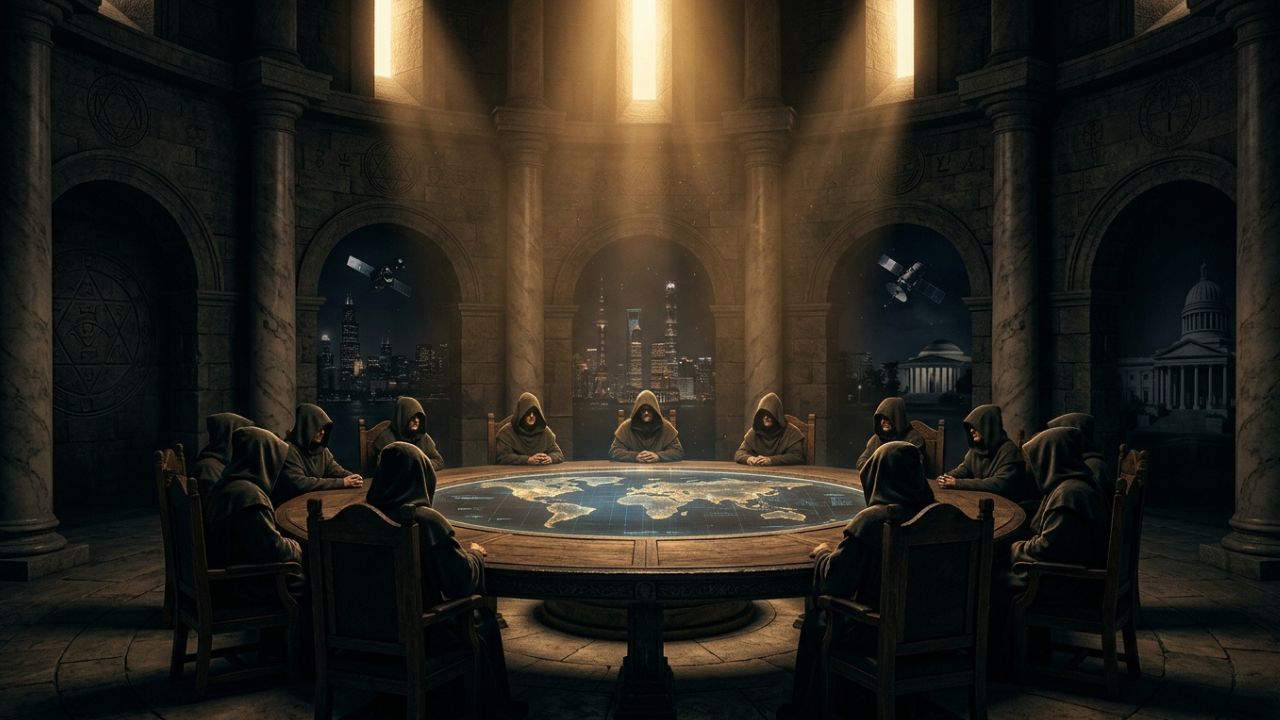
For centuries, rumors about secret societies controlling the fate of nations have fascinated people around the world. From whispered conversations in royal courts to viral social media posts, the idea that a hidden organization quietly manipulates governments, financial markets, wars, and technological progress has become one of humanity’s most enduring conspiracy theories.
The question is simple but incredibly provocative: Is there really a secret society that rules the world?
The short answer is no. There is no credible evidence proving that a single hidden organization controls global events. However, the reasons why so many people believe this idea reveal something far more interesting about politics, economics, psychology, and the concentration of power in modern society.
This investigation explores the origins of these myths, the organizations often accused of controlling the world, why these theories spread so easily, and what genuine influence looks like in today’s interconnected global system.
🏛️ The Ancient Origins of Secret Societies
Secret societies are not fictional inventions.
Throughout history, numerous organizations have operated behind closed doors, often protecting their members through rituals, symbols, and confidential meetings.
Ancient civilizations established exclusive groups dedicated to religious ceremonies, philosophical teachings, or political alliances. Membership was often limited to elites who shared knowledge unavailable to the general population.
Examples include:
- The Eleusinian Mysteries in Ancient Greece
- The Knights Templar during the Middle Ages
- The Rosicrucians
- Freemasonry
- Various royal orders throughout European history
While these groups certainly held influence during different historical periods, none has been shown to possess the kind of global control often described in conspiracy theories.
The existence of genuine secrecy has nevertheless fueled centuries of speculation.
🔺 Why the Illuminati Became the Ultimate Villain
No organization has become more synonymous with global conspiracy than the Illuminati.
The original Bavarian Illuminati was founded in 1776 by Adam Weishaupt, a professor of law in what is now Germany.
Its stated goal was to promote Enlightenment ideals, including reason, secular government, and opposition to religious influence in politics.
The society remained relatively small.
Only a few years after its creation, the Bavarian government outlawed the organization, and historical records indicate that it effectively dissolved before the end of the eighteenth century.
Yet over the following two centuries, the Illuminati evolved from a historical organization into a cultural phenomenon.
Books, movies, documentaries, internet forums, and social media transformed the Illuminati into an all-purpose explanation for nearly every major world event.
Today, it is frequently blamed for:
- Financial crises
- Wars
- Celebrity success
- Political assassinations
- Scientific discoveries
- Technological innovation
- Entertainment industry symbolism
Despite these claims, historians have found no credible evidence that the original organization survived into modern times.
💼 The Powerful Organizations People Often Suspect
Instead of mythical secret rulers, many theories point toward real organizations whose meetings are partially private.
These include:
The Bilderberg Meeting
Founded in 1954, the Bilderberg Meeting brings together influential politicians, business executives, economists, academics, and media leaders for off-the-record discussions.
Because journalists are excluded from the sessions and participants generally do not reveal detailed conversations, speculation has flourished.
Critics argue that this lack of transparency creates unnecessary suspicion.
Supporters say confidential discussions encourage more honest dialogue between global leaders.
No evidence has demonstrated that the meetings produce binding decisions governing world affairs.
🌐 The World Economic Forum
Every year, government officials, CEOs, scientists, economists, and activists gather in Davos, Switzerland.
The World Economic Forum discusses major global challenges including climate change, artificial intelligence, cybersecurity, public health, and economic development.
Its public visibility has ironically made it a frequent target of conspiracy theories.
While influential individuals certainly attend the conference, discussions do not automatically become government policy.
The forum has no authority to pass laws or direct sovereign nations.
💰 International Financial Institutions
Organizations such as the International Monetary Fund and the World Bank are sometimes portrayed as hidden rulers of the global economy.
In reality, these institutions possess significant influence because they provide loans, economic guidance, and development financing.
Their decisions can strongly affect countries experiencing financial crises.
However, their operations, voting structures, leadership, and lending programs are publicly documented rather than secret.
🧠 Why Conspiracy Theories Feel Convincing
Psychologists have studied conspiracy thinking for decades.
Their findings suggest several reasons why people become attracted to explanations involving hidden groups.
Humans Prefer Simple Explanations
The world is extraordinarily complicated.
Economic recessions result from countless interacting factors.
Wars emerge from decades of political tension.
Pandemics involve biology, global travel, healthcare systems, and public policy.
A single hidden mastermind offers a simpler narrative.
Instead of accepting complexity, the mind naturally searches for one central cause.
Random Events Feel Unsatisfying
People often struggle to accept that history sometimes changes because of coincidence, miscalculation, or unintended consequences.
Major disasters seem too significant to be accidental.
Believing someone planned everything can provide a sense of order.
Ironically, a controlled world may feel psychologically less frightening than a chaotic one.
Social Media Accelerates Misinformation
Modern algorithms reward emotional content.
Posts featuring mysterious symbols, hidden messages, shocking claims, or secret documents often generate more engagement than careful factual reporting.
As these stories spread rapidly, repeated exposure can make unsupported ideas appear increasingly believable.
🏦 Is There Really a Global Elite?
Although the concept of a single secret society lacks evidence, there is little doubt that wealth and influence are concentrated.
Large multinational corporations, financial institutions, influential investors, major technology companies, and powerful governments possess enormous ability to shape global events.
Examples include:
- Lobbying governments
- Influencing legislation
- Funding political campaigns
- Controlling large communication platforms
- Investing billions in emerging technologies
- Affecting employment and supply chains worldwide
These forms of influence are substantial, but they differ significantly from the idea of a hidden organization secretly directing every event.
Power is distributed across competing institutions rather than centralized under one invisible authority.
📜 Famous Symbols That Spark Endless Speculation
Many conspiracy theories focus on symbols.
Among the most frequently discussed are:
The Eye Within a Triangle
Often called the Eye of Providence, this symbol appears on the reverse side of the Great Seal of the United States.
It is also visible on the one-dollar bill.
Originally, it represented divine guidance rather than secret political control.
Its later association with conspiracy theories emerged largely through popular culture.
The Pyramid
The unfinished pyramid symbolizes strength, endurance, and the ongoing development of a nation.
Despite countless internet claims, historians have found no evidence connecting it to a hidden world government.
Owls, Obelisks, and Hand Gestures
Images of owls, ancient monuments, or specific hand signs frequently appear in conspiracy videos.
In most cases, these symbols have multiple historical, artistic, or cultural meanings unrelated to secret organizations.
Humans are naturally skilled at finding patterns, even where none intentionally exist.
🎬 Hollywood and Pop Culture Keep the Legend Alive
Entertainment has played a massive role in sustaining the fascination with secret rulers.
Movies, television series, novels, and video games often feature hidden organizations manipulating governments from the shadows.
These fictional stories are compelling because they combine mystery, suspense, and political intrigue.
Popular culture has blurred the line between entertainment and historical reality.
As fictional imagery becomes familiar, some audiences begin interpreting actual news through the same narrative framework.
🌐 The Internet Changed Everything
Before the internet, conspiracy theories spread relatively slowly through books, magazines, and word of mouth.
Today, millions of videos, podcasts, discussion forums, and social media posts circulate every day.
Artificial intelligence has added another challenge by making realistic fake images, videos, and audio recordings easier to produce.
This environment makes critical thinking more important than ever.
Checking sources, comparing multiple reports, and distinguishing verified evidence from speculation are essential skills in the digital age.
⚖️ Real Power Is More Complex Than Secret Control
Political scientists generally describe global influence as a network rather than a pyramid.
Governments negotiate with one another.
Corporations compete for markets.
International organizations coordinate policies.
Military alliances pursue security interests.
Technology companies shape communication.
Financial markets react to countless independent decisions.
No single actor consistently dominates every sector.
Instead, power constantly shifts among competing institutions with overlapping interests.
This decentralized reality is far more complicated than the idea of one secret society controlling everything.
🔍 Why the Myth Endures
The legend survives because it answers emotional questions more effectively than factual ones.
When facing uncertainty, inequality, corruption, or rapid technological change, people naturally search for hidden explanations.
A secret society provides:
- A recognizable villain
- A simple storyline
- An explanation for complex events
- A sense that history follows an intentional plan
These narratives can be psychologically satisfying even when supporting evidence is absent.
📚 What Historians Actually Say
Professional historians acknowledge that secret organizations have existed throughout history.
Governments have conducted classified operations.
Intelligence agencies have run covert missions.
Business leaders have held private meetings.
Political alliances have formed behind closed doors.
None of these realities, however, demonstrate the existence of a single permanent organization directing global civilization.
Historical evidence instead reveals an ongoing competition among nations, institutions, corporations, and influential individuals, each pursuing their own objectives rather than acting under one unified command.
🌟 Final Thoughts
The idea of a secret society ruling the world remains one of history’s most captivating stories. It blends mystery, fear, politics, symbolism, and human psychology into a narrative that continues to evolve with every generation.
While powerful people and influential institutions undeniably shape international events, credible evidence does not support the existence of a single hidden organization controlling governments, economies, media, and society from the shadows.
Reality is both less mysterious and more complicated. The modern world is influenced by countless competing interests, public institutions, private corporations, elected governments, international organizations, technological innovation, and billions of individual decisions made every day.
Perhaps that complexity explains why the myth refuses to disappear. A hidden mastermind offers comforting simplicity, while the truth often requires accepting uncertainty, competing agendas, and the unpredictable nature of history.