Outer space is often imagined as a silent, cold, and completely empty void. It is a place of endless darkness, distant stars, and mysteries that challenge our understanding of reality. Yet among all the fascinating questions scientists have explored about the cosmos, one of the most unexpected has nothing to do with black holes, alien life, or distant galaxies.
Instead, it revolves around a simple question:
What does space smell like?
At first glance, the idea sounds absurd. After all, space is a vacuum. There is no air to carry scents and no atmosphere through which smells can travel. Human noses are incapable of detecting odors directly in the vacuum of space.
And yet, for decades, astronauts returning from spacewalks have reported a remarkably consistent experience. After re-entering their spacecraft and removing their helmets, many have noticed a peculiar smell clinging to their suits and equipment.
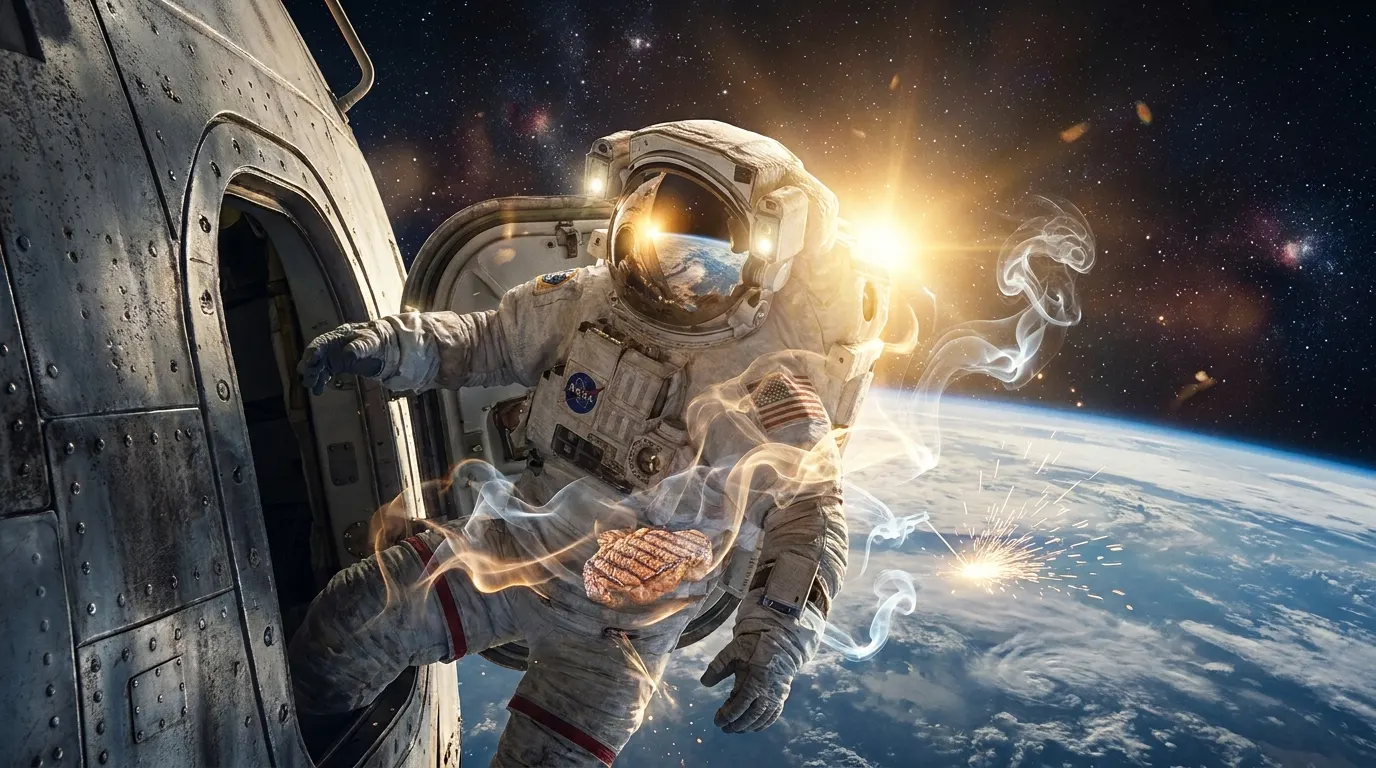
The descriptions vary slightly, but the comparisons are strikingly similar: grilled steak, seared meat, hot metal, welding fumes, gunpowder, and burnt toast.
This bizarre phenomenon has intrigued scientists for years and has become one of the most curious sensory mysteries associated with human space exploration.
🌌 The First Reports From Space
The phenomenon was first noticed during the early years of human spaceflight. Astronauts participating in extravehicular activities, commonly known as spacewalks, repeatedly described a unique odor after returning inside their spacecraft.
Because there is no atmosphere in space, they could not smell anything while outside. The scent became noticeable only after repressurization, when traces of substances attached to their suits entered the breathable air of the spacecraft.
Several astronauts provided remarkably similar accounts.
NASA astronaut Don Pettit famously described the scent as resembling welding fumes. Others compared it to burning metal or the smell produced by a high-temperature industrial workshop.
Some astronauts even likened it to the aroma of a barbecue, specifically grilled steak fresh off a hot grill.
The consistency of these reports captured the attention of scientists. When multiple people from different missions and eras independently describe similar smells, researchers tend to take notice.
🔬 Why Can’t We Smell Space Directly?
To understand the mystery, it is important to recognize how smell works.
Odors are created when molecules travel through the air and interact with receptors inside our noses. Without an atmosphere, there is no medium for those molecules to move through and reach our olfactory system.
Space itself therefore cannot be smelled directly.
The scent astronauts report is actually produced by particles and chemical compounds that accumulate on their suits, tools, gloves, and spacecraft surfaces during exposure to the space environment.
When they return inside and the airlock is repressurized, these compounds interact with oxygen and become detectable.
In other words, astronauts are not literally smelling the vacuum of space.
They are smelling the chemical aftermath of being exposed to it.
☄️ The Violent Chemistry of the Cosmos
The environment outside Earth’s protective atmosphere is far more hostile than most people realize.
Space is constantly bombarded by intense ultraviolet radiation from the Sun, high-energy cosmic rays, charged particles, and microscopic debris traveling at extraordinary speeds.
These extreme conditions trigger chemical reactions that rarely occur on Earth.
When materials on a spacecraft are exposed to such energetic radiation, their surfaces can undergo molecular changes. Tiny fragments of compounds can be altered, broken apart, or recombined into entirely new substances.
Scientists believe many of these reactions contribute to the unusual smells astronauts encounter.
The effect is somewhat similar to what happens during welding, where intense energy transforms molecules and creates distinctive odors.
This similarity helps explain why so many astronauts compare the scent of space to welding fumes or hot metal.
🌠 Polycyclic Aromatic Hydrocarbons: A Possible Culprit
One of the leading scientific explanations involves compounds known as polycyclic aromatic hydrocarbons, often abbreviated as PAHs.
These molecules are surprisingly common throughout the universe.
They form in dying stars, drift through interstellar clouds, and have been detected in distant galaxies. Astronomers have identified their spectral signatures in numerous regions of space.
Interestingly, PAHs are also produced on Earth through combustion processes. They can be found in grilled foods, charred meat, vehicle exhaust, and smoke from fires.
Many of these compounds possess strong odors associated with burning, roasting, or smoky aromas.
Because astronauts often describe space as smelling like grilled steak or burnt food, some scientists suspect that PAHs may play an important role.
Although researchers cannot yet definitively prove this connection, the theory aligns remarkably well with the reports collected from astronauts over the years.
🔥 Why Grilled Steak?
Among all the descriptions, grilled steak remains the most famous.
But why would space smell like a backyard barbecue?
The answer lies in chemistry rather than cuisine.
When meat is grilled, complex reactions occur between proteins, fats, and sugars. These reactions generate hundreds of aromatic compounds responsible for the irresistible smell of cooked food.
Some of these compounds share chemical characteristics with substances produced during high-energy reactions in space.
The result is not that space contains actual steak molecules. Rather, certain cosmic compounds may stimulate our sense of smell in ways that resemble the aromas generated by grilling meat.
The human brain interprets these chemical signals by comparing them to familiar experiences, and grilled steak happens to be one of the closest matches.
🛰️ What Astronauts Have Said
Throughout the history of space exploration, astronauts have provided fascinating descriptions of the smell.
Common comparisons include:
- Grilled steak
- Burnt meat
- Welding fumes
- Hot metal
- Gunpowder
- Burnt toast
- Electrical sparks
- Industrial machinery
The remarkable consistency among these accounts suggests that the phenomenon is genuine and not merely the result of imagination or expectation.
Many astronauts reported the scent before hearing similar descriptions from others, strengthening the credibility of their observations.
Scientists therefore treat these reports as valuable data points rather than amusing anecdotes.
🌍 Is Space the Same Everywhere?
An intriguing question remains unanswered.
Does all of space smell the same?
Probably not.
The universe contains a staggering variety of environments. The chemistry near a star differs dramatically from the chemistry inside a nebula, around a planet, or within a dense molecular cloud.
Astronomers have discovered regions rich in alcohol molecules, ammonia, sulfur compounds, and even complex organic chemicals.
Some clouds in deep space contain ingredients associated with fruits, flowers, and other familiar scents.
Of course, humans could never directly smell these regions because they exist in a vacuum. Yet if those molecules could somehow be transported into an atmosphere, the resulting aromas might be very different from the grilled-steak scent reported near Earth orbit.
The smell astronauts experience likely reflects the specific chemical conditions surrounding spacecraft operating in Earth’s immediate space environment.
🌞 The Role of Atomic Oxygen
Another possible contributor is atomic oxygen.
In low Earth orbit, ultraviolet radiation can split ordinary oxygen molecules into highly reactive individual atoms.
These atoms are extremely energetic and can interact aggressively with spacecraft materials.
When surfaces exposed to atomic oxygen return inside the spacecraft, they may undergo additional chemical reactions that generate distinctive odors.
Researchers believe this process may contribute to the metallic, burnt, or smoky smells reported by astronauts.
Atomic oxygen is also known for gradually eroding spacecraft surfaces, making it one of the most significant environmental challenges in low Earth orbit.
🧪 NASA’s Efforts to Recreate the Smell
The mystery became so fascinating that scientists attempted to recreate it on Earth.
Researchers working with NASA sought to identify the exact combination of compounds responsible for the scent.
The goal was not merely curiosity. Understanding the chemistry involved could provide valuable insights into material degradation, astronaut safety, and the broader conditions encountered in space.
These studies led to the development of training aromas designed to help astronauts recognize what they might encounter during missions.
While no artificial recreation can perfectly capture the complexity of the actual experience, researchers have managed to approximate several of the characteristic notes reported by astronauts.
Descriptions often include metallic, smoky, and slightly charred elements.
🌌 Smell and the Search for Life
The science of cosmic odors extends beyond astronaut anecdotes.
Astronomers routinely analyze the chemical composition of distant objects using spectroscopy. By studying how molecules absorb and emit light, researchers can identify substances present across the universe.
Many of these molecules would have recognizable scents if encountered on Earth.
Understanding cosmic chemistry helps scientists investigate fundamental questions about the origins of life.
Complex organic molecules have been discovered in asteroids, comets, and interstellar clouds. Some of these compounds are considered building blocks for biological systems.
The fact that the ingredients of life are widespread throughout the cosmos suggests that chemistry capable of supporting life may be more common than previously thought.
In this sense, the smell of space is connected to one of humanity’s greatest scientific quests: determining whether life exists elsewhere in the universe.
🚀 The Human Side of Space Exploration
One reason the story of space’s smell captivates people is that it humanizes exploration.
Space missions often involve discussions of advanced technology, orbital mechanics, and scientific instruments. These topics are fascinating but can feel distant from everyday experience.
Smell, however, is deeply personal.
Everyone understands the aroma of grilled food, burnt toast, or hot metal.
When astronauts describe space using such familiar references, they transform an incomprehensible cosmic environment into something surprisingly relatable.
The comparison reminds us that even while floating hundreds of kilometers above Earth, astronauts remain human beings experiencing the universe through the same senses we use every day.
✨ A Mystery That Continues to Fascinate
Despite decades of study, scientists have not completely solved the mystery of why space smells the way it does.
Several plausible explanations exist, including polycyclic aromatic hydrocarbons, atomic oxygen reactions, radiation-induced chemistry, and interactions involving spacecraft materials.
The true answer may involve a combination of all these factors.
What is clear is that the reports are real, consistent, and scientifically intriguing.
The next time you imagine the vast emptiness beyond Earth’s atmosphere, consider this surprising possibility: after a spacewalk, the cosmos may leave behind an aroma reminiscent of a sizzling steak fresh from the grill.
It is a strange thought, but space has never been short on surprises.
Among black holes, exploding stars, and distant galaxies, one of its most memorable mysteries may be something as unexpected as the smell of a cosmic barbecue.