Published 06/17/2026 10:29 | Edited 06/17/2026 10:30
The scope of the New Growth Acceleration Program (New PAC) goes beyond Brazilian borders. A report published in June 2026 by the China International Contractors Association (CHINCA) and the state-owned insurance company China Export and Credit Insurance Corporation (Sinosure) places the PAC as the main driver of Brazilian infrastructure investments and as a decisive factor for the country to lead the Infrastructure Development Index for Portuguese-Speaking Countries (BRIDi).
The survey, launched in June, during the 17th International Infrastructure Investment and Construction Forum (IIICF) in Macau, analyzes nine Portuguese-speaking countries and ranks Brazil in first place with 129 points — an increase of one point compared to 2025. The document directly mentions the New PAC when explaining the country’s upward trajectory, highlighting the expansion of investments in electricity, transport and digital infrastructure as central vectors of growth.
Another aspect highlighted by the report, and which also differentiates Brazil among the community of Portuguese-speaking countries, is the fact that the New PAC gives greater national autonomy in the direction of investments and provides greater protection against external fluctuations resulting from international cycles.
In an exclusive interview with the portal Reddirectly from Macau, professor Evandro Menezes de Carvalho, jurist and specialist in international relations, explained that the Chinese relationship with Portuguese-speaking countries in the field of infrastructure varies according to the fiscal reality of each one, and that Brazil stands out precisely for its internal solidity. “China’s relationship with Portuguese-speaking countries with regard to infrastructure investments varies precisely depending not only on the economic capacity of the country that receives Chinese investments, which attract Chinese investments, but also on the capacity, let’s say, to execute infrastructure projects, including with national resources, including human resources. I think this is a very big difference for Brazil”, pointed out the professor.
For the specialist, the Brazilian institutional arrangement offers parameters that go far beyond abstract legal guarantees. “So, it’s not just about having long-term, structuring projects, with a good regulatory structure, but also the country’s capacity, in this case Brazil, to execute, by having qualified labor at all levels of an infrastructure project. So, I think this is a very big difference that must be taken into account”, added Evandro, highlighting that Brazil offers reliability and longevity due to the robustness of its financing structure and the material capacity to execute the works.
The special secretary of the New PAC of the Civil House of the Presidency of the Republic, Roberto Garibe, shared a similar opinion on the government portal: “The New PAC reaffirms this administration’s commitment to a modern, integrated infrastructure oriented towards the country’s development. The recognition of Brazil as a leader in infrastructure among Portuguese-speaking countries demonstrates that planned investments, executed with continuity and aimed at concrete results strengthen our ability to grow, attract investments and generate opportunities for the population.”
Energy transition and mobility gain prominence
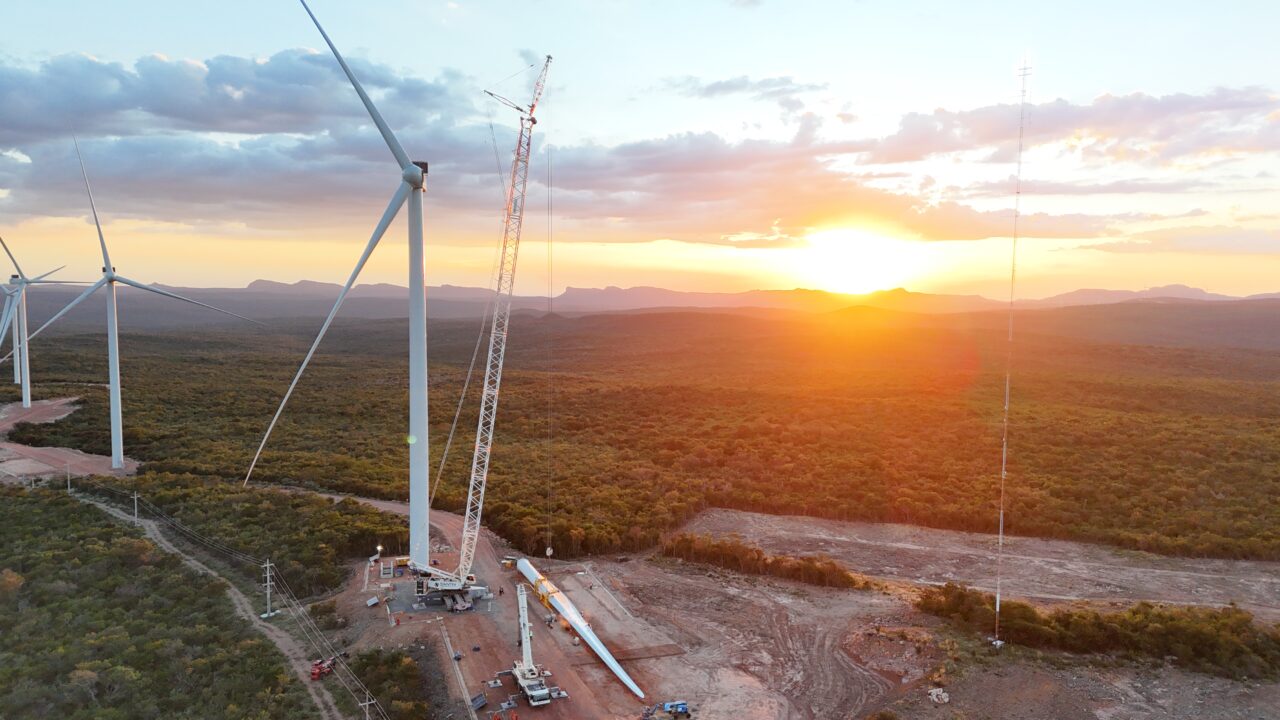
The energy transition is at the heart of the demand projected by the BRID for Brazil in 2026. The index records expected growth of 23.4% in installed wind and solar energy capacity compared to the previous year. Two projects are leading this advance: the 400 MW Rui Barbosa photovoltaic complex and the 846 MW Serra do Assuruá wind farm, both in Bahia. Together, the deliveries add up to 1,246 MW of clean energy reaching the electricity grid.
The report also points out that the New PAC boosted the construction of high voltage transmission corridors between the Northeast – the largest producer of renewable energy in the country – and the consumption centers in the Southeast. The share of non-hydro renewable sources in the electrical matrix is expected to reach 39% in 2026, compared to 32% in 2024.
In mobility, the program supports a robust portfolio. São Paulo breaks a historic record in investments in rail, with R$79.9 billion contributed. The São Paulo – Campinas intercity railway entered planning with structured investment for the railway route, totaling investments estimated at R$ 14.2 billion. Eight federal railway tenders were launched with routes totaling 9 thousand kilometers and R$140 billion in direct investment. In ports, nine modernization projects were approved with R$5.1 billion.
5G and green data centers transform the production base
O BRIDi tIt also highlights the expansion of 5G to the interior of Brazil as part of the Novo PAC’s effort to integrate physical and digital infrastructure. The report points to the arrival of networks in the agricultural Midwest as a qualitative leap — connectivity that enables automation, remote monitoring and reduction of losses in the food supply chain.
The implementation of large green data centers in São Paulo and Fortaleza, powered directly by solar energy, is cited as a model for integration between clean infrastructure and digital transformation. The document points to this fusion between computational capacity and renewable energy as Brazil’s competitive advantage in Latin America and as a direct reflection of the New PAC guidelines for the sector.
In the overall index ranking BRIDE, Brazil consolidated its isolated leadership by reaching 129 points. What ensured the top of the table for the Brazilian market was its record performance in specific categories of the report: the demand sub-index – which measures the volume of new works ready to come to fruition –, where the country reached 161 points, and the market temperature sub-index, which scored 133 points, signaling a highly heated environment for investors.
Ranking and contrast with other Portuguese-speaking countries
Second place in the ranking went to Mozambique (118 points), driven by energy projects and support from multilateral financial institutions. Angola appears in third (115 points), with advances in the Lobito railway corridor and solar expansion in the south of the country.
The report is precise in distinguishing the trajectories: while other Portuguese-speaking countries depend on external financing and partnerships with foreign contractors to make their portfolios viable, Brazil has its own public infrastructure policy, with a long-term horizon and capacity for continuous execution. For associations like CHINCA, which guides investments by construction companies in more than 70 countries, this is exactly the type of signal that differentiates a structured market from a market dependent on external cycles.
Professor Evandro Carvalho warns, however, that Brazil needs to recover lost ground in cooperation with African partners, a space that collapsed after the dismantling of national engineering. When analyzing Brazil’s ability to establish partnerships with other Portuguese-speaking countries, especially Portuguese-speaking countries in Africa, Evandro states that “Brazil was already very present and active in this regard with its construction companies, investments, which Lava Jato broke. And this ended up causing, obviously, China to gain ground, because Brazilian competitors for China, in Africa, no longer existed. Lava Jato broke these companies. This was a crime against national economy. Because fighting corruption is fine. But fighting corruption and destroying the country’s economy is not the case”, criticized the professor.
What recognition represents in Brazil-China relations
For analysts of Sino-Brazilian economic relations, the endorsement of central Chinese entities such as CHINCA and Sinosure reinforces Brazil as a reliable and structured partner in the context of South-South cooperation. The recognition validates a long-term strategy that combines state planning with investment attraction, especially in priority sectors for China, such as renewable energy, transmission and digital infrastructure.
Unlike projects in several Portuguese-speaking African countries or in emerging economies of the Belt and Road Initiative (BRI), where Chinese financing and execution often take on a greater role in contexts of lower domestic fiscal capacity, the Brazilian case allows for a more balanced partnership. The New PAC offers a structured portfolio and sustained demand, attracting Chinese capital and technology in a way that complements national public policy.
In this sense, Evandro defends strategic joint action. “So, this is another point that is also worth reflecting on, which is Brazil’s ability today to also, even in partnership with China, develop infrastructure projects in Portuguese-speaking African countries. This cooperation within the framework of the community of Portuguese-speaking countries is very important and we must look at it very carefully. Especially because China itself created the Macau Forum with this objective, to establish a relationship between China, China, and Portuguese-speaking countries. And Brazil, from an economic point of view, is the country most important of all the countries of the community, of the Portuguese-speaking countries, CPLP”, he concludes.
Source: vermelho.org.br