Published 11/26/2025 12:26 | Edited 11/26/2025 12:39
The decision of the Federal Supreme Court (STF) that decreed the beginning of serving the sentence of 27 years and three months in prison for former president Jair Bolsonaro had wide repercussions in the world press this Tuesday (25).
Media outlets from the United States, Europe, Latin America, Israel and Russia classified the case as a milestone in holding the extreme right accountable and revisited the evidence of the coup plan that sought to prevent Luiz Inácio Lula da Silva from taking office in 2023.
The publications emphasized the failure of the conspiracy, the attempt to damage the electronic ankle bracelet and the resilience of Brazilian institutions in the face of internal and external pressure.
Read also: Brazil makes history and puts Bolsonaro and generals in prison for coup plot
The European repercussion focused on the seriousness of the coup plot and the role of the STF. El País stated that “the moment long awaited by Brazilian left-wing activists and families of coronavirus victims has arrived”, classifying Bolsonaro as responsible for “leading a coup plot”.
The newspaper highlighted that the former president is “technically imprisoned” and stated that the Court took into account his “age and fragile health” when determining the place of the sentence.
The publication defined the STF as a “great defender of democracy” and recalled that Alexandre de Moraes — called by Bolsonarists “the worst enemy” — denied house arrest.
The newspaper also wrote that “if Bolsonaro served his entire sentence in prison, he would be released after almost 100 years”, pointing out that the silence imposed by the process weakened his political capital.
In an incisive tone, the newspaper stated that “not even the formidable pressure exerted by the president [Donald] Trump, in the form of threats, tariffs and economic sanctions against judges, managed to save his ally”, concluding that “Brazilian institutions demonstrated remarkable resilience in the face of threats and aggression from the most powerful politician in the world”.
In France, the The World reported that Bolsonaro began serving his sentence, making his conviction “definitive” after “exhausting all available resources”. THE France24 highlighted that “Bolsonaro’s defense resources have been exhausted”, reinforcing the conclusive nature of the decision.
The British The Guardian stressed that the former president, described as an “extreme right-wing populist”, will stay in a “12 square meter room” and that the conspiracy included “the murder of Lula and his vice, Geraldo Alckmin”.
The newspaper also stated that the arrest generated “jubilation among progressive Brazilians” due to the memory of a government marked by environmental devastation and hostility towards minorities.
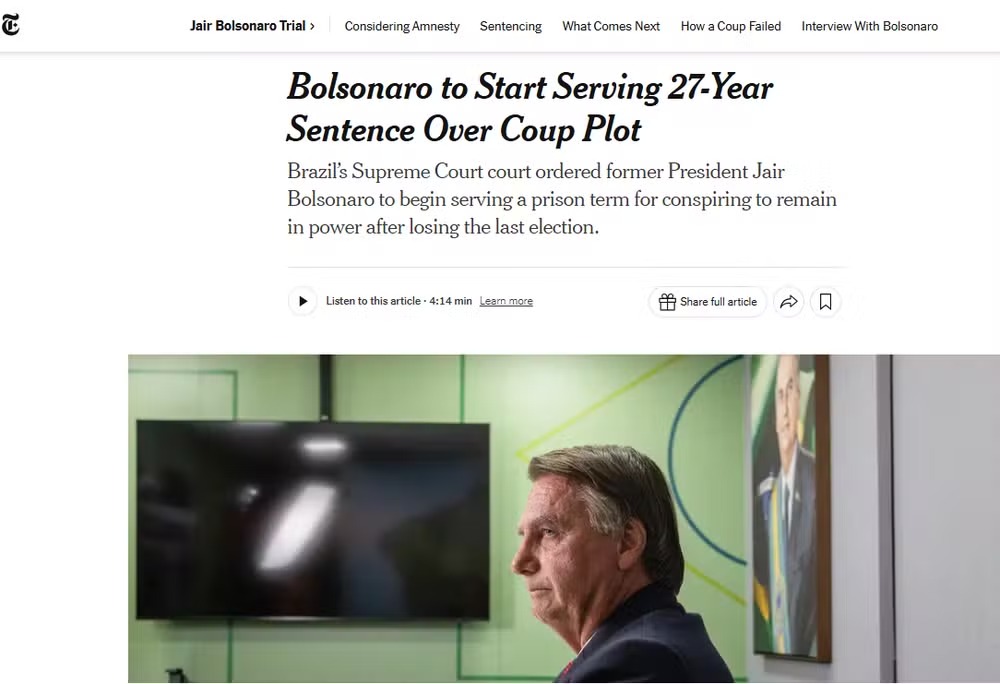
In the United States, the The New York Times highlighted that “Brazil’s Federal Supreme Court ordered former president Jair Bolsonaro to begin serving a prison sentence for conspiracy to remain in power after his defeat in the last elections.”
The newspaper defined the plot as “a failed conspiracy to stay in power” and revisited the central elements of the plan, including the dissolution of the STF and the assassination of Lula and Alexandre de Moraes.
Read also: Bolsonaro’s arrest is legal and reinforces democracy, say parliamentarians
The newspaper recorded that the defense attributed the former president’s health condition to “health problems related to complications from a stabbing attack suffered in 2018”, also mentioning “frequent bouts of hiccups and vomiting”.
In an article, correspondent Jack Nicas wrote that “President Trump tried to prevent former Brazilian president Jair Bolsonaro from being arrested. He failed and is now moving on”, indicating that the Republican reduced his interest in the case after the diplomatic rapprochement between Washington and Brasília.
A Bloomberg he returned to the nickname “Trump of the Tropics” and recalled that Bolsonaro sought external support after his defeat, but that “Trump’s interest in Bolsonaro’s situation seems to have diminished”.
A CNN International highlighted the institutional robustness, noting that “Bolsonaro tested Brazilian democracy. The Supreme Court intervened.”
The broadcaster classified preventive detention as “one of the most extraordinary responses that a democracy can employ against a former leader”, highlighting that the former president’s political trajectory took Brazilian institutions “to the limit of their capacity”.
In Latin America, coverage emphasized Bolsonaro’s political and physical deterioration. THE Clarion mentioned that he “has poor health, suffers anxiety attacks, hiccups and vomiting” and highlighted his attempt to damage the electronic ankle bracelet.
The newspaper reported that Bolsonaro “denied (…) that his intention in trying to damage his electronic ankle bracelet with an improvised soldering iron was to escape”, attributing the episode to “paranoia” and “hallucinations” caused by medication.
The Argentine press also highlighted that the former president is today one of the greatest international symbols of the declining far right.
The Channel RT Newsfrom Russia, reproduced the police version, stating that Bolsonaro remains in prison “after trying to damage his electronic ankle bracelet with a soldering iron” and that the precautionary measure was maintained due to the “risk of escape detected by the Federal Police”.
The Latin American press also reflected the political impact among the military involved in the coup plot, recording that several convicted generals began serving their sentences in military facilities.
Regional vehicles highlighted the breaking of a history of impunity and the exposure of operational links between Bolsonarism and segments of the high military hierarchy.
O Times of Israel stated that the conviction should trigger “an eventful and tense week”, citing senator Flávio Bolsonaro, who promises to “continue pushing for the approval of an amnesty project”, despite the newspaper noting that the initiative “has lost momentum in recent months”.
According to the publication, the topic should return “throughout 2026”, indicating that Bolsonarism will try to politically capitalize on the former president’s arrest.
The German German wave classified the decision as a “historic decision”, remembering that it comes almost three years after the January 8th attack, when “protesters vandalized Praça dos Três Poderes in an attempt to reverse the result of the 2022 elections” — a direct association between Bolsonarism and political violence.
Agencies like EFE e Reuters also covered the case, with the British agency describing that the STF concluded the process “paving the way for the beginning of its sentence”, reinforcing the international perception that Brazil has ended one of the most serious episodes in its recent institutional history.
Source: vermelho.org.br