Published 10/23/2025 12:21 | Edited 10/23/2025 18:29
The United States carried out this Wednesday (22) the first military attack in the Pacific Ocean as part of its supposed campaign to combat drug trafficking. The operation, carried out by direct order from Donald Trump, killed two people on a vessel that, according to the US government, was transporting drugs in international waters close to the coast of Colombia.
The action marks the expansion of the offensive that began in September, which had already produced at least seven bombings in the Caribbean and caused dozens of deaths.
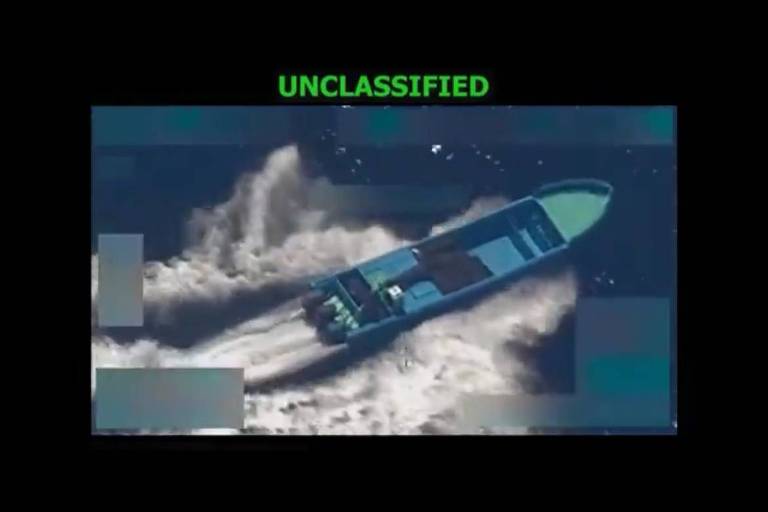
Defense Secretary Pete Hegseth confirmed the attack and released a video showing a speeding boat being struck by an explosion.
“Yesterday, at the direction of President Trump, the Department of War conducted a lethal kinetic attack on a vessel. There were two narco-terrorists on board. Both were killed, and no American forces were harmed,” the secretary stated.
Hegseth also stated that “narco-terrorists who intend to bring poison to our shores will not find safe haven anywhere in our hemisphere” and compared drug trafficking groups to Al-Qaeda.
The military offensive, described by the White House as part of the “total war against the cartels”, has already left more than 30 people dead and is considered by jurists and diplomats as the most aggressive United States operation in Latin America since the invasion of Panama in 1989.
Since the beginning of September, Washington has claimed to combat transnational drug networks, but has not presented evidence or revealed the identities of the victims.
The White House also did not disclose the exact location of the bombings — the international database Acled (Armed Conflict Location and Events) identified the approximate areas of the attacks only based on press reports, and with the lowest possible degree of precision.
Trump’s rhetoric associates Latin American cartels with the war on terrorism discourse.
“Just as al-Qaeda waged war on our homeland, these cartels are waging war on our border and our people. There will be no refuge and no forgiveness — only justice,” the Republican said.
The declaration reflects the attempt to justify the unrestricted use of force in the name of national security, expanding the Executive’s power over military operations outside American territory.
The new attack reignites diplomatic tensions with Colombia, whose coast was the likely scene of the operation.
The Colombian Ministry of Foreign Affairs denounced the episode as “comparable to the application of the death penalty in foreign territory”. Vice Chancellor Mauricio Jaramillo classified the action as “disproportionate and outside international law”, stating that “the occupiers had no possibility of defending themselves” and that “there was no process or court order”.
President Gustavo Petro, in turn, accused the United States of “opening a new theater of war in the Caribbean” and stated that “the solution to this crisis is to remove Trump from power”.
The climate between the two countries deteriorated rapidly. Trump accused Petro of being an “illegal drug leader” and promised to cut subsidies and increase trade tariffs against Bogotá.
The Colombian reacted by calling the Republican “rude and ignorant” and ordered the return of his ambassador to Washington. The American then publicly attacked him again, calling him a “miscreant” and a “bad guy”, to which Petro responded by promising to take him to court for the “slanders uttered”.
The military escalation also deepens the crisis between Washington and Caracas. US government sources told the press that Trump’s strategy is to “apply maximum pressure on Nicolás Maduro to remove him from power, including by force”.
In August, Washington doubled to US$50 million the reward for the capture of the Venezuelan president, accused of leading the alleged Cartel de los Soles — an organization whose existence is disputed by experts and the Venezuelan government itself.
Maduro reacted by declaring that the country is ready to respond to any attack. “If the foreigners attack, we will respond,” said the president.
Defense Minister Vladimir Padrino López stated that Bolivarian forces are prepared “for drone attacks, aerial campaigns or sabotage conducted by US special forces.”
Military rhetoric and the deployment of warships, F-35 fighters and a nuclear submarine to the Caribbean indicate a long-range offensive, not restricted to drug trafficking.
Washington claims to act against criminal networks, but the geographic reach and volume of troops — around 10,000 troops — suggest an effort at political intimidation amid Trump’s diplomatic isolation. Ecuadorian President Daniel Noboa, on the other hand, praised American actions, in the context of his own “war against gangs”, which earned him support from Washington.
International law experts consulted by Folha and European outlets maintain that the American offensive, at the very least, lacks a legal basis.
International law prohibits attacks against people who do not present an imminent threat, except in cases of declared war or explicit authorization from the UN Security Council. “Without process, without court order and without immediate threat, this is a summary execution,” a Colombian jurist told the BBC.
Even the justification for combating drug trafficking is contested by analysts. Data from the DEA (US Drug Enforcement Agency) itself indicates that most of the cocaine destined for the American market enters through the Pacific Ocean and the Mexican border — not through the Caribbean, where the attacks occurred —, while the synthetic drugs that fuel the opioid crisis, such as fentanyl, originate mostly in China.
For diplomats and multilateral organizations, Trump’s offensive represents “a historic setback” and reopens the precedent of extraterritorial interventions that marked the Cold War.
The new phase of the North American naval war in Latin America is seen as a movement of a political nature, aimed both at Trump’s electoral campaign and at Washington’s strategic repositioning in the face of governments that challenge its influence.
By bringing the rhetoric of drug trafficking closer to the language of the war on terror, the Republican reinforces the ideological character of his foreign policy and reintroduces South America as a zone of military confrontation under the mantle of “hemispheric security”.
Source: vermelho.org.br