Published 09/23/2025 17:14 | Edited 23/09/2025 18:01
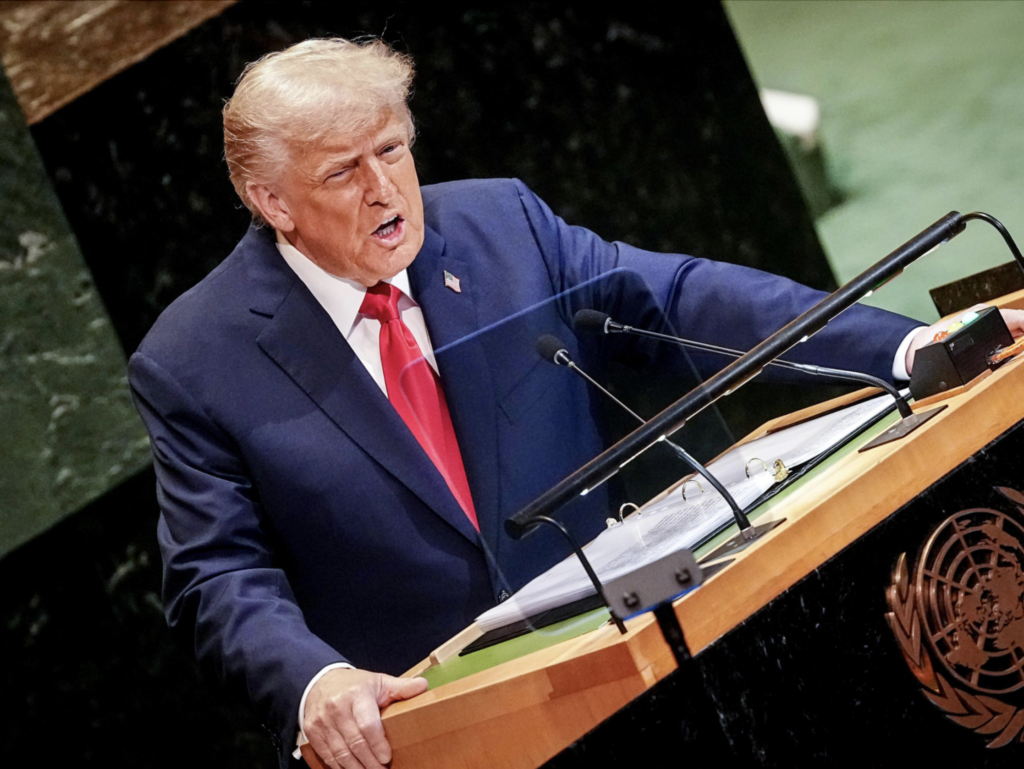
On a stage for dialogue between nations, Donald Trump once again staged his spectacle of institutional humiliation. His speech at the UN General Assembly was not a call to cooperation, but an attack calculated to the organism itself that hosting it. Through a populist rhetoric that mixed excessive self -loom with superficial criticism and comic anecdotes, Trump sought to undermine the credibility of the multilateral forum to present himself as the only leader capable of resolving crises with “action” – a term that, in his vocabulary, is synonymous with unilateral action.
From the escalator to teleprompter: the attack by the annex
Trump began his speech not with a geopolitical view, but with a bureaucratic and occasional complaint. Teleprompter’s malfunction served as the first forced metaphor for incompetence. He turned the technical incident into his own virtue – “That way you talk more to the heart” – and in a defect of the institution. The apex of this demoralization strategy came with the anecdote on the “escalator that, on the way up, stopped in the middle.”
By reducing the United Nations to an incompetent administrator of his own physical infrastructure, Trump sought a clear goal: to divert attention from substantive discussions about peace and cooperation to a narrative of inefficiency and irrelevance. The strategy of reducing a multilateral institution complex to insignificant operational failures by painting the UN as incompetent in basic tasks and, by extension, unworthy for serious global affairs.
“These were the two things I received from the UN: a bad escalator and a bad teleprompter,” he said in a tone that equalized the complexity of global governance to the inability to keep equipment in operation. This approach is a classic of populism: attacking institutions through everyday and anecdotal, suggesting that they are incapable and therefore trusted unworthy for larger missions.
“I ended the UN”: the substitution narrative
The core of the attack was the allegation of solving problems alone that the UN supposedly ignored. By claiming to have closed “seven” unfinished “wars in seven months, Trump built a powerful dichotomy: on the one hand, the decisive and successful action of the US under his command; on the other, the supposed paralysis of the multilateral organization.
“It is a pity that I had to do these things instead of the United Nations. And unfortunately, in all cases, the United Nations have not even tried to help in any of them,” he said. He reinforced this idea with the accusation that the UN comes down to “writing a very strong letter and then never pursuing”, characterizing it as a producer of “empty words.”
This narrative deliberately ignores the mechanisms of UN diplomacy, mediation and maintenance, which are by nature mediated and collaborative, to contrast them with the image of a strong and unilateral leader. It also ignores the fact that the UN Security Council is sub-reported, and the US has veto power on unanimous decisions among other members, a mechanism that Joe Biden and Trump used and abused to facilitate the continuity of armed conflicts useful to the US war industry.
The “Trump in the UN” style: populism as a global strategy
The speech was a masterclass In the communication Trump style, adapted for the global stage:
- Improvisation and Breaking Protocol: By playing on Teleprompter and narrating personal stories about the renovation of the UN building, he broke the formality of the event. This conversational tone creates a false sense of authenticity and approach, typical of populism, while moving the focus of the collective agenda to their personal experiences.
- Manichean Ufanism and Contrast: the exhaustive repetition of economic and military deeds – “America is blessed with the strongest economy, the strongest borders, the strongest army” – It serves to establish a clear hierarchy: the US is the indispensable actor, and the UN, a useless parasite. The constant mention of the “golden age of America” under his government contrasts with the image of a world in crisis under the aegis of multilateralism.
- Creation of common enemies: The UN was painted not as a partner, but as part of the problem. By accusing her of “financing an attack on Western countries and their borders” by supporting migrants, Trump turns her into an internal enemy, “globalism” that betrays national interests. This unifies its domestic base and projects this logic of conflict for the international scenario. More than a potentially useless forum, this argument makes the UN an active enemy. By accusing her of financed illegal immigration, he frames the organization as part of a hostile globalist agenda to national sovereignty, thus justifying its rejection and paragraph.
- “Each sovereign nation must have the right to control its own borders… paid by the people of this nation, which built this nation.” Its conception of sovereignty is, by definition, contrary to deep multilateral cooperation. Sovereignty, in its view, is about total autonomy and independence of international organizations, which are seen as a threat to national control.
- “This is exactly what the globalist migration agenda has done.” By using the word “globalist” as a pejorative term, it does not only attack policies, but an alleged diffuse agenda of which the UN is an integral part. This feeds the theory of conspiracy that international forces conspire against the nation states, being the UN a key piece in this scheme.
The attack on multilateralism as a project
Trump’s performance on the UN was not a simple outburst or a moment of self -centeredness. It was a strategic onslaught against the very idea of cooperative global governance. By delegitimizing the UN with criticism from the coach to the noun, he seeks to dismantle a pillar from the post-World War international order.
The ultimate goal of course: replacing the multilateral system with a bilateral power relations of power, where unilateral force and loyalty to Washington are the exchange coins.
Together, these phrases do not simply show a critique of UN inefficiency. They reveal a deeply hostile political philosophy to the very concept of multilateral governance. Trump sees the UN not as an imperfect partner, but as a competitor to be defeated – a symbol of a global system that dilutes national sovereignty and prevents the unilateral exercise of American power. His speech is an effort to dismantle the institution’s moral and political authority, replacing it with a model where the US, under its command, acts as the global judge and executor.
The “Trump no UN” style – with its jokes, improvisations and attacks – is the perfect packaging for this project. It is populism served as foreign policy, where the humiliation of an institution is the first step to its irrelevance, paving the way for a more divided world and where the law of the strongest prevails. The real target was not a defective teleprrompter, but the idea that nations should solve their problems dialoguing, not just obeying.
Source: vermelho.org.br