Posted 20/08/2025 10:36 | Edited 20/08/2025 14:32
The White House elevated on Tuesday (19) the imperialist tone against Venezuela by claiming that President Donald Trump is willing to use ‘all the strength’ to overthrow Nicolás Maduro, accused without proof of leading a drug cartel.
The announcement was made in Washington by the press secretary Karoline Leavitt, who ranked Maduro as “fugitive” and “drug cartel boss.”
Caracas countered the statements, accusing the United States of defamation and ‘despair’. In a speech, Maduro stated that “no empire will touch the sacred soil of Venezuela” and that ‘rifles and missiles will be in the hands of the working class to defend the homeland. “
“Maduro is not a legitimate president. He is a fugitive and boss of a US -accused drug trafficking cartel. Trump is prepared to use the entire American force to stop drug trafficking,” Leavitt told journalists in the White House.
The English term used by Leavitt, “power”, can be translated as “strength” or “power.”
Caracas reacted by calling the accusations of defamation without proof and a sign of Washington’s “despair”. Chancellor Yván Gil stated that “accusing the Venezuela of drug trafficking reveals the lack of credibility and the failure of US policies in the region” and classified the increase in reward for the capture of Maduro as “a ridiculous propaganda operation and a joke.”
The Venezuelan president himself also mocked the offensive, saying that the threat from the United States is “extravagant and bizarre, of an empire in decline.”
In a speech broadcast on state TV, Maduro insisted that peasants and workers are prepared for national defense. He stated that the country is mobilized to watch over seas, heavens and land, promising that South America will not be subjected to any type of invasion.
“Rifles and missiles for the working class, to defend our homeland,” he said. “We defend our seas, our heavens and our lands. We free them. We watch them and patrol them,” added the Venezuelan President.
Mobilization is part of a structure created by Hugo Chávez in 2005 and formalized in 2010. Popular Force was incorporated as a fifth component of the Bolivarian National Armed Force and includes retired civilians, reservists and military.
The Ministry of Defense estimates that between 95,000 and 150,000 fighters are in active service, supported by hundreds of thousands of volunteers organized in urban and rural brigades.
The American climb
The clash occurs in parallel to the increase in the reward offered by the US to capture mature. The Trump government set the record of $ 50 million in August, double the figure announced in January by Joe Biden and well above the $ 15 million defined in 2020.
The amount exceeds the amount intended for the leader of Al Qaeda, Osama Bin Laden, after the 2001 attacks.
Attorney General Pam Bondi has classified Maduro as “one of the world’s greatest drug traffickers” and pointed out the Sacred Cartel as a threat to US safety. In February, Trump had already designated the Sinaloa cartel in Mexico and Venezuela’s Aragua Tren as foreign terrorist organizations, a category hitherto reserved for groups such as al-Qaeda and the Islamic State.
O New York Times He revealed that at the beginning of August the president confidentially signed an executive order that authorizes the Pentagon to perform direct military operations against cartels in the region.
The measure was interpreted as the most aggressive step of its management in the anti -drug field, as it makes room for attacks on foreign territory.
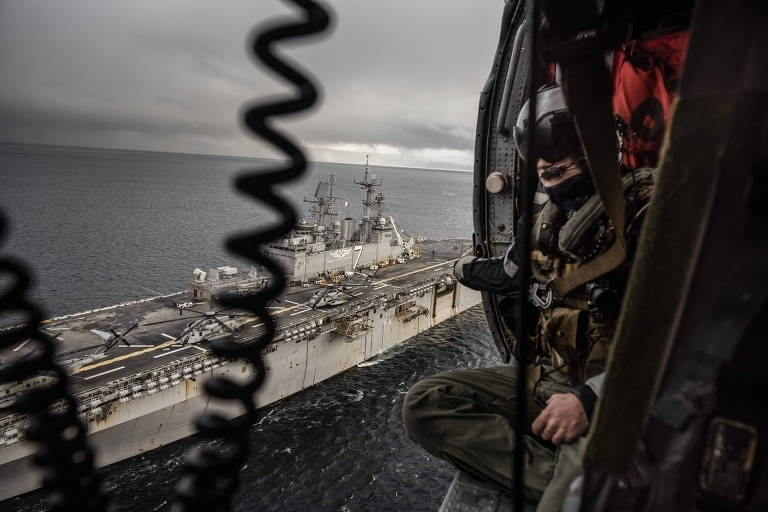
On Monday (18), Reuters reported that three destroyers equipped with Aegis guided missiles-USS Gravery, USS Jason Dunham and USS Sampson-would be displaced to the Venezuelan coast.
Other agencies pointed out that the operation would include more than 4,000 Naval Marines, a nuclear submarine, P-8 Poseidon recognition aircraft, the USS Iwo Jima, the USS Fort Lauderdale and USS San Antonio and a guided missile cruise.
Although military sources have classified displacement as a demonstration of strength, analysts remember that the executive order allows effective attacks.
The Pentagon, however, has never officially confirmed the sending, which raises suspicions that this is a psychological operation designed to expand the pressure.
The goal would be to intimidate Caracas, condition their decisions and provoke neighboring governments to speak, creating a climate of hostility. The picture, according to analysts, intimidation mixing, calculated provocation and actual attack capacity.
Part of the climb is also attributed to the Secretary of State and interim national security advisor, Marco Rubio, who concentrated functions after Mike Waltz’s departure from the security summit in May.
Compared to Henry Kissinger in the 1970s, Rubio controlled both diplomacy and military and intelligence orientation, converting the “fight against drugs” into US foreign policy axis to Latin America.
Analysts point out that the strategy also serves to reinforce its electoral base in Florida, where it faces criticism that “it does nothing to overthrow mature,” and to project its leadership within the Republican Party with a possible presidential candidacy in 2028.
Diplomatic reaction and quadrants of peace
The Venezuelan Chancellery responded hardly on imperialist statements. Minister Yván Gil stated that the accusations of drug trafficking “reveal the lack of credibility and failure” of US policies.
According to Gil, “these threats not only affect Venezuela, but also endanger the peace and stability of the entire region, including the Peace Zone declared by Celac.”
The chancellor also stressed that since the expulsion of the DEA in 2005, the country has obtained “successful catches, dismantling of networks and effective control of borders and back.”
“While Washington threatens, Venezuela advances in peace and sovereignty, demonstrating that the true effectiveness against crime is achieved by respecting the independence of peoples,” Gil said.
“Each aggressive statement confirms the inability of imperialism to subdue a free and sovereign people. The people of Bolivar and Chavez will continue to overcome any attempt at intervention. Venezuela is a lighthouse of dignity, resistance and security for Latin America and the world.”
Another important voice of Chavismo to react was Diosdado Cabello, Minister of the Interior, Justice and Peace and considered the number two of Caracas.
He said the Venezuelan Navy is positioned on the coast to defend national sovereignty. He also rejected the US accusation of the so-called Suns Cartel, classifying it as a “invention” of Washington. According to him, “the only drug cartel that works in the world is Dea.”
This Tuesday, Maduro participated in Caracas in the relaunch of 299 new quadrants of peace in the Commune Antonio José de Sucre, in the neighborhood El Guarataro.
The quadrants integrate the so -called plane of the 7 transformations, a strategic axis launched by Maduro to reorganize the state and consolidate what the government calls “popular power.”
They are delimited areas of citizen security and community organization, which operate in articulation with the police, the armed forces, the communes and the popular councils.
They differ from Bolivarian militia, but they are part of the same logic of integral defense: while militia is a militarized component of Fanb, quadrants act in urban and communal territory, reinforcing surveillance, crimes and popular mobilization in the face of external and internal threats.
The Venezuelan president said the system, which already has 5,336 units in the country, transforms Venezuela into an impregnable homeland. He also said that the country will have a perpetual peace and that the popular organization is a guarantee of resistance.
During the ceremony, it awarded 27 officers with the Order for Peace, recognition created to celebrate national security defense actions. According to the government, quadrants reinforce surveillance in Caracas and other urban centers, as well as articulate quick responses against external threats.
Other recent tensions
In addition to military climbing, Caracas reported that 66 Venezuelan children remain in the US after being separated from their parents in deportation processes. The president of the Return to Fatherland program, Camila Fabri, classified the case as “cruel and inhuman policy” and asked the children to be returned.
The government also suspended the civil use of aircraft and drones for 30 days, extendable measure as part of the actions to reinforce air safety.
Venezuelan authorities also evoked the Celac Peace Zone, a regional mechanism threatened by Washington’s stance, to argue that Latin America must preserve its sovereignty and stay free from external interventions.
Source: vermelho.org.br