Published 18/08/2025 18:13 | Edited 18/08/2025 20:12
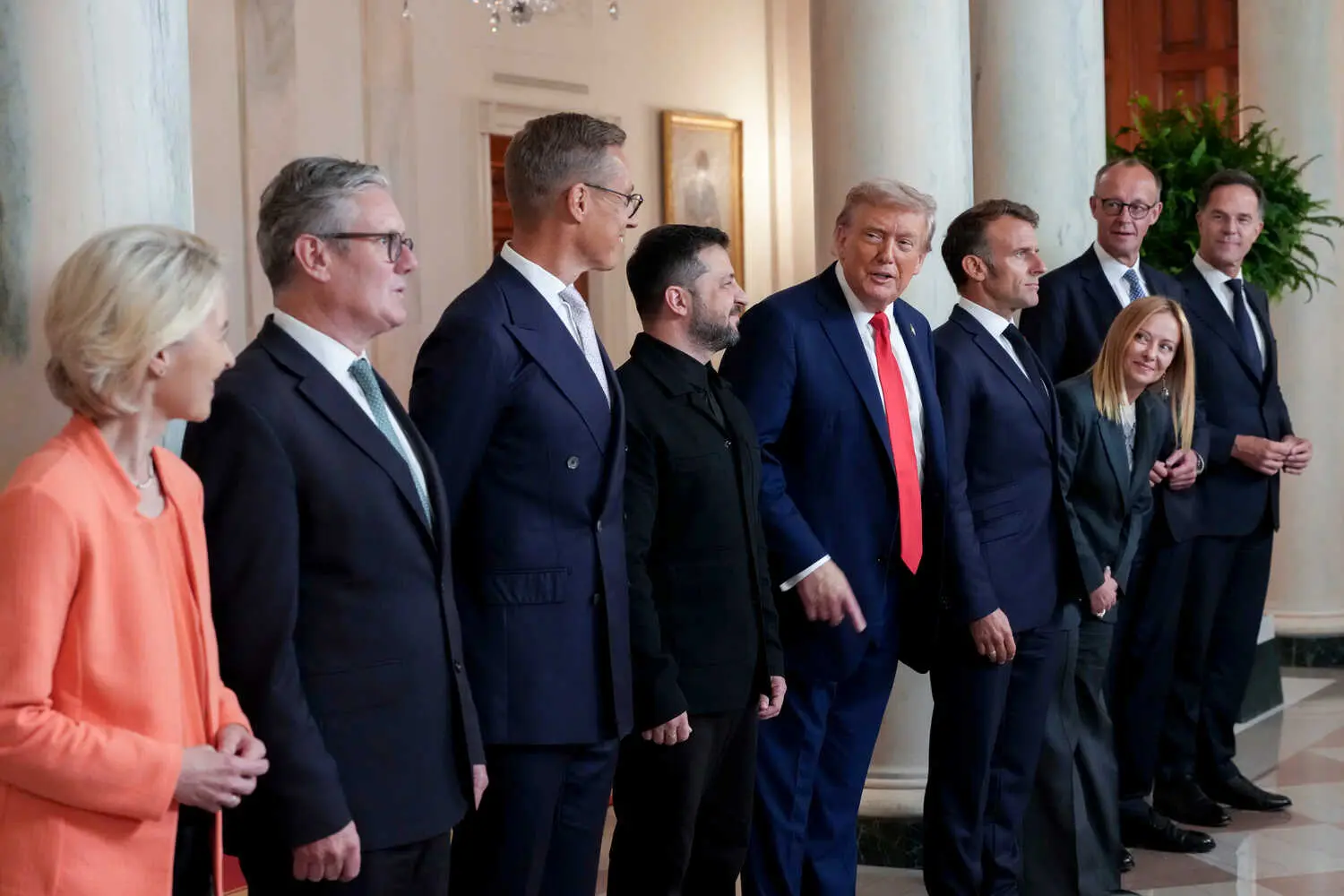
United States President Donald Trump said on Monday that “in one or two weeks” it will be possible to know if his diplomatic effort will be successful in ending the Ukraine war. The statement was given alongside Ukrainian President Volodimir Zelensky and six European leaders during a meeting at the White House, headquarters of the US government.
The meeting took place three days after Trump’s summit with Russian President Vladimir Putin, Alaska. According to the Republican, Moscow charges Kiev’s territorial concessions, but agrees to discuss safety guarantees for Ukraine in a possible peace agreement.
By gathering in Washington, Zelensky and the European leaders troop, Trump again posed by mediator. The meeting, however, revealed more political theater than substance, as the attacks on Russia had no time. The US leader made it clear: the “peace” he proposes requires territorial concessions by Ukraine, echoing the position of Kremlin. He also stated that his tactics that “may work, maybe not.”
Zelensky in humiliating position
Zelensky, who had already experienced moments of public embarrassment in February, returned to the White House as a supporting figure. His calculated smile and his attempt to flatter Trump showed the fragility of his position: a president who does not control the direction of war and depends on Washington’s goodwill to stand up.
Trump stated that he was willing to offer “good protection” to Ukraine, in partnership with European allies, in a model similar to article 5 of NATO, which provides for mutual defense between members. Asked about the possibility of sending troops -North American to the war, he said that “nothing is discarded.”
On the other hand, US President reiterated that an agreement would involve territorial exchanges, which would mean defeats for Kiev. Zelensky rejected formally discussing the theme, stating that he could only treat him in trilateral negotiations with Trump and Putin.
There was no point in the presence of European leaders alongside Zelensky-Emmanuel Macron (France), Friedrich Merz (Germany), Giorgia Meloni (Italy) and Alexander Stubb (Finland), as well as the president of the European Commission, Ursula Von Der Leyen, and OTA secretary general, Mark Rutte. They only served to reinforce the image of a dependent and insecure Europe, unable to impose themselves before the US agenda.
Subordinate Europe and aimless
The attempt to “process” Trump by the Europeans was evident. Fearful of being abandoned, they pressured for security guarantees similar to NATO Article 5, as if the US were to offer unlimited protection to Kiev. The result was a surface alignment, in which Europe again showed its inability to formulate its own strategy.
Macron even proposed a “European peace force,” the idea rejected by Moscow and impractical in reality. Merz, in a rare moment of divergence, spoke in immediate ceasefire-but was isolated. Collective submission to the American rhetoric reinforces the leadership crisis on the continent.
Meanwhile, Putin remains at the front of negotiations. By signaling the possibility of exchanging regions occupied in the north for definitive recognition in the east and crime, Kremlin maintained the coherence of its strategy: consolidating gains and ensuring Ukrainian neutrality.
The Russian proposal that circulates among diplomats also provides for Moscow’s control over much of the Donbas and the military neutrality of Ukraine – conditions that Kiev considers unacceptable.
Although Zelensky has reaffirmed that he will not accept assigning territories, his statement to the press confirmed that negotiations can start from the current front lines of the conflict, which extends for over a thousand kilometers.
From the Russian point of view, there is no news. Crimea has been a fait accompli for over a decade, Donbas continues under Moscow’s majority control and the front lines remain stable. Trump’s narrative that “Putin wants peace” only confirms what analysts already pointed out: Russia is in advantage and negotiates a position of superiority.
An unbalanced game
The meeting in Washington showed that the so-called “American peace” is actually a way to show Kiev its limitations. Trump acts as a central actor, Zelensky as embarrassed extra, and Europeans as an audience eager for relevance.
Moscow, in turn, remains firm in his strategy: he expects the Western political and military wear and tear to open space for the recognition of his influence on key territories. Ultimately, the outcome of negotiations does not depend on Zelensky, nor Macron or Ursula von der Leyen – but Trump’s willingness to accept the terms already placed by Putin.
Source: vermelho.org.br