Published 10/28/2025 15:33 | Edited 10/28/2025 15:50
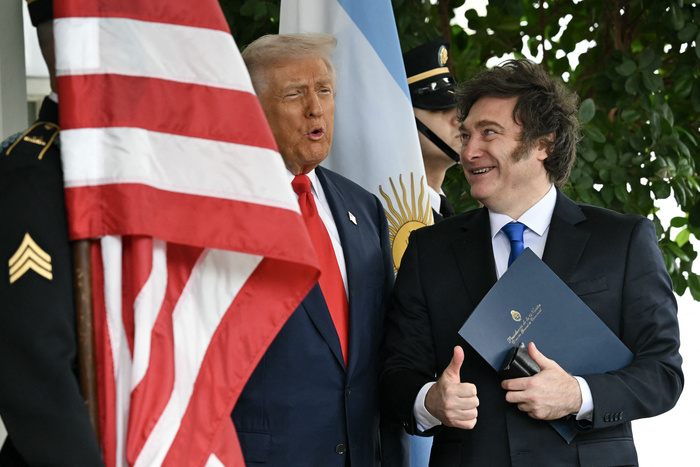
Former US President Donald Trump’s confession about Washington’s role in Javier Milei’s victory in the Argentine legislative elections caused astonishment among diplomats and political analysts.
In statements made during a trip to Asia, Trump stated that Milei had “a lot of help from us” to achieve victory and that the American government offered a US$40 billion rescue package, including a US$20 billion currency swap and equivalent investments in Argentine debt.
“He had a lot of help from us. A lot of help. I supported him strongly,” said Trump, who hailed the result as a “huge, unexpected victory” and praised his own team for having contributed to their ally’s success. The election result gives Milei a reinforced mandate to continue promoting his radical economic reform, despite popular discontent with austerity measures.
The speech reveals what specialist James N. Green, professor at Brown University and Brazilianist, defines as an advance in the North American willingness to directly interfere in South American electoral processes.
Read also: Trump’s rescue plan for Milei provokes global reaction: “financial imperialism”
Delegation in Washington warns about risks to democracy in Brazil
US Senator wants to approve resolution in support of Brazilian democracy
USA is at risk of repeating tragic mistake of 1964, says Brazilianist
Warning signal for Brazil

In an interview with Red Portalthe historian specialized in Latin American studies at Brown University (USA), stated that Trump’s statements sound like an “important warning for Brazil”, which will have presidential elections in 2026. According to him, the Republican shows growing interest in the region, and the possibility of North American interference in future elections cannot be ruled out.
“With the elections in Argentina, the threats to Venezuela and Colombia, it is clear that Trump has increased his interest in South America. It is a warning sign for anyone who is worried about the 2026 elections,” said Green.
For the Brazilianist, cooperation between Latin American democracies will be essential to contain any attempt at political or economic manipulation by Washington.
“The democratic forces allied with Brazil, academics and citizens living in the United States, we all need to work together to denounce and pressure against any electoral interference,” he warned. Green was an important coordinator of the group of friends of Brazil, in Washington, before the 2022 elections, when he sought support from progressive North American sectors for a clean electoral process, which would guarantee full democracy in Brazil, which had been suffering attacks from Bolsonarism.
Direct and indirect interference risks
James N. Green describes two possible paths for future US interference in Brazil under Trump: clandestine financing actions and public economic pressure.
“Trump could act clandestinely, financing the opposition with technological resources and behind-the-scenes support through the CIA. Publicly, he could threaten Brazil with tariffs or sanctions, to strengthen the extreme right,” he explained. Green notes, however, that this strategy articulated by Eduardo Bolsonaro, directly from Washington, had the opposite result to what was expected. Brazilians viewed the external interference with indignation and opened a strong margin of support for the Lula government.
These strategies, according to him, resemble classic actions from the Cold War, when Washington acted to shape governments aligned with its geopolitical interests. The difference is that now the interference occurs without disguise, in the name of “defending freedom and the free market”.
Economic and strategic interests
Trump’s support for Milei is not limited to ideological affinity. The North American aid package was designed to protect investments and guarantee access to strategic minerals — such as lithium, essential to the technology industry. Washington signed a memorandum of cooperation with Buenos Aires on critical minerals, aiming to reduce China’s dependence on the global production of inputs for batteries and semiconductors.
In addition to commercial interest, analysts see the American stance as an attempt to reconfigure its political influence in the region, weakening progressive governments and bringing together right-wing ideological allies.
The dispute for influence on the continent
For Green, South America is once again a field of dispute between powers, with the United States acting in an increasingly open manner.
Trump sees the continent as the USA’s natural zone of influence. He wants to contain China and keep governments ideologically aligned. This threatens the democratic sovereignty of the region.
The public celebration of Milei’s victory by Trump and his Treasury Secretary, Scott Bessent, reinforces this strategy. Both stated that Argentina now represents “a model of freedom and free enterprise” and that Washington intends to expand the partnership.
The democratic challenge of 2026
The Argentine case reignites the debate about the vulnerability of South American democracies in the face of external interference. In Brazil, the prospect of a new Lula candidacy in 2026 — and a possible alignment of the Brazilian right — raises concern among experts.
Green’s warning points to the perception that it is time to strengthen electoral institutions and transparency. South America needs to learn from the Argentine experience: there is no neutrality when the interests of foreign powers are at stake.
For James N. Green, Trump’s admission about helping Milei shows that the US has once again acted without disguise in South America — and Brazil must prepare to resist.
Source: vermelho.org.br