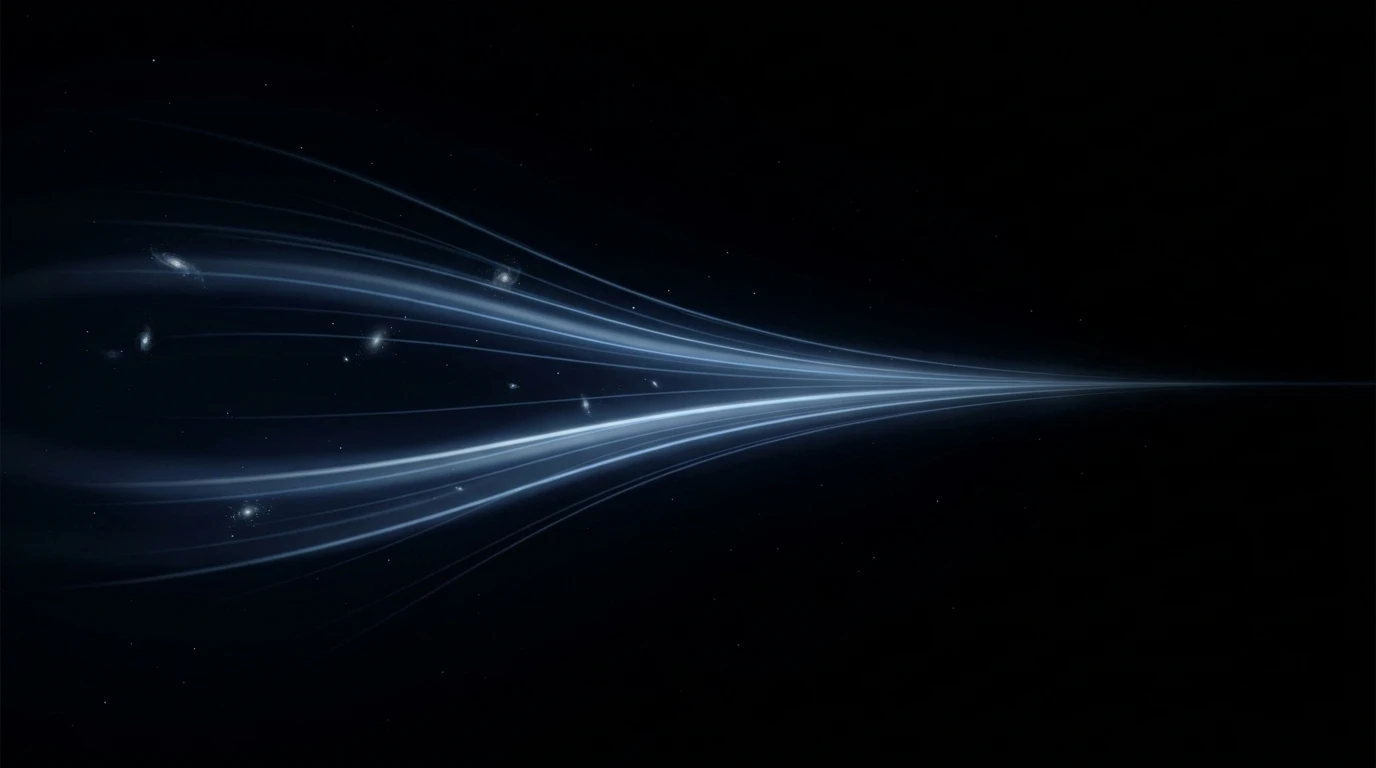
For decades, astronomers have worked to understand how galaxies move through the universe. The standard picture is relatively straightforward. The universe has been expanding since the Big Bang, and galaxies are generally carried along with that expansion. Gravity then adds local motions, pulling galaxies toward massive structures such as galaxy clusters and superclusters.
Yet in the early years of the 21st century, scientists uncovered evidence suggesting that something unusual might be happening on an enormous scale. Vast groups of galaxy clusters appeared to be moving together in the same direction, as if being pulled by an invisible force far beyond the observable universe.
This phenomenon became known as the “Dark Flow.”
The idea immediately captured the attention of cosmologists and the public alike. If real, dark flow could point to structures existing beyond the limits of what we can see. It could challenge some assumptions about the universe’s large-scale behavior and perhaps even provide clues about what lies beyond the observable cosmos.
Years later, however, the mystery remains unresolved. Some researchers argue that dark flow is a genuine cosmic phenomenon. Others believe it may be the result of statistical noise, measurement errors, or limitations in the available data.
What exactly is dark flow, how was it discovered, and why does it continue to generate debate among scientists?
🔭 Understanding Motion in the Universe
To appreciate the significance of dark flow, it helps to understand how astronomers measure motion in space.
The universe is expanding. This expansion causes distant galaxies to move away from us. The farther away a galaxy is, the faster it appears to recede. This relationship is described by the famous Hubble-Lemaître Law.
However, galaxies do not simply drift passively with cosmic expansion. They also possess what scientists call “peculiar velocities.” These are motions caused by local gravitational influences.
Imagine leaves floating down a river. The river’s current represents the expansion of the universe. The leaves themselves may swirl, drift sideways, or move around obstacles. Those additional movements are similar to peculiar velocities.
Large concentrations of matter generate gravitational attraction. Galaxy clusters can pull neighboring structures toward them. As a result, galaxies often exhibit motions that differ slightly from what would be expected from expansion alone.
Astronomers have long studied these peculiar motions because they reveal where mass is distributed throughout the universe, including matter that cannot be seen directly.
🌠 The Discovery That Sparked the Debate
The dark flow hypothesis emerged from research led by astrophysicist Michael Kashlinsky and colleagues.
The team analyzed data from observations of galaxy clusters spread across vast cosmic distances. Their work focused on measurements of the Cosmic Microwave Background, often abbreviated as the CMB.
The CMB is the faint afterglow of the Big Bang. It fills the entire universe and provides a snapshot of conditions roughly 380,000 years after the universe began.
Scientists can use subtle distortions in this ancient radiation to investigate the motion of galaxy clusters. One particularly important effect is known as the kinematic Sunyaev-Zel’dovich effect.
When cosmic microwave background photons pass through hot gas inside a moving galaxy cluster, their energy can be altered slightly. By measuring these tiny changes, researchers can estimate the cluster’s motion relative to the cosmic background.
Using this approach, Kashlinsky’s team reported something remarkable.
Hundreds of galaxy clusters appeared to be moving in a common direction at speeds reaching hundreds of kilometers per second. More strikingly, the motion seemed coherent across immense distances spanning billions of light-years.
Rather than moving randomly according to local gravitational influences, these clusters appeared to be participating in a giant cosmic flow.
The researchers named this phenomenon “dark flow.”
🧭 Why the Findings Were So Surprising
The proposed motion was surprising because it extended across regions of space that should not strongly influence one another.
According to standard cosmological models, the universe becomes increasingly uniform at larger scales. Local structures create local motions, but on extremely large scales, those effects should average out.
Dark flow seemed to suggest the opposite.
If galaxy clusters separated by billions of light-years were moving together, some enormous gravitational influence might be affecting them all simultaneously.
The most provocative possibility was that the source of this influence existed beyond the observable universe.
Because light travels at a finite speed, there is a limit to how much of the universe humans can observe. The observable universe contains everything whose light has had time to reach us since the Big Bang.
Beyond that horizon, there may be far more cosmos than we can ever directly see.
Dark flow appeared to hint that hidden regions outside our observable boundary might still exert gravitational effects on visible structures.
Such a possibility fascinated scientists because it touched on one of cosmology’s deepest questions: Is the observable universe merely a small portion of a much larger reality?
🌍 What Lies Beyond the Observable Universe?
The concept of something beyond the observable universe can sound mysterious, but it is actually a natural consequence of modern cosmology.
The observable universe is not necessarily the entire universe. It is simply the region from which light has had enough time to reach Earth.
Many cosmologists believe the full universe extends far beyond that limit.
If this is true, enormous structures may exist outside our observational horizon. Massive concentrations of matter could potentially influence regions we can see.
Supporters of the dark flow hypothesis suggested that these unseen structures might explain the coherent motion of galaxy clusters.
In this scenario, dark flow would serve as indirect evidence for cosmic regions forever hidden from direct observation.
Such a discovery would have profound implications.
It could provide insights into the universe’s earliest moments, the distribution of matter on unimaginable scales, and the possibility that our visible cosmos is only a small fragment of a much larger whole.
🌀 The Role of Cosmic Inflation
Dark flow also became linked to discussions about cosmic inflation.
Inflation is a leading theory describing what happened immediately after the Big Bang. According to this idea, the universe underwent an extraordinarily rapid expansion during a tiny fraction of a second.
This explosive growth stretched space itself and helped create the large-scale uniformity observed today.
Some versions of inflation suggest that our observable universe may be one region within a vastly larger cosmic structure. In certain models, multiple regions with different properties could exist beyond our horizon.
Because dark flow appeared to indicate influences originating outside the observable universe, some researchers wondered whether it might offer evidence supporting aspects of inflationary theory.
Although these connections remained speculative, they added another layer of excitement to the debate.
Dark flow was no longer merely a question about galaxy motions. It became tied to fundamental questions about the origin and structure of the cosmos.
📡 How Scientists Tried to Verify the Phenomenon
Extraordinary claims require extraordinary evidence.
Once the dark flow hypothesis gained attention, researchers around the world began examining the data independently.
Several teams sought to reproduce the original findings using alternative methods and newer observations.
One of the most important sources of information came from the European Space Agency’s Planck mission.
Planck produced the most detailed map of the cosmic microwave background ever created. Its measurements surpassed earlier observations in both sensitivity and precision.
Many scientists expected Planck to provide a definitive answer.
If dark flow were real, the mission should detect similar signals.
If not, the phenomenon might disappear under closer scrutiny.
The results, however, complicated the picture.
⚖️ Conflicting Evidence Emerges
When researchers analyzed Planck data, many studies failed to find convincing evidence for dark flow.
Some teams concluded that the observed signal was consistent with random fluctuations rather than a genuine large-scale motion.
Others argued that the original measurements may have been influenced by statistical uncertainties or challenges in separating weak signals from background noise.
These findings weakened confidence in the dark flow hypothesis.
Yet the story did not end there.
Supporters of dark flow maintained that the phenomenon remained detectable under certain analytical approaches. They argued that differences in methodology could explain why some studies found evidence while others did not.
As a result, the scientific community became divided.
The debate shifted from whether dark flow existed to whether the available data were sufficient to answer the question conclusively.
🔬 The Challenge of Measuring Tiny Signals
One reason the controversy persists is that the measurements involved are extraordinarily difficult.
The kinematic Sunyaev-Zel’dovich effect produces extremely subtle distortions in the cosmic microwave background.
Scientists must isolate these tiny signals from numerous competing sources of noise.
Instrument limitations, background radiation, astrophysical contamination, and statistical uncertainties can all affect the results.
Imagine trying to detect a whisper during a thunderstorm.
Even with sophisticated instruments and advanced mathematical techniques, extracting reliable information remains challenging.
Because the signals are so faint, different analysis methods can sometimes produce different conclusions.
This complexity explains why dark flow has remained controversial despite years of investigation.
🌌 Could Dark Flow Rewrite Cosmology?
If future observations confirm dark flow, the implications could be profound.
Current cosmological models assume that the universe is broadly homogeneous and isotropic on large scales. In simple terms, the cosmos should look roughly similar in every direction when viewed at sufficient distances.
A large-scale coherent flow extending across billions of light-years could challenge this assumption.
Scientists might need to revise their understanding of cosmic structure formation, gravitational influences, and the universe’s largest scales.
Some theories would gain support, while others might require modification.
Dark flow could even provide indirect clues about regions of space that can never be observed directly.
Such a discovery would rank among the most important developments in modern cosmology.
🚀 New Technologies May Provide Answers
Astronomy is entering a new era of precision observation.
Powerful telescopes, improved detectors, and advanced computational methods are enabling researchers to study the universe with unprecedented accuracy.
Future surveys may map galaxy motions across larger volumes of space than ever before.
These observations could help determine whether dark flow represents a genuine cosmic phenomenon or merely a statistical illusion.
Several next-generation projects are expected to improve measurements of large-scale structure, galaxy clustering, and cosmic background signals.
Artificial intelligence and machine learning techniques may also assist researchers in identifying subtle patterns hidden within enormous datasets.
As technology advances, scientists hope to obtain a clearer picture of cosmic motion.
🧠 What the Debate Reveals About Science
Regardless of whether dark flow ultimately proves real, the controversy highlights an important aspect of scientific progress.
Science advances through questioning, testing, and verification.
New ideas are proposed, challenged, refined, and sometimes discarded. Even exciting hypotheses must survive rigorous scrutiny before gaining widespread acceptance.
Dark flow demonstrates this process in action.
Researchers made an intriguing observation.
Other scientists examined the claim independently.
Additional evidence produced competing interpretations.
The debate continues because the available data have not yet settled the issue definitively.
Far from being a weakness, this process is one of science’s greatest strengths.
It ensures that conclusions rest on evidence rather than speculation.
🌟 The Continuing Mystery
More than a decade after dark flow entered the scientific spotlight, the mystery remains alive.
Some astronomers believe the evidence points toward a genuine large-scale cosmic motion.
Others view the phenomenon as a product of measurement limitations and statistical effects.
At present, there is no universal consensus.
What makes dark flow so compelling is that both possibilities are fascinating.
If the phenomenon is real, it could reveal hidden structures beyond the observable universe and reshape our understanding of cosmology.
If it is not real, the investigation still teaches valuable lessons about the challenges of measuring the cosmos and interpreting complex data.
Either outcome advances scientific knowledge.
🔮 Looking Toward the Future
The universe continues to surprise humanity.
Every generation of astronomers uncovers mysteries that challenge existing assumptions. Dark flow is one of the most intriguing examples of this tradition.
Future observations may eventually resolve the debate. More sensitive instruments, larger surveys, and innovative analytical techniques will provide new opportunities to test the hypothesis.
Until then, dark flow occupies a unique place in modern astronomy.
It sits at the intersection of observation, theory, and imagination.
It raises questions about the limits of the observable universe, the nature of cosmic structure, and the possibility that unseen regions of reality influence the cosmos we can measure.
Whether confirmed or disproven, the investigation into dark flow reminds us that the universe is still filled with unanswered questions.
And in science, unanswered questions often lead to the most exciting discoveries of all.