Published 11/26/2025 11:14 | Edited 11/26/2025 11:55
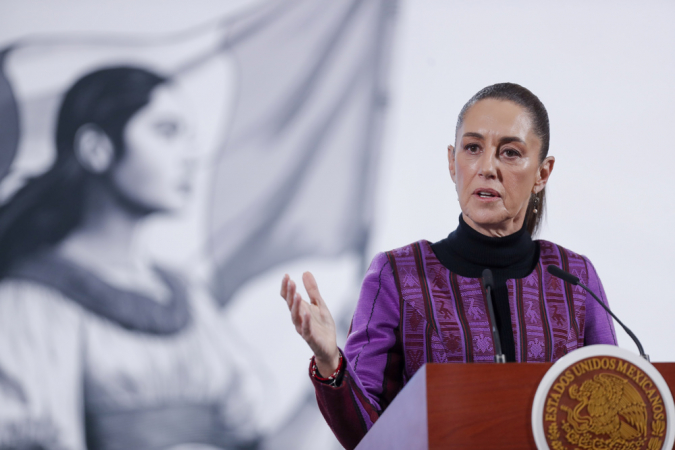
The President of Mexico, Claudia Sheinbaum, sent this Tuesday (25) to the Chamber of Deputies a package of reforms that amends at least 17 federal laws and reorganizes the entire state structure responsible for preventing, investigating and responding to cases of violence against women, girls, adolescents and children.
The initiative was presented on the International Day for the Elimination of Violence against Women, amid the launch of the 16-day day of activism, and marks the government’s broader movement to consolidate a unified national gender equality policy.
The shipment occurred simultaneously with the signing of a federative pact with all 32 governors, creating bases for the standardization of protocols in states and municipalities.
She stated that Mexican women “are not alone” and that the State has an obligation to act decisively to confront a phenomenon that she described as “systemic and structural”, a direct result of inequalities in power and deep-rooted stereotypes.
“Violence against women is not an isolated or individual fact. It is a systemic and structural phenomenon, deeply rooted in unequal power relations and the persistence of stereotypes that perpetuate the subordination of women”, he said at a press conference this Tuesday.
The package was distributed to legislative committees and includes changes to laws related to justice, education, labor, health, housing, social security, migration and social development policies.
The government considers that this agenda must go beyond the normative dimension and requires institutional, cultural and intergovernmental transformations.
For Sheinbaum, gender-based violence cannot continue to be treated as a set of isolated incidents, but rather as a large-scale national problem that requires coordinated responses.
In her assessment, “there must be a process of education, training and awareness so that any action of violence against women ceases to be customary and so that behaviors can be transformed.”
The government highlights that the package presented now complements constitutional initiatives already sent to Congress at the beginning of the mandate.
The president insisted that violence needs to be faced with policies “that eliminate normalized practices of violence in everyday life” and that incorporate the gender perspective as an axis of the Mexican State.
The initiative is seen internally as an institutional consolidation movement. The government is betting that, by associating the delivery with November 25th, it reinforces the symbolic nature of the package and expands the conditions for states and municipalities to move forward in updating their own legal frameworks.
The president also sought to link the reform to the commitments made internationally by Mexico in conventions on human rights and the protection of women.
Legislative package affects 32 states and provides for complete reorganization of the state apparatus
The government announced the National Commitment for Life, Happiness and Respect for Women, signed by Sheinbaum and governors of all federative units, with the aim of standardizing structures and accelerating investigations in cases of violence.
“Today we signed a commitment from all governors to support and defend women, say that they are not alone and make a commitment to ratify all laws in each entity of the Republic,” said Sheinbaum.
The document establishes ten priority actions to guide the actions of the authorities and includes everything from the approval of the criminal type of sexual abuse and harassment to the creation of new prevention mechanisms in schools, hospitals, social services and security forces.
The pact is based on the assessment that current fragmentation compromises the effectiveness of public policies. The president classified the effort as a necessary response to the persistence of inequality in all spheres of public life.
In her words, “violence against women originates from inequalities in power and deep-rooted stereotypes”, which requires simultaneously legal and cultural actions.
The government argues that combating violence must be a State policy, with shared responsibilities and unified protocols. Sheinbaum announced that the expectation is to complete the national approval of the definitions of abuse and harassment this year, ensuring consistency between federal and state codes.
Hernández stated that the country needs a coordinated structure to respond in an equivalent manner throughout the territory. He said that “we are building a national system that allows us to face violence with the same force in all states of the country” and that “coordination between the Federation and states is essential so that no woman finds different responses depending on where she lives”.
The secretary defended the standardization of procedures throughout the state apparatus and stated that “we want unified protocols and for all institutions to know what to do from the first moment a woman reports violence”.
The pact also provides for permanent coordination with schools, universities, hospitals, companies and social programs, in an attempt to expand prevention and care networks.
The government argues that combating violence requires coordinated action between different areas of public power and cannot be restricted to the field of security or justice.
For Sheinbaum, incorporating measures in areas such as work, housing and education is essential to reduce structural vulnerabilities.
The document aims to create accountability mechanisms that involve everything from data production to monitoring cases of sexual torture, vicarious violence and digital violence.
The government is betting on interinstitutional coordination and integration of information as a way to prevent complaints from being lost between different state bodies. The president declared that she expects states to review their Constitutions and penal systems to incorporate a gender perspective.
Women’s Secretariat takes over national command and replaces previous body
The reform transfers powers from the Governance Secretariat to the Women’s Secretariat, created at the beginning of the government, and transforms the body into the central axis of the policy for combating violence.
The new structure will now direct the National System to Prevent, Respond, Sanction and Eradicate Violence against Women, replacing the National Commission dedicated to the topic. The change reaffirms the government’s intention to consolidate an exclusive and specialized body in coordinating national policies.
The Women’s Secretariat will be responsible for issuing gender alerts, managing the National Database on violence against women, coordinating sexual torture protocols and supervising the installation and operation of justice centers.
Sheinbaum stated that it is necessary to “incorporate the gender perspective into the Constitutions of the 32 states” and ensure that equal pay and the right to a life free from violence receive uniform treatment. For her, legislative updating in federative entities is an essential part of national policy.
The package also changes the way the State collects information on violence and assistance in two of the country’s main social security systems: the IMSS, which is the Mexican Institute of Social Security and serves the majority of private sector workers, and the ISSSTE, the Institute of Security and Social Services for State Workers, responsible for public servants.
The two institutions will be required to record more detailed data — including gender, age, ethnic origin and disability status — to allow the government to identify specific vulnerabilities and accurately assess how violence and inequalities affect different groups in the population.
This measure, according to the government, will identify inequalities in access to health and social security and guide prevention and care policies. In the labor field, the reform obliges the State to eliminate the gender wage gap and establishes that, under equal working hours and job conditions, the salary must be the same.
Even with the scope of the changes, a transitional article determines that none of the actions can generate an increase in spending in 2025 and 2026. This has provoked internal debate, but the government states that the adaptations must be made with resources already authorized.
The expectation is that the integration between agencies and the standardization of procedures will help to optimize the execution of policies.
Child protection, inclusive education and combating structural inequalities
The reform also strengthens the protection of girls, boys and adolescents and redefines public administration obligations in areas such as education, health and social assistance.
The new standards determine that schools, hospitals and public services adopt discrimination-free services, with specific measures for vulnerable situations.
The government emphasizes that children and adolescents are among the groups most affected by gender inequality and that universal policies have not been sufficient to respond to the needs of this population.
The proposal includes guidelines to eliminate structural barriers that affect girls in schools and universities, with special attention to migration, indigenous and poverty contexts.
The reform also prioritizes female heads of households and victims of violence in housing programs, requiring that all instruments be designed with a gender perspective.
In the field of social development, the package provides for exemption from payments for users in situations of poverty and determines the transversality of the gender perspective in the planning and evaluation of federal policies.
In health and social security, changes require data collection, allowing the assessment of inequalities in access. The government argues that, without robust data, it is impossible to measure the differential impact of policies on women, girls and adolescents.
The reform also includes protocols to prevent obstetric violence, described by Sheinbaum as a situation in which women face mistreatment and disrespect during childbirth and other medical care.
In the field of migration, the package determines reinforced duties for authorities who work with women and girls on the move, with a requirement that administrative decisions incorporate a gender perspective.
The government assesses that, without this approach, migrant women remain exposed to institutional and social violence. For Sheinbaum, integrated policies are necessary to ensure that the country consistently confronts the inequalities that structure violence.
Source: vermelho.org.br