Published 10/21/2025 11:22 | Edited 10/21/2025 11:44
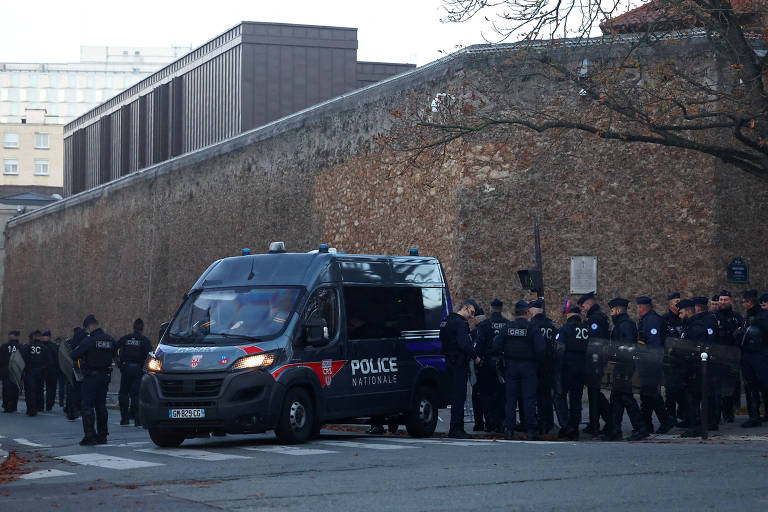
Former French president Nicolas Sarkozy, 70, began serving a five-year prison sentence this Tuesday (21) at La Santé penitentiary in Paris, after being convicted of criminal association in the case of illegal financing of his 2007 presidential campaign with resources from the Libyan regime of Muammar Gaddafi.
The decision, considered historic, makes Sarkozy the first former French head of state since the Second World War to be imprisoned, and the first in the European Union to serve a sentence for corruption linked to the presidency.
The former president arrived at the prison at around 9:30 am, accompanied by his wife, Carla Bruni, to the applause of supporters who sang the French national anthem.
Before entering the penitentiary, he published a message on network
Convicted at the end of September, Sarkozy was considered responsible for allowing his closest collaborators to seek financial support from the Gaddafi regime.
The court highlighted the “exceptional seriousness of the facts”, committed by a politician who “aspired to the highest function of the Republic”. The sentence also imposed a fine of €100,000 and a temporary ban on holding public office.
The former president denies the accusations, alleges political persecution and has already submitted a request for provisional release, which should be judged in the coming weeks.
Sarkozy will occupy a 9 square meter cell in the isolation wing, where he has no contact with other inmates. According to the Ministry of Justice, the cell does not represent a privilege, but a security measure.
The former president has a bed, table, shower, towels, dishes and toilet paper, with the right to three visits per week, use of a landline telephone and one hour of sunbathing per day.
He carries three books with him, including The Count of Monte Cristoby Alexandre Dumas — a novel about a man unjustly imprisoned — and revealed that he intends to write about his experience in prison.
Political repercussion and debate on judicial independence
The arrest divided French politics and reached the Élysée Palace itself. The newspaper Libération revealed that President Emmanuel Macron received Sarkozy on Friday (17) in an audience outside the official agenda, an event that caused a strong repercussion.
On a visit to Slovenia, Macron confirmed the meeting. “It is normal, from a human perspective, that I receive one of my predecessors. But I reaffirm my respect for the independence of the Judiciary,” he said.
The speech attempted to contain criticism from the opposition and the legal community, who saw the visit as an inopportune political gesture.
Justice Minister Gérald Darmanin, a former pupil of Sarkozy, also announced his intention to visit him in prison. “I have the right to visit any detainee,” he said.
The French left reacted to the government’s gesture of solidarity with Sarkozy, pointing out a contradiction between the speech of equality before the law and Macron’s proximity to a convicted politician.
Crisis of confidence and historical significance
Sarkozy’s arrest deepens the crisis of trust between French institutions and society. The former president remains influential among sectors of the right and tries to present himself as a victim of “politicized justice”, a speech that resonates with part of the conservative electorate.
For progressive sectors, the episode is a belated demonstration that French justice is beginning to reach the highest levels of power.
French analysts interviewed by the country’s press see the conviction as a watershed in the fight against political corruption in France and a test for the credibility of the republican state.
It is also a warning about the spread of political resentment: figures such as Marine Le Pen, who is also appealing a conviction for embezzling funds from the European Parliament, use the case to attack the judicial system and reinforce their rhetoric of persecution.
At the same time, the Sarkozy case reflects a shift in the European paradigm: the notion that former heads of state can face criminal charges in consolidated democratic regimes.
The image of a former president entering a prison in central Paris, amidst cameras and applause, summarizes a scene of rupture — the fall of a man who symbolized French neoliberal power and now becomes a mirror of the contradictions of the Fifth Republic.
Source: vermelho.org.br