Published 09/23/2025 16:16 | Edited 09/24/2025 08:05
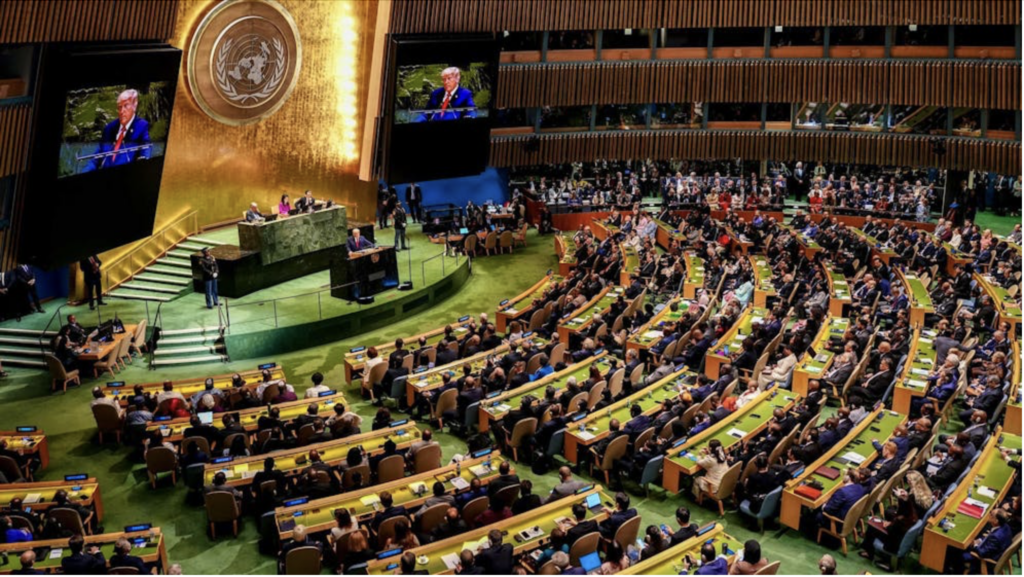
In a discourse marked by Ufanism, attacks on opponents (and allies) and personal anecdotes, Donald Trump presented himself to the UN General Assembly as the architect of a new American “era” and the international conflict peacemaker. However, a critical analysis of his allegations reveals a profound abyss between triumphalist rhetoric and complexity – and often the aggravation – of the global crises he claims to have resolved.
The fallacy of the “seven unfinished wars”
Trump’s most bombastic allegation was ending “seven flamboyant wars” in seven months. He cited conflicts such as Pakistan and India, Israel and Iran, and Armenia and Azerbaijan, among others. However, international relations experts question the truth and depth of these successes.
Many of the conflicts mentioned were not in a state of open and massive “war” as suggested. Others, such as Entre Israel and Iran, saw a dramatic climb during their previous management and culminated in the operation “Midnight Hammer”, which Trump himself proudly described: “Seven American B-2 bombers released pumps of 30,000 pounds each on Iran’s main nuclear facilities, totally obliterating everything”.
In fact, the action, far from “ending” a conflict in a diplomatic way, was an act of war of mass destruction, a unilateral aggression that exponentially increased tension in the region, creating a dangerous precedent and leaving a legacy of instability. The claim of pacification sounds, therefore, as an euphemism for a policy of maximum coercion.
From then on, Iran that had never proven uranium enrichment for military purposes, should rethink the theme and accelerate the search for nuclear weapons, as it felt vulnerable to attacks.
Middle East: From unconditional support to the obstacle to peace
The contradiction in the role of “Peace” is even more evident in analyzing his posture in the Middle East. Trump devoted part of the speech to the conflict in Gaza, but his narrative is unilateral. By stating that “Hamas repeatedly rejected reasonable proposals of peace” and condemn any recognition of the Palestinian State as a “reward to terrorism,” he completely exempts Israel of any responsibility for the humanitarian and genocide crisis.
“Some here in this body are trying to unilaterally recognize a Palestinian state. This would be too big for Hamas terrorists for their atrocities.” The phrase demonstrates how he sees diplomatic concessions as a “reward for terror”, solidifying his unconditional alignment to Israel and acting as a blocker, not a facilitator, of a negotiated solution.
This position ignores the context of decades of occupation and the policy of settlement, as well as minimizing the role of the US as the greatest military financier of Israel, support that many international bodies and human rights advocates point to the perpetuation of conflict and the conditions described as genocide by UN experts. Trump’s rhetoric is not mediation, but of unconditional endorsement to one party, making it an obstacle, not a facilitator, of peace.
Latin America in the target: militarization and the threat to Venezuela
Another pillar of the New Trumpist Order is the opening of a tension front in Latin America. Trump nominally cited the Venezuelan cartel Tren de Aragua and the government of Nicolás Maduro, promising a direct military combat. His threat was clear and blunt: “To all terrorists who smuggle poisonous drugs to the United States, be warned: we will erase them from existence.”
This language signals a potential direct military intervention or high impact operations in the region, under the justification for combating drug trafficking. For analysts, such an approach simplifies a complex problem (drug trafficking is a matter of internal demand in the US and transnational corruption) and risks climbing geopolitical tensions, threatening the sovereignty of Latin American nations and potentially generating more instability and migratory flows-the opposite than Trump says.
Military intervention hints in Brazil, coming from members of government, cannot be ignored. Even if inconsequential, it does not fail to create a tense climate with a fundamental ally on the continent. The justifications for sanctions and tariff against Brazilians and their democratic institutions range from punishment to Jair Bolsonaro to Lula’s preferred alliance with Brics.
The UN as a scapegoat and the narrative of the “strong leadership”
Throughout the speech, Trump has used the UN as a mirror to design his own image of efficiency. He criticized the organization for his supposed inaction, ironically citing a broken escalator and the teleprrompter that failed as examples of his incompetence. This strategy serves a double purpose: delegitimizing multilateralism – which by definition requires dialogue and concession – and valuing its own figure as a unilateral and decisive action leader.
“It is a pity that I had to do these things instead of the United Nations. And unfortunately, in all cases, the United Nations have not even tried to help any of them.” It also completed the reasoning with the anecdotal criticism and scarcely to the UN building: “Everything I received from the United Nations was a escalator that, on the way up, stopped in the middle.”
This posture, however, is seen as cynical. In disregarding the multilateral forum par excellence, Trump denies the complexity of global governance. Its solutions, based on threats, tariffs and military power, are presented as simple antidotes for deep problems, an approach that many fear being incendiary and long -term counterproductive.
The belief that coercive economic pressure (not diplomacy) is the primary tool for resolving international conflicts reflects a transactional view of gross power on nations relations. “If Russia is not ready to agree to end the war, then the United States is fully prepared to impose a very strong round of powerful tariffs that, I believe, would end the bloodshed very quickly.”
The cost of cynicism
Trump’s speech on the UN was not a script for international cooperation, but a manifesto of “America First” [Os EUA primeiro] invigorated and aggressive. The self -image of “Peacemaker” is built on the moved sand of exaggerated allegations, unilateral military actions and unconditional support for allies in asymmetrical conflicts.
Still on the case of Russia, Trump explains that “for these tariffs to be effective, the European nations – all of you gathered here now – would have to join us… and Europe needs to take your responsibility. They can’t keep doing what they are doing.” With this phrase, he reaffirms the leadership style that charges unconditional alignment, even allies, under implicit threat. The phrase shows the lack of horizontal collaboration, replaced by a demand for obedience within an international order commanded by the US.
These phrases are not just rhetoric; They are the operational essence of Trump’s worldview – a cynical, bellicose and deeply disconnected view of international cooperation mechanisms.
While he celebrates the supposed end of distant wars, his policies light up new musts in the Middle East and Latin America. The distance between rhetoric and reality exposes not the strength of a peacemaker, but the cynicism of a strategy that, under the varnish of effectiveness, promises to deepen divisions and expand the crises that claims to be resolved. The real legacy – it is necessary to make the warning – can be a more polarized and dangerous world, where diplomacy is replaced by threat and brute force is sold as the only solution.
Source: vermelho.org.br