Published 10/09/2025 12:20 | Edited 10/09/2025 12:36
The president of the European Commission, Ursula von der Leyen, said on Wednesday (10) that the European Union will adopt punitive measures against the government of Israel before the offensive in Gaza.
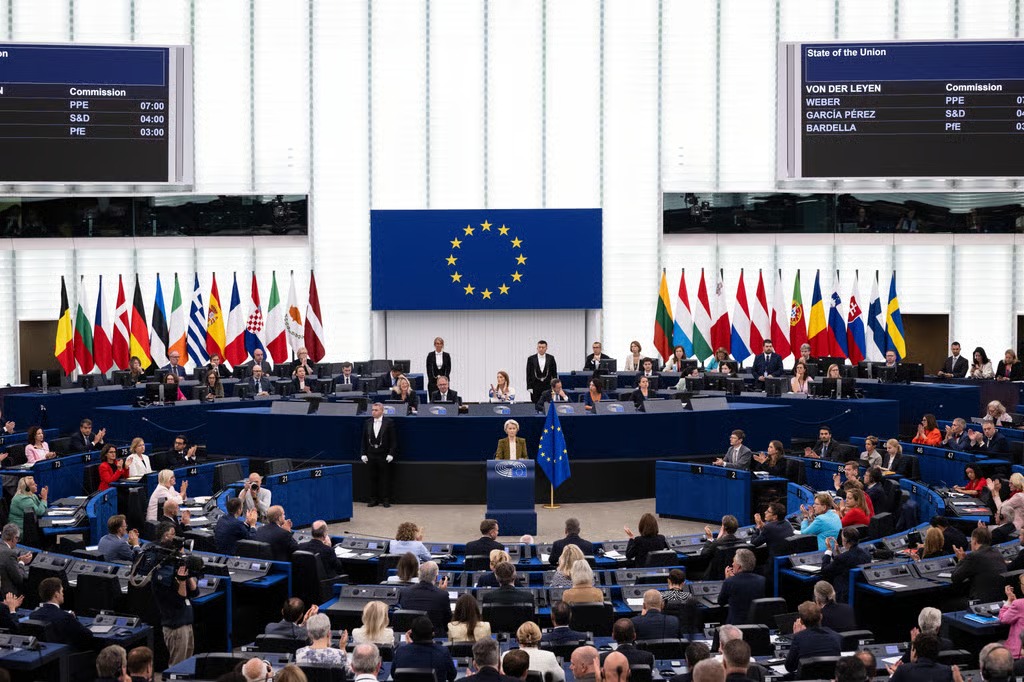
In a speech in the Parliament of the European Union in Strasbourg, she classified the situation at the Palestinian enclave as “catastrophic” and stated that “what is happening in Gaza is unacceptable.”
The proposal includes sanctions against extremist ministers and settlers, suspension of bilateral payments and even the partial stoppage of the Brussels and Tel Aviv Commercial Association Agreement.
The European Commission’s turn, after months of inertia, generated a strong reaction in the plenary and revealed the political division within the bloc. Left and center left parliamentarians applauded the measurements, some wearing red in solidarity with the Palestinian people.
Already MEPs of the far right, as members of the German AFD, reacted with protests and boos.
Outside Parliament, the repercussion was immediate in Tel Aviv. Israeli Chancellor Gideon Sa’ar used the old Zionist rhetoric and accused von der Leyen of echoing “the propaganda of Hamas and his partners” and said the statements were “unfortunate” and “contrary to the spirit of partnership between Israel and Europe.”
Von der Leyen stated that the commission will propose sanctions against figures such as Itamar Ben-Gvir and Bezalel Smotrich, extreme right Israeli ministers who incite violence against Palestinians.
He also promised to freeze the Union’s financial support to Israel, preserving only the transfers for civil society and the Yad Vashem Holocaust Museum. In addition, he announced his intention to suspend the commercial parties of the EU and Israel association agreement, which guarantees preferential access to European markets.
The measure, if implemented, would directly affect the Israeli economy: by 2024, the Union accounted for 32% of Israel’s foreign trade, moving 26.7 billion in exports of machinery, chemicals and transport equipment.
Proposals, however, must face resistance within the block. Countries such as Spain and Ireland have been defending economic restrictions for months and even arms embargo against Israel, but other capitals, such as Germany, Hungary, Poland, Austria and Tchéquia, are aligned with Tel Aviv.
Von der Leyen acknowledged that the absence of consensus “feeds public anger” and defended the end of unanimity in union foreign policy decisions in an attempt to accelerate measures in crisis situations.
For part of the European left, however, the initiatives are late. Socialist Iratxe García Pérez stated that the proposal is “very little, very late” and harshly criticized the committee’s recent commercial agreement with Donald Trump, which called “abuse of power” and “attempt to bury European strategic autonomy under a golf course.”
In addition to Gaza, the speech also aimed the war in Ukraine. Von der Leyen defended new sanctions against Moscow, classified as “reckless and unprecedented” Russian drone violations in Poland airspace and guaranteed “full solidarity” to Warsaw.
It also announced the preparation of the 19th Package of Sanctions against Russia, including the parallel fleet block used to carry oil and measures against countries that help Moscow circumvent restrictions.
The commission works on a proposal to use interest of € 300 billion in frozen Russian assets in the West as the basis for a “repair loan” to Ukraine. He also promised to summon an international summit to coordinate the return of Ukrainian children kidnapped by Russian troops.
In the political balance, the speech was marked by an attempt to recover ground after months of wear. Von der Leyen received intense criticism during the European summer, both for passivity against the massacre in Gaza and the deal with Trump.
She sought to wave on the left with social commitments, promising a poverty eradication strategy by 2050 and reiterating the union’s climate goal. He also mentioned initiatives to regulate the use of social networks by children, inspired by the Australian model.
Even so, it faced hostility of the far right in Parliament, which has flowed it when dealing with vaccination and combating misinformation.
The hardening of the discourse against Israel, however, was the central point of the pronouncement. Von der Leyen spoke of “hunger caused by man” and said that “by humanity, it needs to stop.” The gesture reinforces the pressure of social movements and European governments that require concrete measures in the face of genocide allegations in Gaza.
But in the face of Israel’s economic weight and the lack of internal consensus, doubt remains whether the proposals will be able to become effective decisions of the European Union.
Source: vermelho.org.br