Published 10/09/2025 10:06 | Edited 10/09/2025 10:50
Poland said on Wednesday (10), driving drones that violated their airspace during a massive Russian air strike against Ukraine, in the first episode in which an NATO member triggers directly in the context of the war.
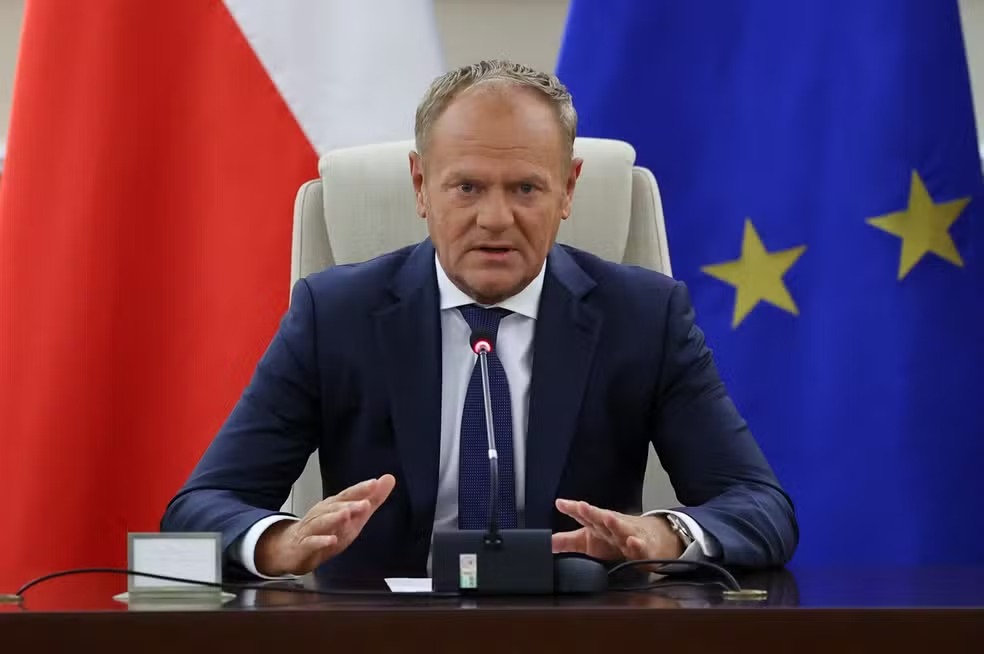
Prime Minister Donald Tusk classified the action as “large-scale provocation” and invoked Article 4 of the Alliance Treaty, a mechanism that provides for consultations between allies in the face of security threats.
The Polish gesture, celebrated by European leaders as a demonstration of firmness, accentuated fears that war expands beyond Ukrainian borders.
In speaking in Parliament, Tusk stated that it was “the closest to a conflict open since World War II.”
He said, however, he did not believe that the country is “on the brink,” although he has warned that “the situation is serious, and no one doubts that we should prepare for various scenarios.”
The Armed Forces of Poland reported that they detected 19 aerial raids in seven hours and slaughtered at least three drones. Chief of staff, General Wieslaw Kukula, called the episode “act of aggression that represented real threat to the security of our citizens.”
The answer involved P-16 Polish fighters, F-35 Dutch, Italian espionage aircraft and a Holland tank plane.
Radars Patriot from Germany helped identify targets, according to a military statement. At dawn, the airspace was closed in four airports, including both of the capital, Warsaw.
Chopin airport resumed flights in the morning, but warned that delays would persist throughout the day. Popular received emergency messages on cell phones guiding to report drill wreckage and not to approach.
The remains of shrewd aircraft were found in seven regions, as well as fragments of an unidentified missile, which military personnel suggested being Ukrainian air defense.
In Lublin, residents reported being awakened by the noise of fighters at dawn. For Tusk, “the fact that these drones have been knocked down changes the political situation” and requires the country to prepare for “various scenarios.”
Moscow denies attack and speaks of dialogue
Russia has rejected Polish accusations and denied any liability for drones in NATO’s airspace. The Ministry of Defense, Andrey Belousov, said the targets of the operation were “industrial facilities in western Ukraine” and that “drones have no reach to penetrate such a background in Polish territory.”
He said he was available to talk to his neighbors about the episode. The Russian business officer in Warsaw, Andrei Ordach, called by the local government, stated that “the drones came from Ukraine,” echoing the official version of Moscow.
The speech was reinforced by Belarus, who claimed to have alerted Poland over drones out of the route due to electronic war interference.
Belarusian-Chief of Staff General Pavel Muraveiko said part of the aircraft was intercepted by defenses in the country and that “communications with Poland are part of a regular aerial protocol.”
By putting themselves as actors willing to the dialogue, Moscow and Minsk tried to contain the warmth that marked European rhetorical.
The European choir and the shadow of the third war
The European Union and the main leaders of NATO reacted in a tone of seriousness. Block’s head of diplomacy, Kaja Kallas, considered the episode “the most serious violation of European airspace for Russia since 2022” and said “evidence suggests that it was intentional, not accidental.”
The president of the European Commission, Ursula von der Leyen, has called for more sanctions against Moscow and announced that the bloc prepares measures against oil tankers and the shadow fleet and countries that buy Russian oil.
French President Emmanuel Macron said the raid was “simply unacceptable,” while Briton Keir Stmerer and leaders from Finland and the Netherlands repeated the conviction.
Alied near Moscow, Hungary Prime Minister Viktor Orbán stated that “violation of sovereignty is unacceptable.” Slovak prime Minister Robert I stay, partially detached by asking for caution: “It is necessary to establish whether it was intentional or accidental, and who controlled the drones.”
The explicit fear is that the incident leads to an unwanted climb that could result in direct shock between Russia and NATA. American parliamentarians even spoke of “World War Third” on Tuesday night (9).
Analysts heard by the European press suggested that the high number of diverted drones may have been an action to test the allies’ reaction.
Scenario of accelerated militarization
The incident occurs on the eve of Zapad military exercise, held by Russia in conjunction with Belarus, traditionally seen as a demonstration of strength against the West.
Expected to start this Friday (12), the exercise should involve between 6,000 and 13,000 soldiers, including simulation of tactical nuclear attacks, according to Belarusian authorities. Poland had already closed borders preventively and is the NATO country that invests most in defense in proportion to GDP: 4.12% in 2024, with a goal of reaching 5% in ten years.
Tusk stated that the consultation for article 4 “changes the political situation” and that the country is preparing for “various scenarios.”
Speech echoes the Polish option for accelerating militarization, with plans to double the staff of the Armed Forces for half a million soldiers. In May, the prime minister came to the acquisition of nuclear weapons, signaling that Warsaw seeks to establish himself as NATO’s front line in Eastern Europe.
Source: vermelho.org.br