PUBLISHED 09/09/2025 09:36 | Edited 08/09/2025 10:51
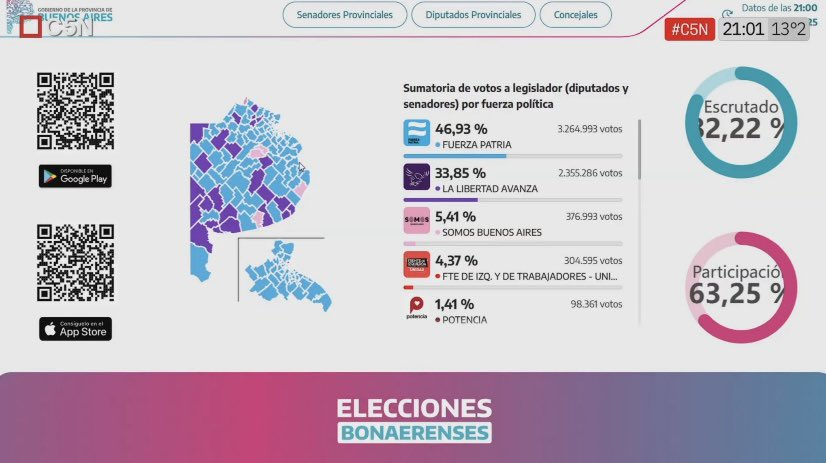
Argentine President Javier Milei suffered his most significant defeat on Sunday since he arrived at Casa Rosada. In the legislative elections of Buenos Aires Province, which concentrates about 40% of the national electorate, the Peronist Coalition Força Pátria, led by Governor Axel Kicillof, economist and former Minister of Finance of Cristina Kirchner, won with 46.93% of the votes, against 33.83% of freedom advances.
Other parties, as we are (5.41%) and the left (4.37%), were in secondary positions.
The election is treated in Argentina as a true early plebiscite about the far right government.
The result guaranteed to Peronism 34 of the 46 chairs in dispute in the provincial legislature. In the previous elections, held in 2021, the block had won 29 of these seats and therefore expanded its representation in five chairs. Freedom advances was 26 posts.
The score has consolidated the peronist advantage in six of the eight electoral sections, including the two most populous
The defeat of freedom advances must have immediate effect on national political balance. The setback in Buenos Aires, added to limited performance in provinces such as Jujuy, Santa Fe and Corrientes, puts in check Milei’s ability to sustain his agenda of cuts and reforms.
The election that became a national thermometer
The elections in Buenos Aires were legislative, designed to partially renew the Chamber of Deputies and the Provincial Senate. In all, 46 chairs were in dispute.
In four electoral sections senators were chosen; In the other four, deputies. Although it was a local election, the district’s political weight turned the dispute into a national episode.

In the first electoral section, which brings together the North and West of Conurban, Gabriel Katopodis (Force Patria) defeated Diego Valenzuela (Freedom Advances) by 47% to 37%. Already in the third, considered a historical bastion of the justicialist party (Kirchnerist party), Verónica Magario (Force Patria) imposed a triumph by 53% to 28% on Maximiliano Bondarenko (Freedom Advance), candidate launched by the national government.
In La Plata, the capital of the province, Peronism beat Francisco Adorni (Freedom Avança), brother of the presidential spokesman.
Freedom Avança made victories only on fifth and sixth sections, where it was supported by pro allies.
In Bahía Blanca, Oscar Libeman (Freedom Advances/Pro) defeated Kicillof’s list and secured five senator chairs to the government. Still, the final balance exposed the fragility of the official strategy, based on makeshift alliances and the bet on digital influencers, which did not convert into votes.
The electoral result transformed Buenos Aires into the epicenter of the resistance to the Milei government. At the same time, he designed Kicillof as the main figure of the opposition field, with a strong territorial presence and popular support.
Early wear and historical weight of defeat
The governing failure was not a radius in blue sky. Searches conducted weeks before already indicated loss of support. A study by QSocial consultant, completed on August 20, showed that only 35% of Argentines considered Milei honest and less than half had some affective bond with him.
The president’s popularity had fallen to 39%, the lowest rate since the beginning of the term.
Subsequently, this wear was aggravated by economic turmoil and scandals that directly reached the government’s core. The so -called Karinagate, revealed by audios about alleged bribes in drug contracts for people with disabilities, placed the president’s sister at the center of a credibility crisis.
The association between corruption and neglect of vulnerable sectors had symbolic weight in public perception.
The historical weight of defeat is evident. Peronism has not won an intermediate election in Buenos Aires since 2005, when Cristina Kirchner defeated Chiche Duhalde. Since then, the field had suffered successive setbacks, including central names such as Nestor Kirchner, defeated in 2009, and Cristina herself in 2017. Sunday’s victory was therefore a milestone in the resumption of protagonism.
The predominant reading is that the vote functioned as a political brake on the ultraliberal government, eroding its hegemony narrative and making room for an opposition reorganization.
Five conclusions and the factors of the setback
In analysis published in the Page/12journalist Martín Granovsky summed up the result in five conclusions: Milei lost; Karina lost; The government was defeated in its first major plebiscite; Peronism won; and Kicillof won.
In his analysis, Martín Granovsky states that Milei leads “the first government since Nazism that transformed the disabled people into human target and budgetary”, referring to the Karinagate scandal.
The journalist recalls that the president is also accused of trivializing the Never again – CONADEP report, published in 1984, which documented the crimes of the military dictatorship and became one of the main democratic consensus of Argentine memory.
The defeat was explained by a combination of factors that feedback: the economic cliff of everyday life, brutal attack on direct and indirect salary, cruelty as a system, loss of confidence in the president and, finally, the corruption scandal involving his sister.
Each of these elements eroded different portions of the social base that supported the government. The end result was a block rejection, expressed at the polls of the largest province of the country.
Presidential reaction and controlled self -criticism
Faced with defeat, Milei adopted an initial tone of self -criticism. “We had a clear defeat and we need to accept it. We had an electoral setback,” he said in his bunker in La Plata. Cynic, he attributed the peronist victory to the “40 -year apparatus performed efficiently” and said that the result was only “the ceiling of peronism”.
Accompanied by ministers such as Patricia Bullrich and Federico Sturzenegger, as well as his sister Karina, the president promised to correct political errors, but made it clear that he will not change his economic agenda.
“The course will not change, it will be redoubled. It is not retrained even a millimeter,” he said, listing the tax surplus, currency policy and deregulation reforms as pillars.
In the speech, Milei defended the legacy of his early months: he said he reduced inflation from 200% to 20% and took 12 million people out of poverty. The evaluation, however, contrasts with the social perception of stagnation and fall of income, reinforced by the ballot boxes.
The coldness with which he greeted Martín Menem, president of the Chamber of Deputies and strategic ally, also exposed internal tensions in his coalition, already worn out by disputes between different power groups.
The election in Buenos Aires recorded 63% of the electorate, well below the historical average of 76% for intermediate elections. The data reinforces the idea of electoral apathy and crisis of representation, which now also reaches Milei, previously benefited by social disenchantment with traditional politics.
The result expands the fragility of the government on the eve of the national legislative elections of October 26, the first major management test at the national level.
Peronism comes strengthened, with Axel Kicillof consolidated as leadership and already pointed out as a potential presidential candidate in 2027. The former minister of Cristina Kirchner and governor of the most populous province projected himself as a national voice by turning Buenos Aires into the epicenter of resistance to the Milei government.
In the celebration speech, Kicillof classified victory as a “popular celebration” and sent direct messages to the president.
“The polls told President Milei that public works cannot be paralyzed. The ballot boxes explained to him that retirees cannot be defeated. The ballot box, with a difference of 13 points, explained to him that people with disabilities cannot be abandoned,” he told mayors and leaders of coalition for force homeland.
Internally, defeat deepens the dispute for conducting the strategy between Karina Milei, Sebastián Pareja and the Menem Brothers, criticized by the choice of fragile candidates and the bet on digital influencers without political density.
The fragmentation of alliances in the interior also contributed to the setback. On the other hand, Peronism feels strengthened and speaks of “resuming the path of unity” to project a return to power. Cristina Kirchner, even under house arrest, celebrated the victory and mocked Milei on the networks.
Source: vermelho.org.br