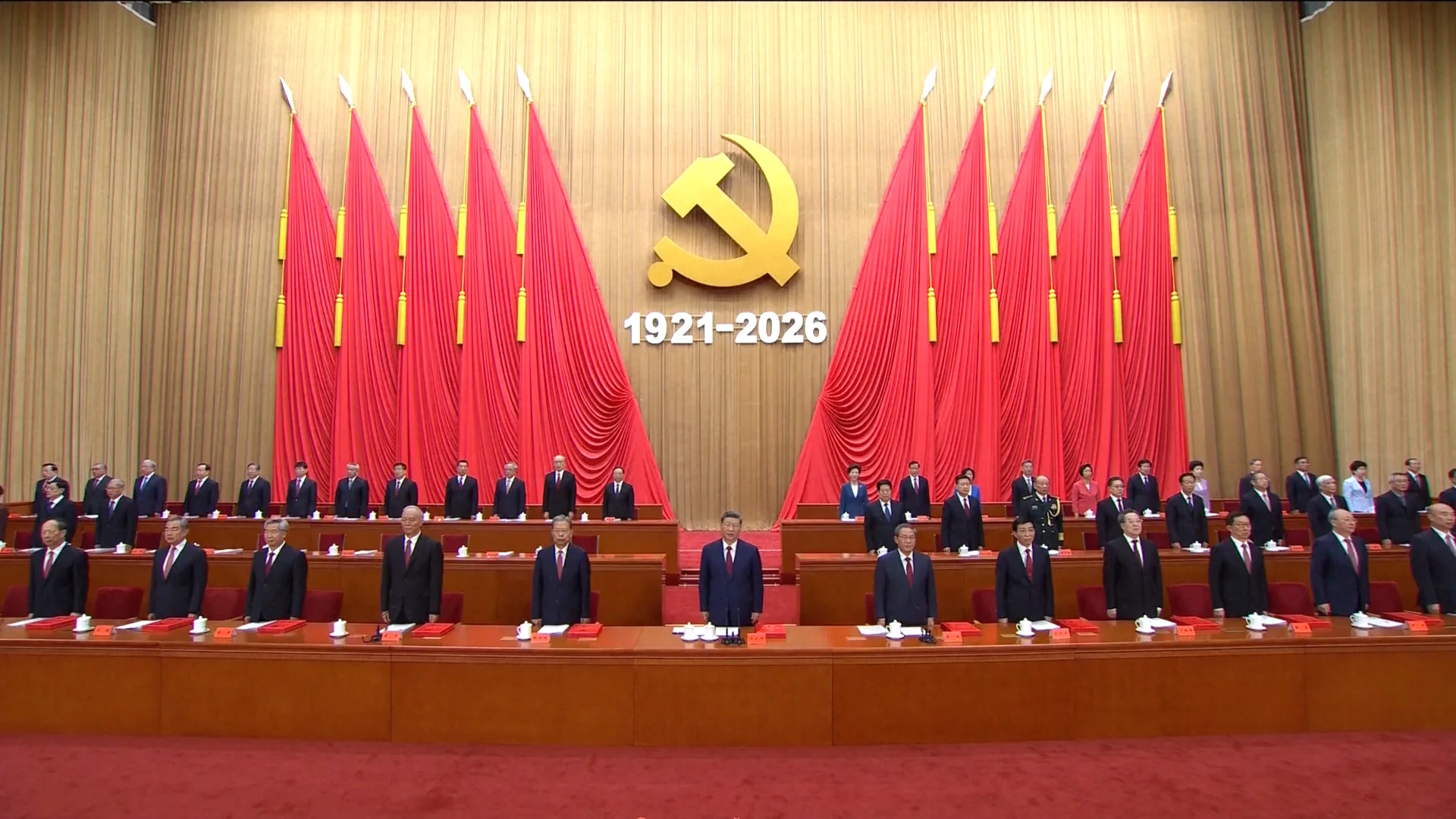
The general secretary of the Communist Party of China (CCP), Xi Jinping, highlighted the “vitality of Marxism” as the foundation of the Party’s historic achievements and warned of “storms and rough seas” in the international situation in a speech at the celebrations of the 105th anniversary of the founding of the CCP, held this Wednesday (1st) in the Great Hall of the People, in Beijing. Xi also decorated eight members with the July 1st Medal, the country’s highest party distinction.
The 1st of July Medal was created in 2021 to mark the centenary of the CCP and is awarded to members with exceptional contributions to the Party and the country. Exemplary members, outstanding party workers and grassroots organizations from across the country were also honored at the ceremony.
The Party currently has 101 million members, having surpassed the 100 million mark for the first time last year.
When reviewing the Party’s centenary trajectory, Xi listed five achievements in 105 years of “unceasing efforts”: the fundamental change in the destiny of the Chinese people, with the overcoming of extreme poverty and the construction of a moderately prosperous society; the opening of the “correct path” for the revitalization of the nation, identified with Chinese-style modernization; the demonstration of the “vitality of Marxism”, through the articulation of Marxist principles with the concrete Chinese reality and the country’s traditional culture; the profound influence on world history, with the “creation of a new form of human civilization”; and the strengthening of the CCP itself, which Xi described as “the world’s largest ruling party with significant global influence.”
“Socialist China, led by the Party, is recognized as a builder of world peace, a contributor to global development and a defender of international order,” Xi said.
Army’s centennial goal
Xi Jinping demanded the punctual fulfillment of the centenary goal of the People’s Liberation Army (PLA). In 2027, the ELP celebrates 100 years since its founding in 1927, during the revolutionary period. The date constitutes an intermediate strategic stage: the 2027 target precedes the basic modernization of national defense, scheduled for 2035, and the construction of “world-class” armed forces for 2049, at the end of the second centennial target.
“It is necessary to fully implement the New Era Military Strengthening Thought, execute the new military strategic guideline and achieve the army’s centenary objectives on time,” Xi said.
The centenary objective encompasses the completion of the integrated modernization of the armed forces in three dimensions: mechanization, computerization and incorporation of artificial intelligence systems into military operations.
To achieve the goal within the deadline, the PLA must simultaneously advance combat, war preparation and force building. Xi reiterated the five pillars of military strengthening: political development, reform, science and technology, human resources training and governance by law.
The Secretary-General also highlighted the need to “resolutely defend national sovereignty, security and development interests and make greater contributions to world peace and development”.
Humanity at crossroads
Addressing the international situation, Xi Jinping said that “China’s development is in a period of coexistence of strategic opportunities and risks and challenges, with uncertain and unpredictable factors increasing.” “We must always be prepared to face severe tests, including strong winds and rough waves, or even storms and rough seas,” said the secretary general.
Xi assessed that “the world has entered a new period of turbulence and transformation” and that “humanity finds itself once again at a crossroads.” To face the scenario, the general secretary called on the CPC to strengthen danger awareness, maintain baseline thinking, and enhance the ability to “predict changes in advance, perceive risks in time, and effectively respond to challenges.”
The secretary-general also reiterated the need to promote China’s global development, security, civilization and governance initiatives.
Fundamental theory, line and strategy
At the celebration of 105 years, Xi Jinping reaffirmed that the CCP must persist in the “three fundamental issues”: the Party’s theory, basic line and strategy. “They constitute the primordial achievements obtained after arduous exploration by the Party and the people, and are the fundamental guidelines for the cause of the Party and the State,” he said.
The fundamental theory covers the set of Marxist thought adapted to the Chinese reality over more than a century, including Mao Zedong Thought, Deng Xiaoping’s theories, the concept of the “Three Representations”, the Scientific Perspective of Development and Xi Jinping Thought for Socialism with Chinese Characteristics of the New Era.
The Party’s fundamental line guides the primary period of socialism based on the principle of “one center and two basic points”: economic construction as the central axis, maintenance of the four fundamental principles (the socialist path, popular democratic dictatorship, CCP leadership and Marxism-Leninism) and continued reform and opening up. The fundamental strategy emerged at the 19th CPC National Congress in 2017 and has 14 “commitments” that guide the practice of socialism in the new era, bringing together what were previously five separate programmatic documents.
Xi associated adherence to the “three fundamental issues” with the “four trusts” that the Party must maintain: trust in the path, theory, system and culture of Chinese socialism. The general secretary called on the Party to “steadfastly maintain the path and objectives” and deepen new-age socialist thinking in all spheres of governance.
Source: www.brasildefato.com.br