Published 01/11/2025 13:02 | Edited 01/11/2025 14:41
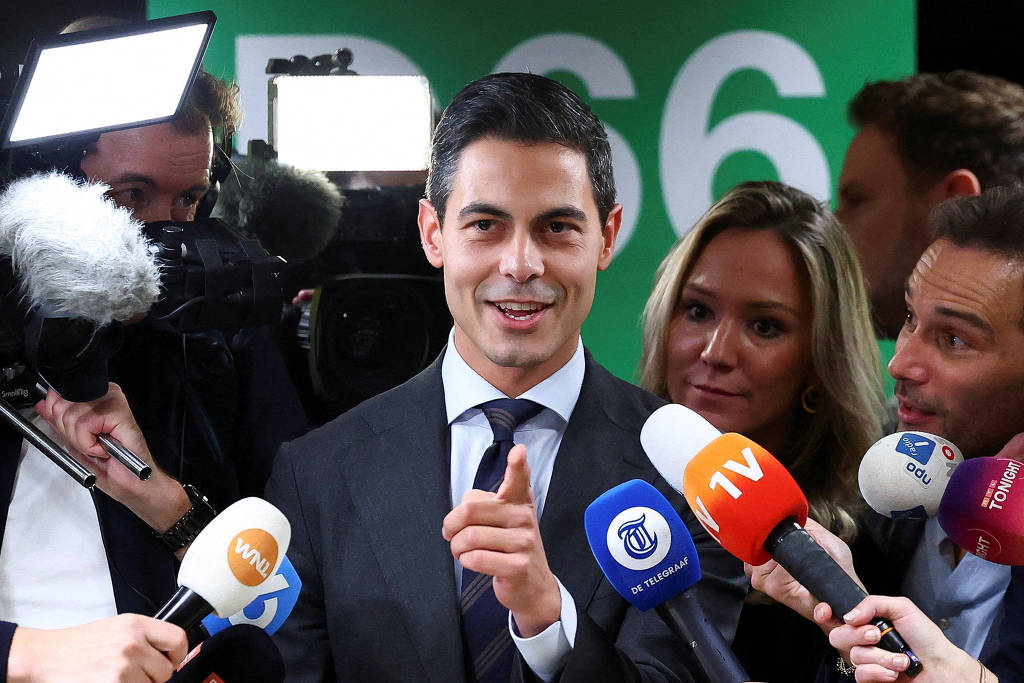
Liberal Rob Jetten, leader of the Democrats 66 (D66) party, was confirmed as the winner of the Dutch parliamentary elections held last Thursday (29), ending the cycle of far-right hegemony in the Netherlands.
With almost all votes counted, D66 obtained around 18% of the national vote and an advantage of 15,155 votes over Geert Wilders’ Freedom Party (PVV), according to the ANP agency.
The PVV is a far-right nationalist party, known for its anti-immigration, anti-Islam and eurosceptic discourse. Founded by Wilders in 2006, the party advocates closing borders, banning mosques and removing the Netherlands from the European Union.
Despite having won the 2023 elections, the PVV lost support after a series of internal crises and the collapse of the government it led, which was overthrown in June 2025 due to differences over asylum and family reunification policies.
The victory, defined by one of the narrowest margins in the country’s electoral history, is expected to see 38-year-old Jetten become the youngest prime minister in modern Dutch history.
The result marks a symbolic turn on the European political map: the country that two years ago had been the scene of the advance of the extremist Wilders is once again commanded by a liberal, pro-European Union leadership committed to democratic reconstruction.
D66, founded in 1966, jumped from nine to 26 seats in Parliament, and could reach 27 — an unprecedented growth for a centrist party amid the party fragmentation that characterizes the Dutch political system.
The formation of the new government, however, will require complex coalition negotiations, as D66 will need at least three allies to reach a majority of 76 seats.
The process of final confirmation of the result will take place on November 7, after the votes of around 90,000 Dutch people abroad have been counted.
The city of Venray, in the southeast of the country, is also expected to release its definitive result in the coming days, after a fire in the city hall delayed the count.
Despite the pending details, the consolidated advantage of D66 makes Wilders’ defeat irreversible and symbolizes the weakening of the rhetoric of intolerance that marked the last legislature.
Wilders’ defeat and the reflux of the far right
Far-right leader Geert Wilders, known for his anti-Islam rhetoric and proposals such as banning the Quran, refused to recognize the result and accused the press of favoring his opponent.
Wilders called the ANP agency “ANP66” and published unproven allegations on social media about alleged voting irregularities, which were denied by local authorities.
The city council of Zaanstad, one of the cities mentioned, stated that “the vote took place with complete transparency and supervision”.
Wilders’ refusal to admit defeat reflects the wear and tear of the far right after two years of unstable government.
The PVV had won the 2023 elections, winning 37 seats, but the cabinet collapsed in June 2025 after impasses over asylum and family reunification policies.
The crisis led to the call for new early elections and paved the way for the reorganization of the political center, which emerged strengthened amid the social fatigue caused by hate speech and internal divisions.
Jetten’s victory represents a broader realignment in Western Europe.
Analysts at Deutsche Welle and Reuters interpret the result as a counterpoint to the rise of the far right in countries such as France, Germany and the United Kingdom.
The Dutch case shows that urban and young voters tend to react against polarization and seek alternatives that combine political stability, social regulation and ambitious climate policies.
“We showed Europe and the world that it is possible to defeat populism with a positive message”, declared Jetten after the ANP announcement.
Jetten proposes democratic reconstruction and broad-center coalition
Former Minister of Climate and Energy in Mark Rutte’s government, Jetten presented a social and ecological reconstruction program for the country during the campaign.
Among the priorities are the construction of ten new cities and one hundred thousand homes per year, the expansion of preventive health policies and the reduction of energy costs through the green transition.
The centrist also defends a reform in migration policy based on linguistic and labor integration, with the possibility of asylum requests outside the European Union, in addition to the expulsion of irregular immigrants.
With 18% of the votes, D66 obtained a clear plurality, but far from an absolute majority, which will require prolonged negotiations.
The party has already signaled that it intends to seek a broad center coalition, with the VVD (liberal-conservative), the GroenLinks/PvdA alliance (green-labor) and the CDA (center-Christian democrat) — together, they would add up to 85 to 87 seats.
The first phase of the conversations will be led by a “scout” appointed by Parliament on November 4, who will probe the possibilities of agreement before choosing the “trainer” responsible for assembling the new cabinet.
Jetten said he felt “great responsibility” after the result and promised to form a stable, progressive and moderate government.
The current interim prime minister, Dick Schoof, has already admitted that he should remain in office until Christmas.
Even so, the victory of D66 is seen as a watershed: it ends the cycle of far-right hegemony and returns the Netherlands to the liberal-progressive European camp, alongside France, Germany and Spain.
The country, a historical symbol of tolerance and political modernity, now resumes its role as a bridge between social humanism and democratic governance.
Source: vermelho.org.br