Published 10/27/2025 11:24
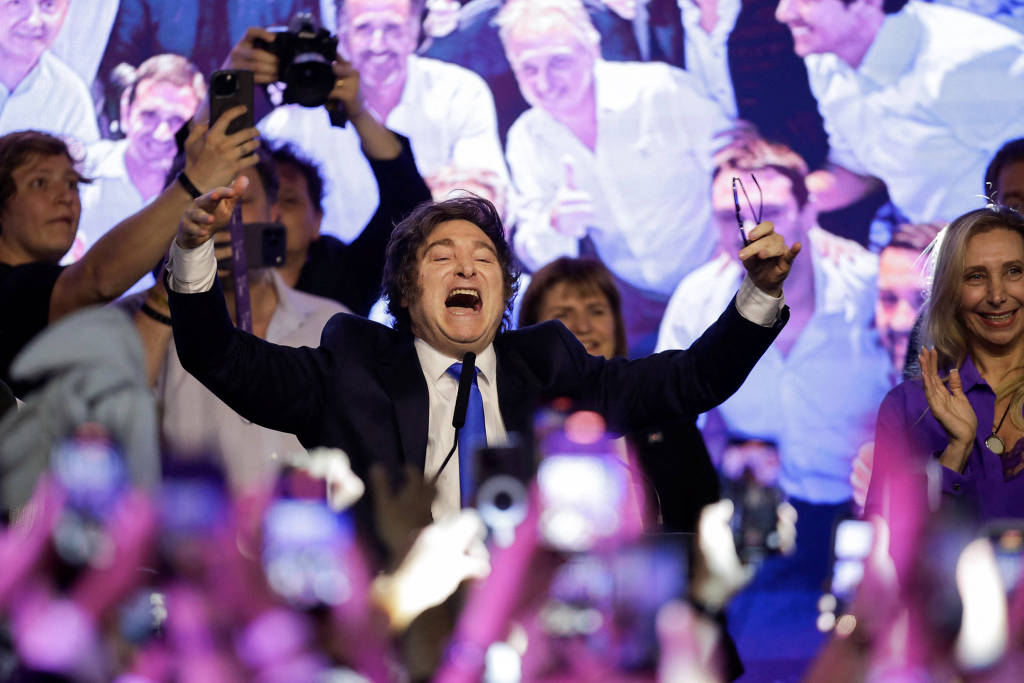
The president of Argentina, Javier Milei, emerged stronger from the mid-term legislative elections held this Sunday (26). The governing party, La Libertad Avanza, obtained 40.8% of the votes and won 64 of the 127 seats up for grabs in the Chamber of Deputies.
The victory, lower than polls indicated, gives the government veto power in Congress and political breathing room after months of economic turmoil and internal scandals. The coalition won in 15 of Argentina’s 24 jurisdictions, including the province of Buenos Aires, a historic stronghold of Peronism.
In the Senate, the LLA won 13 of the 24 seats in dispute, against 6 for Peronism and 5 for regional parties. The final composition ensures a real bench, but still a minority, which will force Milei to negotiate if he wants to approve his reforms.
With more than 97% of the ballots counted, Peronism, united under the label Fuerza Patria, obtained 31.6% of the votes and won 44 of the 127 seats up for grabs in the Chamber, in addition to 6 of the 24 seats in the Senate.
The Provincias Unidas alliance, formed by governors from different parties — including dissident Peronists, radicals and former Macristas — totaled 7.1% and won 8 seats in the Chamber, while the Left Front received 4.8% of the votes and 3 seats.
Provincial forces and independent groups completed the picture with around 15.7% of the votes and 8 vacancies, consolidating a fragmented Parliament, in which the Milei government will depend on specific agreements and temporary alliances to approve its reforms and sustain the fiscal adjustment program.
The result confirmed the election as a referendum on the first half of the mandate. With participation of just 67.9% of the electorate, the lowest since 1983, the election registered a record level of abstention, especially in large urban centers.
Even so, the president celebrated the result and announced that he will deepen the structural reform program.
“Today the construction of a great Argentina begins,” he declared. According to him, the government intends to advance labor, social security and educational changes, considered by Milei essential to “take the country back to the greatness it had a hundred years ago”.
The victory guaranteed Milei a strategic asset. His government now has minimal stability in Congress and will be able to avoid defeats in key projects. The alliance with PRO, the party of former president Mauricio Macri, was decisive.
Together, the two groups exceed a third of the seats in the Chamber, enough to block vetoes and maintain control of the agenda. The president’s desire to break with Macri and govern without alliances, however, did not materialize.
Despite the triumphalist speech, the result was 15 points below the performance obtained in the 2023 presidential elections.
Milei lost around 2 million votes compared to Mauricio Macri in the 2017 legislative elections (Macri’s mid-term elections). Even so, it received a vote of confidence in a context of slowing inflation and rising unemployment.
The most common reading among analysts is that the result reflects more of a punishment for Kirchnerism than a popular endorsement of the current government’s policies.
The campaign was marked by explicit support from the United States. On a trip to Malaysia, President Donald Trump stated that Milei “had a lot of help from us” and confirmed the rescue package of up to US$40 billion to avoid a currency crisis before the elections.
The program included a currency exchange operation equivalent to US$20 billion, used to expand Argentine reserves, and the creation of a debt investment fund of the same value, both supervised by Treasury Secretary Scott Bessent.
“We made a lot of money from this election because Argentine bonds went up and the credit rating improved,” Trump said, before adding that Washington’s interest “isn’t exactly the money.”
Bessent stated that Milei “is facing a hundred years of bad policies and will be able to break this cycle thanks to US support”.
North American support was decisive in stabilizing the exchange rate and containing the rise in prices in the weeks before the election. According to the Fitch Ratings agency, US aid prevented a further downgrade of Argentina’s credit rating.
In return, Trump demanded that Milei demonstrate strength at the polls — which provoked criticism of external interference and reinforced the perception of Argentina’s political and economic subordination.
The governor of Buenos Aires, Axel Kicillof, reacted to the dependence. “The United States is not a charitable society; it came to Argentina to profit and put our resources at risk,” he said.
The Minister of Economy, Luis Caputo, thanked the partnership and declared that “the support of the United States for this economic direction is of vital importance for Argentina and the region”.
Domestically, Milei is trying to reorganize the government after weeks of instability. Chancellor Gerardo Werthein and Justice Minister Mariano Cúneo Libarona left, while Patricia Bullrich (Security) and Luis Petri (Defense) left their positions to take up mandates in the Legislature.
“Freedom requires this order that we are carrying forward,” said Bullrich, when defending the continuity of policies to repress protests.
Even with progress in Congress, Milei faces increasing disapproval and social wear and tear. North American support reinforces the austerity policy and increases the risk of external dependence. The electoral result, interpreted as a momentary vote of confidence, keeps the government standing, but does not change the situation of economic instability or discontent in the streets.
The scenario is reminiscent of the trajectory of Carlos Menem, who, in the 1990s, promised modernization and ended up immersed in scandals and currency devaluation. Today, even liberal economists point out that a new devaluation of the peso is practically inevitable in the coming months, which threatens to erode the political capital gained at the polls.
Milei’s promise to transform Argentina into “a European country in 15 years” seems increasingly distant. The economy, still fragile, depends on foreign credit and new contributions from Washington.
The record abstention and the division between anti-Kirchnerists and antimileists highlight a polarized society and a country trapped between debt and social malaise.
The victory gives Milei time — but it also puts him under guardianship. Between dependence on the United States and the risk of social upheaval, the Argentine president enters the second half of his term with short breath and increased responsibility.
The results of the polls ensure the political survival of the government, but also make clear the price of this stability: the surrender of economic sovereignty and the deepening of the social crisis.
Source: vermelho.org.br