Published 09/23/2025 18:24 | Edited 23/09/2025 19:07
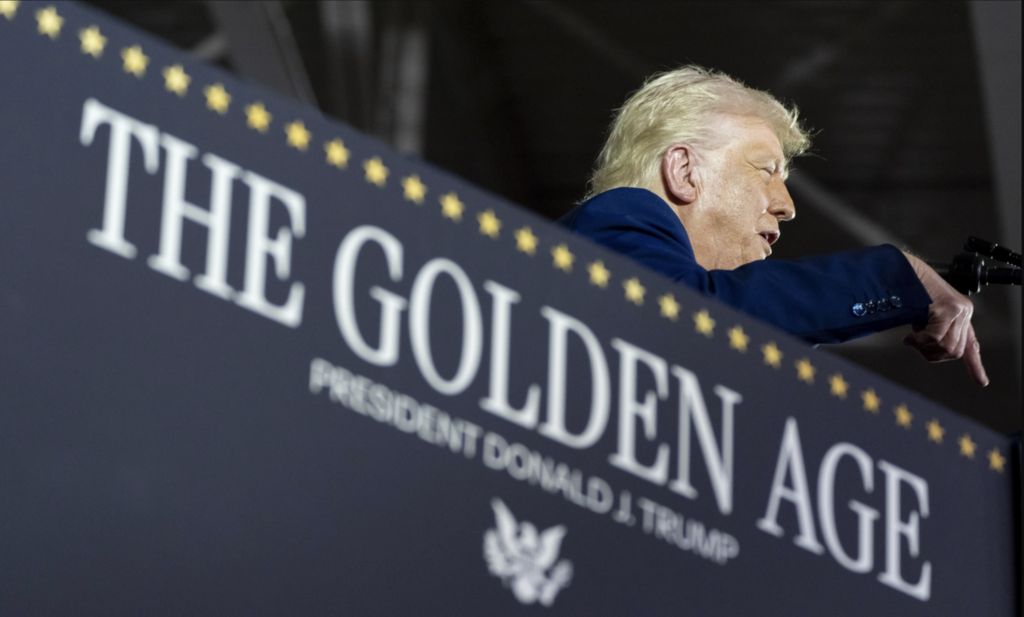
Donald Trump spared no superlative to describe the American economy in his speech at the UN General Assembly. According to the president, the US live a “golden age” [golden age]with defeated inflation, falling prices, record investments and wages. However, this Ufanist narrative, central to justifying its global leadership, seems to exist in a plan parallel to the reality of official economic indicators, which show a more complex and less spectacular scenario.
While promoting this idyllic view, Trump repositioned the US not as a partner, but as a lone and threatening referee on the global stage. He attacked Russia, China, and India, charged Europe’s military spending and threatened with punitive tariffs, outlines the contours of governability based on populist unilateralism, the crusade against immigration and a new commercial cold war.
“I was right about everything,” said the president, repeating a series of misleading and false allegations.
The economy of hyperbole: the abyss between rhetoric and data
Trump’s description of the US economy was an exaggeration exercise. Allegations such as “salaries are rising at the fastest pace in over 60 years” and that inflation has been “defeated” dramatically simplify a multifaceted economic reality. Experts point out that while these indicators point to the lack of labor and leftover local products on the shelves (boycotted by importers), others-such as record public debt and stubborn inflation in specific sectors-are omitted in this narrative.
“Under my leadership, energy costs fell, gasoline prices fell, food prices fell, mortgage rates fell, and inflation was defeated.”
The most bombastic allegation, however, was “$ 17 trillion” in investments guaranteed in just eight months. This number, presented without independent sources or details, is of magnitude higher than historically recorded investment flows and is seen with skepticism by analysts. By contrasting him with a supposed “less than 1 trillion” during the Biden government, Trump uses a common figure in his repertoire: spectacular data creation to build an alternative reality of unparalleled success, where factual truth is subjugated to the rhetorical impact.
According to the check of New York TimesMister Trump is comparing apples with oranges and is inflating the numbers of his own government. Biden’s collection in manufacturing projects, driven by the approval of four laws, contains details about the location of specific facilities, for example, a US $ 11 billion semiconductor factory and a $ 1 billion solar panel factory in Oklahoma.
In contrast, Trump’s $ 17 trillion is twice as much as his own White House has accounted for: $ 8.8 trillion. But even this value is not totally “paid”, as Trump would have said. It includes broad and informal promises from foreign countries to invest in the United States, which experts warn that they can be unrealistic. A promise of Saudi Arabia 2017, still in its first term, to buy $ 450 billion in American products, for example, did not fully materialize.
“America Fortaleza”: the anti-immigration crusade as an economic pillar
Trump’s economic narrative is inextricably linked to his anti-immigration crusade. The claim that the southern border is fully controlled and that the number of illegal entrances is “zero” is presented not only as a security victory, but as a prerequisite for economic prosperity. It is the belief that economic health depends on isolation and absolute control of borders.
In describing previous migrants as coming from “prisons, mental institutions, [e] Drug traffickers, ”he builds a necessary enemy to justify zero tolerance policies.
This view translates “America Fortaleza” into an economic principle: internal prosperity, in its logic, depends on the isolation and purge of external elements considered threatening. It is an economy based on exclusion, where growth is the result of protectionism and restriction.
Unilateralism as a strategy: threats, tariffs and the new cold war
The speech was a manifesto of unilateralism. Trump did not propose cooperation, but subordination. Their threats were clear:
- To Europe: He has charged to increase military spending to 5% of GDP, a goal considered exorbitant by allies, and accused them of hypocrisy for continuing to buy Russian energy. “China and India are the main financiers of the ongoing war by continuing to buy Russian oil. But unjustifiably, even NATO countries have not cut much of Russian energy…”
- To Russia, China and India: attacked them directly as “leading warfunders” in Ukraine and threatened to impose a “very strong round of powerful tariffs.” “If Russia is not ready to make a deal … The United States is fully prepared to impose a very strong round of powerful tariffs that, I believe, would end the bloodshed very quickly.”
- In the world: It reiterated that it will use tariffs as a “defense mechanism”, signaling an aggressive and conflict -based trade policy, not negotiation. “Brazil now faces major rates in response to their unprecedented efforts to interfere with the rights and freedoms of our citizens … You can only do well when working with us. Without us, you will fail.” This phrase synthesizes the doctrine: subordination or punishment. The economy is instrumentalized to punish critics and force alignment.
This posture redefines the US not as a consensual leader, but as a hegemonic power that said. Multilateralism of institutions such as the UN is despised in favor of a system where Washington acts as a judge, jury and executor. It is the consolidation of a new cold, not necessarily ideological, but geoeconomic war, where power is exercised through sanctions, tariffs and isolation.
The fable of self -sufficiency
Trump’s speech on the UN was the staging of a fable: that the US can reach a “golden age” through isolation, threat and rejection of global cooperation. Inflated economic narrative serves as a foundation for this project, creating an illusion of success that justifies unilateral actions.
The reality, however, is that the global economy is deeply interconnected, especially when countries articulate in dollar resistant blocks and Washington -articulated financial mechanisms. Generalized tariff policies can trigger global recessions, and partner removal can weaken American influence in the long run.
The trumpland view of a “lone referee” is, in practice, that of a country that exchanges the complex global leadership for powerful and potentially detrimental loneliness. The promised “golden age” may actually be the era of isolation in the shadows.
Source: vermelho.org.br