Published 11/17/2025 17:56 | Edited 11/17/2025 18:37
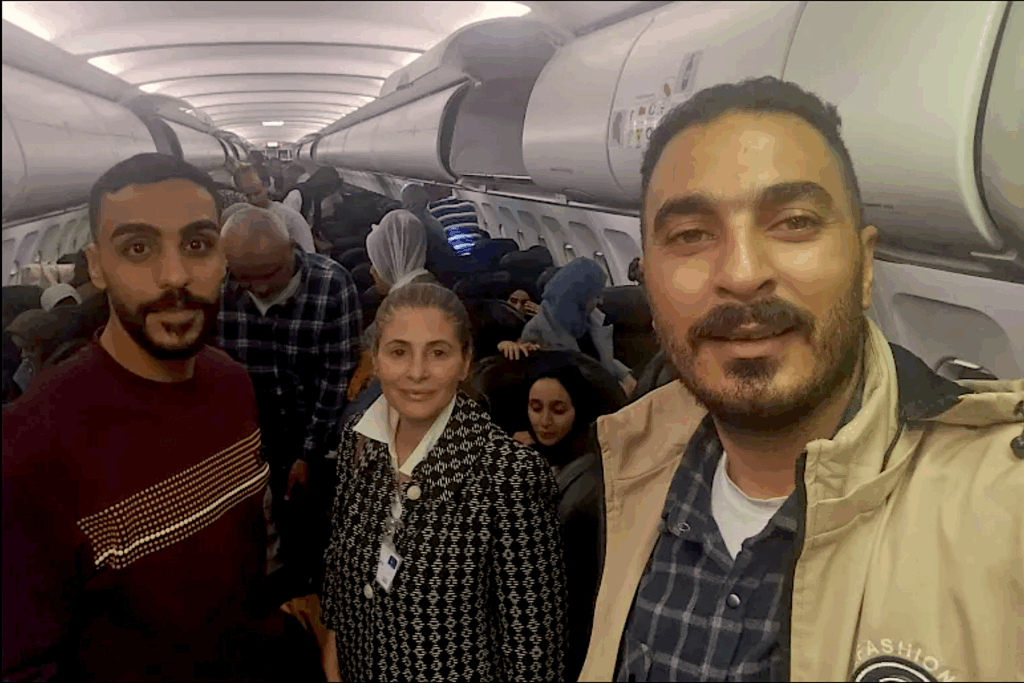
On Thursday morning (13), a chartered plane landed near Johannesburg bringing 153 Palestinians who had left Gaza without stamps or exit documents. Not knowing where they would stay and unable to answer immigration questions, the group remained inside the aircraft for almost 12 hours. Only after the South African NGO Gift of the Givers [dádiva dos doadores] to offer emergency assistance is that they were authorized to disembark.
The government confirmed that 23 passengers continued their journey to other countries. President Cyril Ramaphosa called the episode “mysterious” and suggested that people appeared to be “expelled” from Gaza. Intelligence services are investigating the case.
O obscuro papel da Al-Majd Europe
The operation was conducted by Al-Majd Europe, an entity that presents itself as a humanitarian organization, but which faces accusations of acting in coordination with Israeli authorities.
According to a report by the Israeli newspaper Haaretzthe group would be led by Tomer Janar Lind, an Israeli-Estonian citizen who would have collaborated with a sector of the Ministry of Defense known as the “Voluntary Emigration Bureau”, created in 2025 to facilitate the exit of Palestinians from Gaza.
Al-Majd’s website describes alleged ransom operations, but inconsistent details raise suspicions: domain registered only in February, non-existent emails, no verifiable address and broken links. There are also reports that payments were made to personal, not institutional, accounts.
Experts consulted state that the mechanism is in line with a historical colonial logic. For researcher Oroub el-Abed, this is a “systematic displacement”, part of Israeli efforts to empty the territory of its native population.
How passengers were selected and removed from Gaza
Testimonies collected by Aljazira reveal that families paid between US$1,400 and US$2,000 per person — including children — without knowing the final destination.
After registering through advertisements on social media, those approved were instructed to only bring documents, a cell phone and some money. The buses left Rafah and crossed the Karem Abu Salem (Kerem Shalom) checkpoint, in an area controlled by the Israeli Army, which carried out inspections before allowing entry into Israeli territory.
The passengers were then taken to Ramon airport (southern tip of Israel), where they boarded a Romanian plane. No documents were stamped. The route included a stopover in Nairobi before arriving in South Africa.
The lack of exit registration made the passengers, in practice, migrants without valid documentation — a condition that makes an eventual return to the occupied territory unfeasible.
A repeating pattern: previous flights and obscure connections
The flight was not an isolated case. The Israeli newspaper Haaretz identified a similar operation on May 27, when 57 Palestinians left Gaza via the same route and then headed to Indonesia and Malaysia.
Al-Majd itself claims to have flown doctors from Gaza for training abroad, but data and photos related to the alleged missions could not be independently verified.
According to Imtiaz Sooliman, founder of Gift of the Givers, this would be the second flight to arrive in South Africa since October — the previous one, with more than 170 passengers, would not have been officially announced.
Palestinian denunciations and warning of exploitation
The Palestinian embassy in South Africa classified the operation as “misleading”, saying that Al-Majd exploited the desperation of families in extreme situations and organized an “irregular and irresponsible” trip.
The Palestinian Ministry of Foreign Affairs warned that such networks are linked to Israeli interests in removing Palestinians from Gaza, reinforcing a process of ethnic cleansing.
For many of those who arrived, the trip was described as a “path of suffering”. Some planned to go directly to other countries; others intend to stay temporarily in South Africa for medical treatment or a fresh start.
Displacement policy and the long history of expulsion
Experts say the episode is part of a historical pattern of policies to remove the Palestinian population. Since the end of the 19th century, documents, leaders and practices linked to the Zionist movement have mentioned the need to reduce the Arab presence in Palestine.
From the Nakba of 1948 to “voluntary migration” strategies after 1967, including demolitions, economic restrictions and forced internal displacement, initiatives to pressure people to leave have always been part of the occupation dynamics.
In recent years, especially after October 7, 2023, Israeli authorities have openly proposed scenarios for emptying Gaza — including the so-called “Generals’ Plan”, arguing that residents of the north of the Strip should never return to their homes.
The novelty of the current scheme is that Palestinians pay for their own removal, in a process that exploits extreme vulnerability and prevents return to the territory, by suppressing any legal record of departure.
Between reception, uncertainty and future risks
Of the group that landed in South Africa, 130 were allowed to enter the country, while others quickly continued their journey. Part seeks to rebuild life in countries such as Australia, Indonesia and Malaysia; others still don’t know where they will stay after emergency assistance ends.
For experts, the operation reveals a broader mechanism: transforming forced displacements into “privatized”, profitable and politically convenient routes. At the same time, it exposes the despair of civilians subjected to two years of war, siege and destruction in Gaza.
Still, analysts remember that, despite historical and current pressures, the majority of the Palestinian population remains committed to remaining in their land — and that episodes like this, far from putting an end to the issue, rekindle the debate on expulsion, the right of return and international responsibility in the face of the humanitarian crisis.
With information from Aljazira
Source: vermelho.org.br