Published 13/08/2025 15:19 | Edited 13/08/2025 15:53
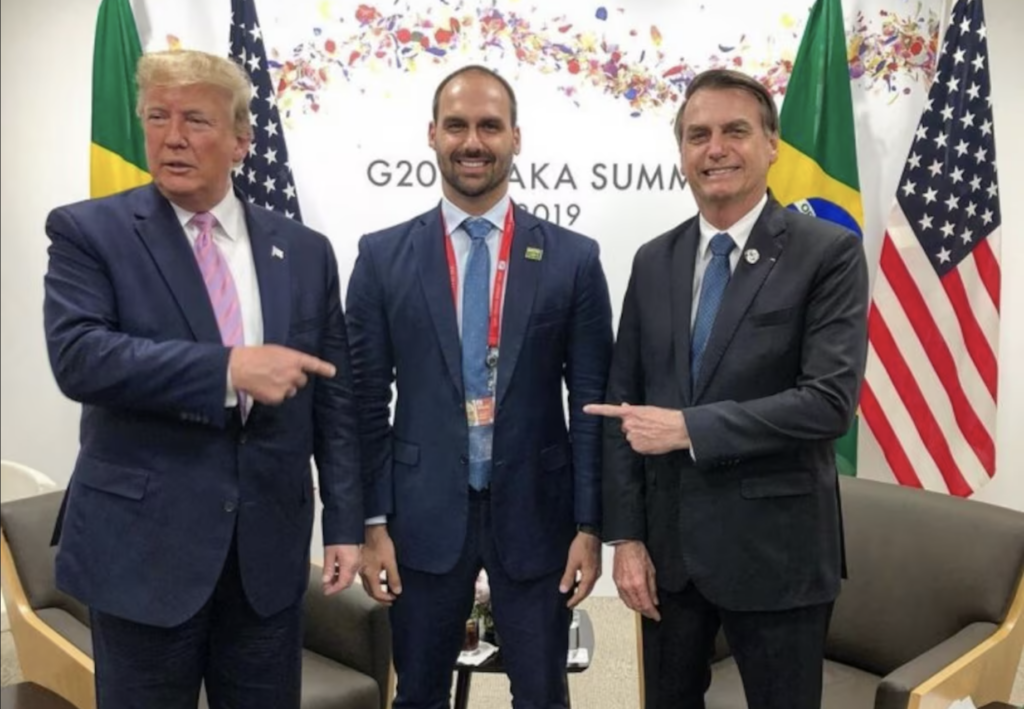
Federal Deputy Eduardo Bolsonaro (PL-SP) began on Wednesday (13) a series of meetings in Washington DC with assistants of US President Donald Trump to deliver a dossier about the application of magnitsky law against the Supreme Court Minister (STF) Alexandre de Moraes. The document, elaborated alongside the former combatant of young Pan Paulo Figueiredo, maintains-with questionable data and interpretations-that the US sanction would have had an effect on the STF and Congress, and that the strategy should be maintained and expanded.
The movement is accompanied by criticism in Brazil, including President Luiz Inacio Lula da Silva, who accuses Eduardo of sending “deformed and wrong information” to Trump – which, according to him, feeds the distorted view of the White House holder about the Brazilian political reality.
According to Lula, the parliamentarian forges a narrative that favors the pocket agenda in Brazil and impairs the image of the country abroad. “If you set up an advice with people linked to Bolsonaro, it will always have wrong information,” Lula warned in an interview with BandNews FM radio.
Strategic distortion
The dossier delivered by Eduardo and Figueiredo presents a selective reading of the Brazilian conjuncture. Among the highlighted points is the supposed “digestion” of the sanction by the “system”, a term used to designate the political and judicial elite. The material claims that Moraes would have decreed the house arrest of Jair Bolsonaro without consulting the Attorney General, Paulo Gonet, or ministers such as Gilmar Mendes and Luís Roberto Barroso, to avoid internal resistance.
The narrative is accompanied by recording of reports and opinion research produced by institutes aligned with pockets, such as IBESPE, which present convenient data to support the Bolsonaro political persecution thesis and minimize the unpopularity of American measures – ignoring broader rejection of the tariffs imposed by Trump.
Political pressure disguised as “diplomatic strategy”
The dossier also tries to link sanctions to a legislative setback that would directly benefit Jair Bolsonaro and his allies. Among the guidelines mentioned are amnesty those involved in January 8 and the end of the privileged forum – measures sold as mechanisms of “liberation” of the “blackmail” congress of the Supreme Court, but in practice weakened the brake and counterweight system.
The attempt to mobilize international support for internal guidelines exposes instrumental use of foreign policy, transforming diplomatic issues into ammunition for domestic disputes. This type of articulation can weaken Brazilian sovereignty and erode the credibility of institutions before other countries.
Objective: Expand sanctions
The offensive tries to frame Moraes in the global magnitsky (EO 13818), a regime that allows the Treasury to sanction “foreign persons” responsible for serious human rights violations or significant corruption, by decision of the Treasury Secretary in consultation with state and justice, based on a robust probative dossier.
Eduardo’s goal in Washington is clear: to convince the White House to maintain and extend the use of magnitsky law to reach Alexandre de Moraes and potentially other STF ministers and Brazilian companies. The document argues that the offensive has already strengthened the opposition in Congress, citing the support of 41 senators to the impeachment of Moraes.
The proposal to end the privileged forum for parliamentarians – presented as a way to “free” deputies and senators of the “blackmail” of the Supreme – also integrates the pressure package about Brazilian institutions.
The legal frame that the dossier ignores
The Magnitsky Law is born from the murder of Russian lawyer Sergei Magnitsky and evolves in 2016 to the global magnitsky, operationalized by the 13818 (2017). Since then, he has been sanctioning individuals and entities involved in torture, extrajudicial executions, arbitrary arrests and great corruption – with significant numbers of annual designations and updated regulation in 2024 to reinforce procedures. This collection built the reputation of the program as a tool, not as a political hammer.
Magnitsky is not a “policy tool” to arbitrate judicial controversies of democratic countries or punish unpopular decisions. Historically, the targets are perpetrators in state repression contexts or remedy of appeals – not judges of constitutional cuts that conduct sensitive cases within a rule of law.
The guiding thread of course: serious and systemic violations, in environments where the judiciary is an instrument of the regime. In seeking to extend the same label to a Supreme Court minister of a partner country and with functional institutions, the dossier tries to normalize an atypical use of the measure – something experts already point out as deviation from the original objective of the law.
Moraes’s designation under magnitsky – politically driven by Bolsonaro allies – opened immediate bilateral litigation and forced banks and companies to evaluate practical effects, even though the target has no US assets. For analysts, the gesture has expanded magnitsky to politicized and unprecedented terrain between allies, with risk of retaliation and inhibitory effect on magistrates who touch sensitive cases.
As the Dossier distorts (and why)
1) Cause and fantasy effect on the STF
The document features internal “discomfort” as proof of moraes isolation, as is said to be – common in cuts – were a causal product of foreign sanctions. It is logical leap: legal divergence becomes “Trump effect”. In democracies, institutional frictions are not a sign of collapse, but of deliberation.
2) TEASTED RESEARCH
The dossier privileges institute surveys without recognized tradition to maintain that punishments divide society and that “Lula is culprit” by US tariffs, ignoring research of consolidated houses that point to the opposite. AND cherry picking Classic: Choose the series that confirms the thesis, discard the rest.
3) MAGNITSKY AS ADVERSARY DISCIPLINARY STICK
The text confuses “application of sanctions” with “pressure tactic” to shape STF decisions and congress agenda (amnesty, end of forum). The law was created for liability for abuse and corruption, not to redesign the balance between powers of another country.
4) Improper equivalence
The dossier brings Brazil closer to Nicaragua/Venezuela standards when speaking of “witch hunt”, ignoring that, in paradigmatic cases, sanctions have aimed alleged “architects of repression and cleptocracies”, although it is also of left -resistant leftist governments of Washington. To compare the performance of a rapporteur minister in criminal and electoral proceedings in Brazil to these contexts is to false the picture.
5) Internal “consultation” as an abuse proof
The allegation that Moraes did not “consulted” colleagues and PGR to decree specific measure is presented as irregularity. Constitutional cuts have functional independence from rapporteurs, and monocratic decisions are an instrument provided for – subject to collegiate control and resources. The dossier transforms ordinary procedure into “proof” of deviation.
Source: vermelho.org.br