Published 07/06/2025 12:48
“Due to the military and informative blockade of the western Sahara for the reign of Morocco, which occupies our territories since 1975, the media team came up with the idea of breaking the wall of silence and invisibility. The documentary 3 stolen cameras exposes oppression, violations and crimes against the people Saarauí,” said Ahmed Ettanji, president of the team, which coordinates the videos, who coordinates the videos, who coordinates the videos, who coordinates the videos, who coordinates the videos responsible activists to turn the foreign domination page.
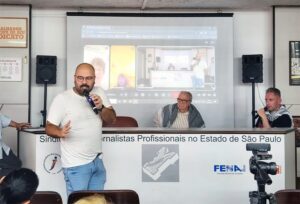
“We are the last African colony,” said Ettanji, who recently participated in the II Conference of the International Federation of Journalists and Solidarity Media to the Saarauí cause in Buenos Aires, displaying and debating the relevant documentary.
On the occasion, the President of the Media Team explained the reason for the images to always come out extremely censored, to have those responsible for all kinds of persecution and violence by the Moroccans, the Sahauí population to be prohibited from using their own names, of speaking Hassania [variedade do árabe magrebino] and to protest against injustices. “It is also denied the entry of journalists in the occupied territories, so all the images of the documentary were captured secret,” he said.
Therefore, more than the awards, such as the best short film of the Medellin International Festival, or the human rights and freedoms of the Valencia International Film Festival, the 3 Cameras stolen represents a strong stimulus that younger and younger Sahauís lift their voice against Moroccan occupation and fight to build an independent nation.
“Now we are victims, but also witnesses”
“In Western Sahara there was no information agencies, there was no international correspondents which meant there were no witnesses. Now we are victims, but also witnesses,” Ettanji said. From this understanding, he pointed out, “we decided to create this communicational project to inform and launch the voice of the Saharauí people, documenting the constant violations of human rights and the robbery of our natural resources”. “Until then, we are working in the clandestinity, criminalized, persecuted and when they identify us we have been tortured. We have even been sent to prison for our work of journalists. Because informing it is to exist. If not informs, do not exist, and the reign of Morocco knows that very well.
According to the president of the Media team, “there are many journalists who have been one, two, ten years in jail and today there are six journalists in Moroccan prisons, sentenced to ten, 20 years, 30 years and even perpetual chain.” “Some are without any contact with the outside world, not even receiving a visit, being unhealthy, without medical attention, in a state of complete neglect, suffering from chronic diseases due to abandonment and lack of proper diet,” he said.
Faced with such aggression, explained activist Saarauí, “we seek to give visibility to what Morocco invisibilizes, trying to show the world the hidden, using photos, videos and testimonies that we send to organizations and international media.” “We seek to convert these facts into articles that evidence the occupation and barbarities perpetrated by the reign against a peaceful, peaceful way, by their inalienable right to their self -determination and independence,” he added.
In this sense, Ahmed Ettanji believes that “the International Federation of Journalists and Media in Solidarity in support of the Saarauí cause, as well as the Latin American network, are crucial, to make the world hear the voices of this oppressed people.” “To count on such supportive professionals, with people who have journalistic ethics and work to denounce injustices, serves as a toolbox to boost the struggle for the truth,” he said.
Asked what he considered most serious in Moroccan occupation, Ettanji replied “not being the torture I suffered, arrests or threats, but seeing that there are people who were raped in front of the family, a woman who was violated in front of her mother.” Moreover, he added, “seeing a child who was born after his father has been arrested and has been unaware of him for ten years, a mother who has a missing son is still waiting for many years, not even knowing where he is, not even if he will know his whereabouts.”
In this clash, communicator Saarauí believes that social movements and civil society are essential “to mobilize and press the governments of the four countries of Latin America – Argentina, Brazil, Bahamas and Chile – who have not yet recognized the Arab Republic Saharauí Democratic (RASD), in the Brazilian case, in particular, a country ruled by a Progressive President, who suffered in his own president, Repression, will surely understand to another people victim of injustice. ”
Watch the short three stolen cameras
Source: vermelho.org.br