Published 10/22/2025 15:39 | Edited 10/22/2025 15:52
The Brics Grain Exchange proposal, officially launched in 2024, constitutes one of the most ambitious de-dollarization initiatives of the decade. This platform aims to directly challenge Chicago’s preponderant role in the global establishment of agricultural commodity prices, with relevant impacts on the international financial system based on the US dollar.
Its implementation represents a technical alternative to the existing model and stands as an instrument aimed at de-dollarization and the promotion of food sovereignty, with the aim of modifying the performance of international financial institutions in the commodities sector.
The Chicago Board of Trade (CBOT), the main global reference in the commodities market, together with the use of the dollar in negotiations, works as a restrictive mechanism for the commercial autonomy of large producers such as Brazil, Russia, India and China – four of the five main global grain producers.
In view of this scenario, there is growing mobilization on the part of the United States to safeguard its strategic role and limit advances that could alter the current configuration.
This article presents a critical analysis of the advances and possible impacts of the BRICS initiative in the multipolar geopolitical context.
Context and Central Motivation
The proposal for the creation of the Brics Grain Exchange was formally presented in October 2024, during the 16th Brics Summit, held in Kazan, Russia, under the leadership of President Vladimir Putin.
However, the topic had already figured in the group’s discussions since its inception, as evidenced in the “Bric’s Joint Statement on Global Security”, approved in June 2009, in Yekaterinburg, Russia.
The Kazan Declaration highlights the importance of resilient supply chains and agricultural trade for food security in developing countries and net food importers.
Furthermore, the Russian side’s initiative to create a grain trading platform within BRICS (“Brics Grain Exchange”) was officially welcomed and debated for potential future expansions, including other agricultural sectors.
The action signals a collective ambition to reconfigure the power dynamics associated with one of the most strategic sectors of the global economy.
Read more: A change will come: Blues, Brics and the multipolar transition
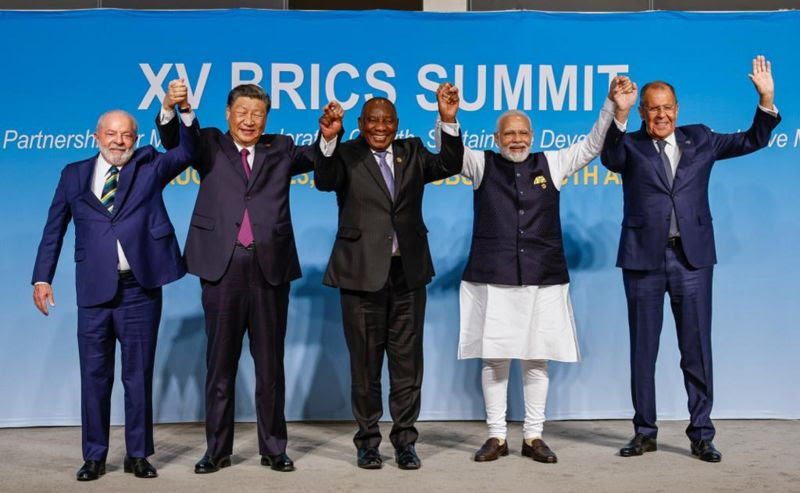
The expansion of BRICS in 2025, incorporating Egypt, the United Arab Emirates, Ethiopia, Indonesia and Iran, and with 11 partner countries, now represents around half of the world’s population and a significant portion of global food production and consumption.
Recent data indicates that current BRICS members account for approximately 44% of global grain production and consumption, and approximately 40% of global exports originate from the bloc and its partners.
Despite their productive capacity, the Brics countries remain “price takers” in markets whose values are mainly defined by Western exchanges such as the CBOT.
Driving Forces
1.Geopolitical Pillar: Dedollarization and Autonomy
The central objective lies in reducing dependence on the US dollar in international commodity transactions, seeking greater decision-making autonomy and reducing the structural power of the US over the international financial system.Trading grains in national currencies – or in the future, in a common BRICS unit of account – seeks to overcome challenges imposed by sanctions and legal restrictions from great powers. In this context, Russia assumes a prominent role as promoter of the proposal, especially after 2022.
This initiative is part of a broader agenda to strengthen the representation of the Global South and build an alternative global architecture.
2.Economic Logic: Price Control and Production Valuation
The project aims to correct the paradox of Brics being an agricultural power and, yet, not defining the prices of the main products it sells.The creation of “independent price indicators” aims for a fairer assessment of agricultural products, benefiting producers in the Global South. Some analysts believe that, depending on coordination between major exporters, the initiative could approach a dynamic similar to that of OPEC in oil.
3.Food and Nutrition Security Imperative
The platform presents itself as a tool to mitigate acute price volatility and supply crises, offering more predictable channels and less subject to speculation.For importing countries, the expectation is greater predictability in access to food and reduced vulnerability associated with speculative markets, in line with the UN Sustainable Development Goals (SDGs).
Structure, Operation and Potential Impacts
1.Operational Design
The central model provides for direct transactions between producers and buyers, with settlement in national currencies.
The Russian proposal, formally endorsed in Kazan and reiterated in ministerial meetings, is being structured by an interministerial group led by the Russian Ministry of Economic Development.
Future expansion is expected to include other strategic commodities, such as energy and metals.
2.Impacts and Expectations
Different Brics members may experience different impacts:
- Brazil may see a strengthening of agribusiness and a reduction in exposure to exchange rate volatility;
- Russia can consolidate leadership in wheat exports and strengthen institutional mechanisms to circumvent sanctions;
- China and India can guarantee stable access to grain markets, giving greater prestige to the Yuan and Rupee;
- South Africa and African countries can benefit from better logistical conditions and affordable prices;
- Members of the Middle East can achieve safer food supply routes.
3.Global Systemic Impacts
The initiative represents a direct challenge to the traditional system centered on the CBOT and the dollar, with the possibility of altering the flow of global liquidity and generating impacts such as inflationary pressure in the United States in the event of a reduction in demand for dollars.
Challenges, Skepticism and Future Perspectives
1. Structural and Political Obstacles
Among the main challenges, the conciliation of divergent interests between large exporters and importers within the BRICS stands out.Creating an exchange from scratch requires robust infrastructure, settlement systems, arbitration rules and regulatory harmonization between different national legal realities.
Furthermore, the market is still dominated by large multinational trading companies (ADM, Bunge, Cargill, Dreyfus), which hold the majority of exports with a broad consolidated structure.
Brics’ track record in reaching consensus to implement projects of great technical complexity inspires caution.
2.Future Perspectives
Although there is strong political mobilization, practical implementation is a long-term issue, remaining “still without clear definitions”.The experience of the New Development Bank (NDB) indicates that institutional movements of this size require time and coordination.
The success of the Grains Exchange could generate a multiplier effect on other commodities and on the international financial architecture.
Conclusion
The Brics Grain Exchange proposal represents an initiative with relevant transformative potential, although faced with considerable structural and political challenges.
It reflects the bloc’s ambition to not only integrate, but also influence and remodel the current global system, based on the projection of its collective weight in agribusiness.
Regardless of the developments, the political formalization of the proposal constitutes a political milestone for the Global South, signaling the transition from rhetoric to concrete institutionality.
What is in dispute is more than grain pricing: it is about the very contours and dynamics of world order in the 21st century
References:
(1) https://admin.bricscouncil.ru/assets/b64d1ad3-88ea-489e-997d-0efb49507365
(2) https://www.gov.br/mre/pt-br/canais_atendimento/imprensa/notas-a-imprensa/xvi-cupula-do-brics-2013-kazan-russia-22-a-24-de-outubro-de-2024-declaracao-final
(3) https://brics.br/pt-br/noticias/brics-compartilha-solucoes-para-promover-a-seguranca-alimentar-global
(4) https://brics.br/pt-br/sobre-o-brics/dados-sobre-o-brics
Source: vermelho.org.br