Published 06/08/2026 15:53 | Edited 06/08/2026 16:31
Bolivia’s Congress has taken an alarming step back in its fragile democracy. Amid a wave of protests that has lasted 37 days and paralyzed the country with roadblocks, parliamentarians approved the Law for the Regulation of States of Exception.
The new legislation, promoted by President Rodrigo Paz, not only revokes previous safeguards, but sets a dangerous precedent by authorizing the use of the Armed Forces to contain popular demonstrations and clear roads.
What the government sells as a tool of “institutional order” is, in practice, a blank check for the militarization of social conflict and the criminalization of political dissent.
The pretext of order and the flight to arms
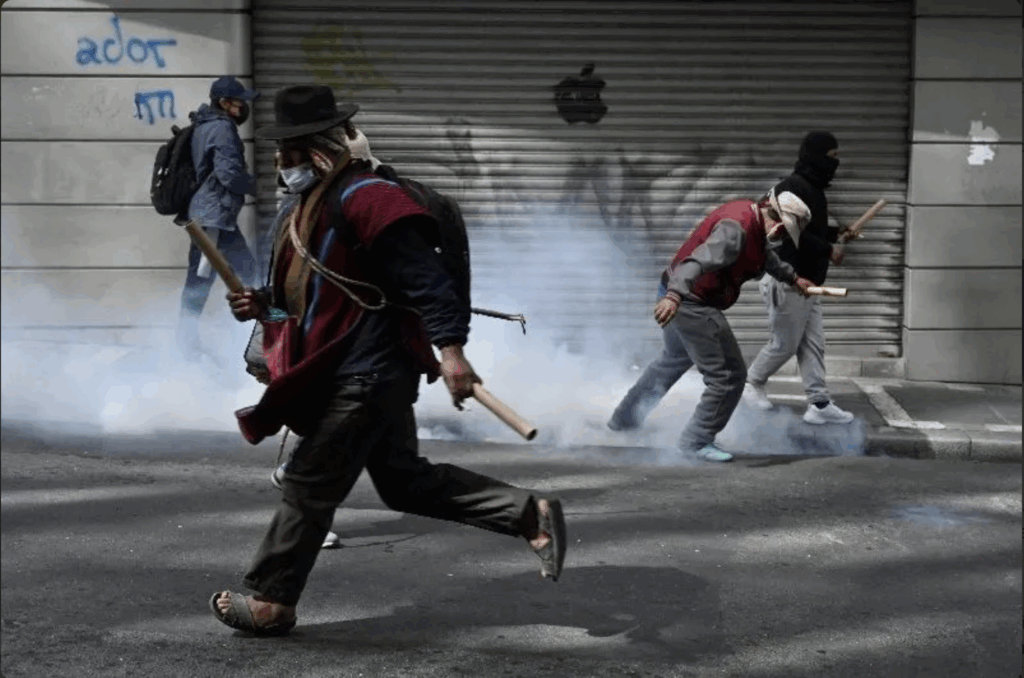
The political and economic crisis in Bolivia has reached a boiling point. For more than a month, tens of thousands of Bolivians have taken to the streets and roads in at least 59 locations, demanding Rodrigo Paz’s resignation and denouncing the economic collapse and the deterioration of basic services.
Instead of opening channels of dialogue and political negotiation, the Executive and its base in Congress opted for the route of force. The approval of the law appears not as a constitutional protection mechanism, but as a political survival tactic.
By facilitating the decree of the state of exception, the Paz government is trying to transform the Armed Forces into its praetorian guard, transferring the responsibility for resolving an impasse that is eminently political and social to the barracks.
A blank check for repression
The details of the new legislation reveal the magnitude of the setback. The law allows a possible state of exception to last up to 90 days, with the possibility of extension upon approval by Congress. Even more serious is the flexibility of military employment. The legislation openly authorizes the Armed Forces to control riots, repress blockades and restrict fundamental freedoms.
By repealing previous laws that imposed strict limits on presidential power in crisis situations, the Bolivian Parliament dismantles the checks and balances of the Democratic Rule of Law. The presidential decree will only have 72 hours to be considered by parliamentarians, which, in practice, guarantees the Executive carte blanche to act with an iron fist before any opposition can react.
The strength of the social and union fabric
The backbone of the resistance continues to be the Central Operária Boliviana (COB) and peasant and indigenous organizations such as the Pacto de Unidad and the CSUTCB (United Union of Peasant Workers of Bolivia). Faced with the criminalization of protests, these entities not only maintained road “blockades” — a historic tactic of economic and political pressure in Bolivia — but transformed them into points of humanitarian resistance and community assemblies (councils).
The cocalero movements and mining federations, which historically have a capacity for rapid and disciplined mobilization, act as the physical vanguard on the roads, defying the presence of the Armed Forces.
Legal shielding and Human Rights
With the state of exception suspending constitutional guarantees, the battle in the streets is accompanied by an intense legal war. Bolivia’s Asamblea Permanente de Derechos Humanos (APDHB), together with collectives of progressive lawyers, set up an emergency network to document abuses.
The focus of legal resistance is to prove that the use of the Armed Forces for riot control is resulting in systematic human rights violations. Collectives of feminists, youth organizations and land defenders are mapping arbitrary detentions, police and military violence, and curtailment of the right to travel. The strategic objective is to compile a robust dossier to take the Bolivian State to the Inter-American Commission on Human Rights (IACHR) and other UN forums, seeking precautionary measures that limit military action and protect social leaders.
The internationalization of conflict and the diplomacy of peoples
Social leaders, intellectuals and politicians from the Bolivian left are in direct contact with progressive governments in Latin America (such as Brazil, Colombia and Mexico) and with forums such as the Puebla Group and the São Paulo Forum.
The strategy is to “internationalize the complaint”, reminding the world that Bolivia is a critical point in the dispute over natural lithium and energy resources in the region.
Popular communication and the war of narratives
To break through the information blockade and the official narrative of “restoration of order”, the resistance resorted to its historic popular communication network. Community, mining and peasant radio stations, which were already targeted for destruction in 2019, have returned to operating as the main means of real-time communication.
They not only inform about troop advances and blockade locations, but maintain protesters’ morale, transmitting messages from social leaders and organizing logistical solidarity (collecting food and medicine for roadside camps). On social media, collectives of young people and progressive hackers work to expose military violence and circumvent censorship, using encryption to organize acts and prevent infiltration by intelligence agents.
Time as an ally of resistance
The analysis of Bolivian progressive movements points to a strategic conviction: states of exception are politically unsustainable in the long term. Bolivia’s recent history — from the Water War in 2000, through the Gas War in 2003, to resistance to the 2019 coup — teaches that military repression tends to further unify the opposition and drain the government’s legitimacy.
The progressive resistance knows that the economic cost of keeping the country paralyzed and the political cost of repressing its own people are double-edged weapons. The current strategy is one of active and peaceful, but uncompromising resistance: withstand military pressure, expose every abuse in the international sphere and keep the country in a state of permanent mobilization until Rodrigo Paz’s government is forced to revoke the exception law, remove troops from the streets and open a national dialogue without preconditions.
The ghost of military intervention
To understand the gravity of this movement, it is necessary to look at Bolivia’s recent history. The country bears the deep scars of the 2019 coup d’état, when the militarization of the streets resulted in massacres and the political persecution of popular leaders. Handing over control of internal security to the Armed Forces in a context of social upheaval is flirting with disaster. The national security doctrine, which should focus on defending borders, is once again distorted to turn its weapons against the people themselves.
The silence of large sectors of the international media and human rights organizations in the face of this legislative maneuver is deafening. What is at stake in Bolivia is not just the permanence of Rodrigo Paz, but popular sovereignty itself. By approving the state of exception law, the Bolivian Congress is not restoring order; it is institutionalizing the exception, paving the way for an authoritarianism that uses its uniform to silence the voices that echo in the squares.
Source: vermelho.org.br