Published 19/08/2025 10:51 | Edited 19/08/2025 11:46
In the middle of the meeting on Monday (18) at the White House, Donald Trump interrupted the meeting with Ukraine President Volodymyr Zelensky and seven European leaders to make a call to Vladimir Putin.
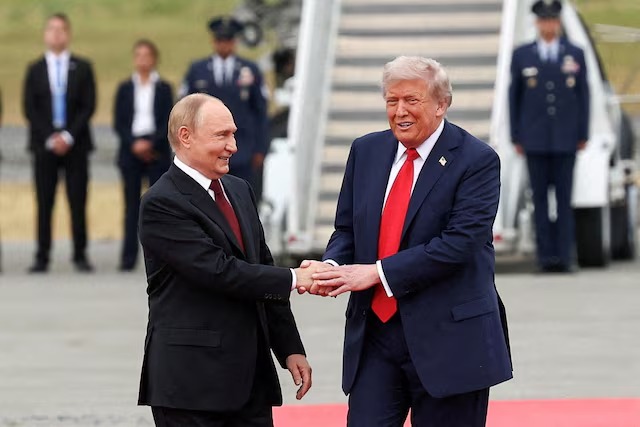
The scene, just three days after the US President extend the red carpet to the Kremlin boss in Anchorage, Alaska, at the first face-to-face meeting since the beginning of the war, became the symbol of the Russian advantage position in the conflict-a turnaround in relation to the correlation of forces of the last two years.
Last Friday’s meeting took place at Elmendorf-Richardson Air Base and marked the return of direct diplomacy between Washington and Moscow after years of isolation.
The interruption of the meeting exposed the central contradiction of the summit: while European leaders ran to Washington to support Zelensky and try to impose Trump the requirement of a ceasefire as a minimal condition for negotiations, the US president followed the opposite way.
If before Trump even supported the idea, after Anchorage adopted Moscow’s position that any agreement needs to be comprehensive, not limited to temporary suspension of combat.
In practice, the so -called “American Peace” presented in the White House did not represent a way out to Ukraine, but the clear demonstration of its limits in the face of Russia’s maneuvering force.
Proof of Kremlin’s advantageous position is the coverage of the international press. Reuters pointed out that “Trump has been pressured for a rapid end to Europe’s most lethal war in 80 years, and Kiev and his allies fear that he tries to impose an agreement in Russia.”
The text also recalled that in Anchorage, “the US President received Putin with pomp, although the Russian leader face accusations of war crimes at the International Criminal Court, which he denies.”
O New York TimesIn turn, he noted that the meeting in Washington made evidently the performative character of Trump’s diplomacy. “In practice, European leaders were hostage to the impulses of a single man, Trump,” the newspaper wrote.
The report stressed that the meeting ended without concrete definitions, but with the realization that the US President “adopted much of Putin’s approach to Ukraine” after the meeting in Alaska.
The “American peace” and the smoke curtain
Trump sought to maintain suspense around what will be American guarantees to Kiev. It did not offer “boots on the ground,” as troops referred to in Ukrainian territory, but promised to sell weapons and expand businesses from US companies in the country-promises seen by Kiev as well as a security guarantee.
In practice, as Gérard Araud, a former France-Basker in Washington, “In Anchorage and Washington, it was the triumph of emptiness and meaningless commitments. Nothing changed”.
The apparent cordiality between Trump and Zelensky, with compliments to the Ukrainian costume and laughs rehearsed in the Oval Hall, functioned as a smoke curtain to hide the true game: the conduct of a negotiation that is already drawing around Moscow’s terms.
Throughout the meeting, however, the presence of Putin pairou as a permanent shadow. Trump mentioned several times that he needed to update the Russian and, in the middle of the meeting, rose to call him.
According to European diplomats, the two discussed the possibility of a direct meeting between Putin and Zelensky, followed by a trilateral dome. Moscow was even suggested by Kremlin as headquarters, but Trump refused.
Still, the message was unambiguous: Kiev is not a protagonist, but ask for a board already dominated by Trump and Putin.
Moscow’s victory and the European retreat
The Europeans struggled to show unity, but in practice they had to swallow Trump’s retreat in relation to ceasefire.
“To be honest, we would all like to see a ceasefire,” said Merz. “I can’t imagine that the next meeting happens without one.” Trump, however, replied by stating that he has already resolved conflicts without having to interrupt the fighting.
Emmanuel Macron, who in 2022 failed to dissuade Putin of the War, merely stated that “President Trump is very confident in his ability to close an agreement, which is good news for all of us.”
Meanwhile, statements about security guarantees were limited to vague promises. Zelensky has announced that Kiev is willing to buy $ 90 billion in US weapons, a number that only reinforces the dependence on a fragile country.
For London, Paris and Berlin, the trip to Washington served more to contain damage than to open perspectives. “We were well prepared and well coordinated,” Merz said after the meeting. “We represent the same points of view, and I think this pleased the US President, who realized that Europeans are talking with one voice.”
Source: vermelho.org.br