Published 12/08/2025 15:34 | Edited 12/08/2025 16:24
A year after the lightning fall of Bashar al-Assad, Syria is still trying to understand the size of the political earthquake that shook the country – and the price of being dragged into the epicenter of the strategic dispute between the United States, Israel and regional powers.
The overthrow of the Syrian government, far from being just the result of internal dynamics, was the culmination of a long hybrid war that, since 2011, sought to weaken one of the last Arab governments that resisted the Western geopolitical agenda in the Middle East. With the rebel offensive led by the militant Islamic group Hayat Tahrir al-Sham (HTS) and the sudden military collapse in December 2024, what was sold as “liberation” quickly turned into a laboratory of instability, violence and fragmentation.
Today, Syria’s new government celebrates the first anniversary of a process that, for many analysts, represents less a transition and more the outcome of a destabilization operation – silently tolerated and, at key moments, enhanced by the interests of the US and Israel.
Read also: Israeli advance in Syria deepens crisis and post-Assad fragility
The Syrian tragedy and the media comedy
End of the Assad era: Syria experiences stalemate after coup that overthrew president
From the fall of Assad to the power vacuum: the beginning of chaos
The 11-day offensive that took Damascus and toppled Assad has thrown the country into a new phase of uncertainty. Although the civil war has officially ended, “post-Assad” has not brought stability. On the contrary:
- sectarian conflicts multiplied,
- Israel has drastically increased its air strikes,
- armed factions reorganized,
- entire regions disconnected from central power,
- and former Western allies began to demand political compensation.
The fall of the Baath (the nationalist party), the dissolution of militias and the start of a provisional government led by Ahmed al-Sharaa – former head of the HTS faction – did not eliminate historical tensions. On the contrary: they exposed the fragility of a country that, even after resisting 14 years of war, remains the target of external pressure and direct interventions.
Israel intensifies attacks and expands military influence
Since December 2024, Israel has intensified air strikes, ground incursions and military presence near Damascus, claiming “protection” of Druze minorities and “external threats”. In practice, it consolidated new zones of influence throughout southern Syria.
The interim government openly denounces what it calls the “exportation of crises” by Israel, accusing Tel Aviv of using its military campaign as a smokescreen for massacres in Gaza and as a means of shaping the strategic map of the region.
On several occasions, air bases have been destroyed, civilians have been killed in night operations and Israel has installed new checkpoints inside Syrian territory.
The Israeli message is clear: without Assad, Syria is a vulnerable country – and therefore easier to shape.
USA: from diplomatic isolation to sudden embrace
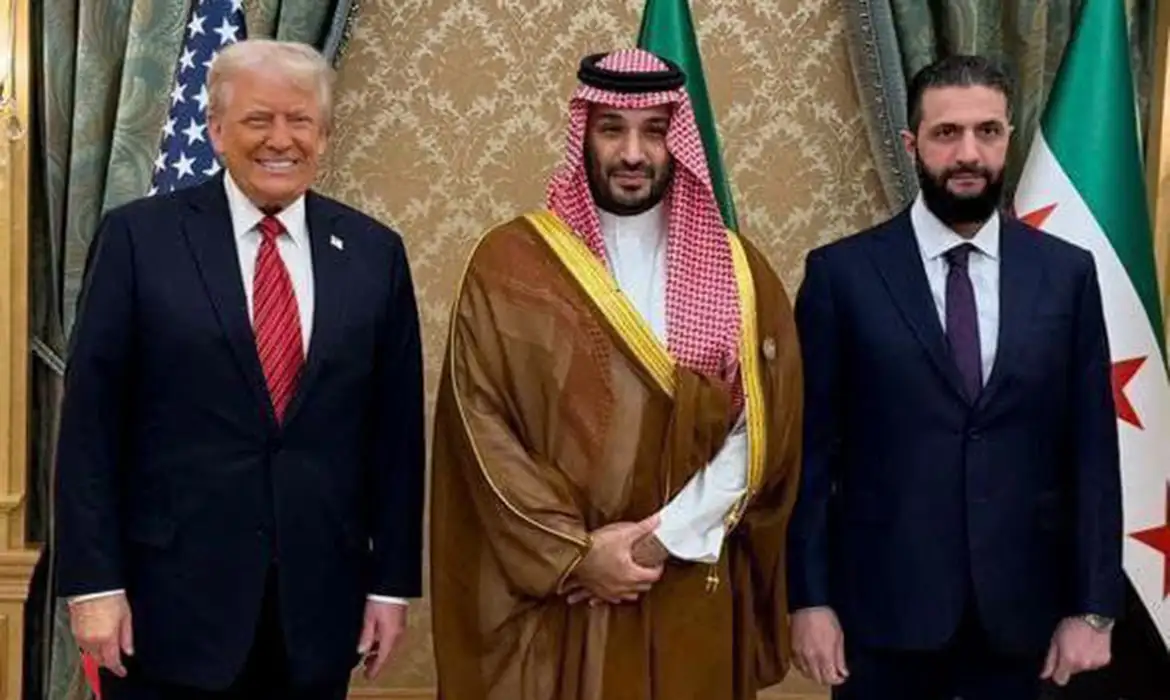
No move has caused as much shock as Washington’s rapid repositioning after Assad’s fall. After supporting sanctions and Syrian isolation for more than a decade, the Trump administration lifted economic restrictions, removed the new president from terrorism lists and established a direct dialogue channel in the Gulf.
The sudden “diplomatic embrace” reveals not only opportunism, but the quest to guarantee:
- influence over the transition process, containment of the Russian and Iranian advance, control of energy routes, and alignment with strategic regional allies, such as Saudi Arabia and Israel.
For critics of the interim government, this realignment suggests that Syria’s destiny is being redrawn not by Syrians, but by the powers that have disputed the geopolitics of the Middle East for decades.
Mass returns, but a destroyed country
Despite the institutional collapse, more than 2.6 million Syrians – including refugees abroad and internally displaced people – have returned to the country since 2024. For many, their return represents hope; for others, resignation.
The problem: they returned to ruins.
In cities like Homs, Idlib and Aleppo, families live in demolished homes, face insufficient wages and depend on humanitarian aid. The economy, devastated by years of Western sanctions, is still breathing hard.
The increase in returns also motivated European countries to reduce Syrian asylum applications – in a decision criticized as hasty and used for political purposes.
New Syria, old dangers: sectarian violence and revenge
The interim government promised “civil peace and transitional justice”, but what was seen was:
- explosion of armed revenge,
- Druze and Bedouin groups in bloody clashes,
- 1,300 documented retaliatory deaths,
- massacre of Alawites on the coast,
- offensives against minorities.
Even allies of the new government recognize that justice has not advanced and that the absence of legal mechanisms leaves room for summary executions and reorganization of armed groups.
Frozen transitional justice: missing persons and mass graves
With accusations of hundreds of thousands of people missing during the old regime and new allegations emerging, transitional justice is moving at a slow pace. For sectors of Syrian society, the risk is clear: without justice, peace will always be provisional.
Committees have been created, but there is still no legal framework, functional reparation mechanisms, guarantees of independence, nor political consensus on the extent of investigations.
Between speech and reality: the difficult task of the new government
Al-Sharaa tries to project itself as a moderate leader, promising:
- women empowerment,
- inclusion of minorities in government,
- institutional stability,
- rapprochement with Arab neighbors.
But internal criticism points out that:
- his trajectory at HTS worries human rights groups,
- violence against civilians remains high,
- territorial control remains fractured,
- and reconstruction depends almost entirely on external powers.
The future of Syria remains in the hands of foreign forces
One year later, Syria lives under the weight of a contradiction:
Assad has fallen, but the country’s sovereignty remains hijacked — now not just by global powers, but also by new armed actors and fragile and volatile geopolitical alliances.
US and Israeli interference, added to the dispute between the Saudis, Russians, Iranians and Europeans, has transformed the Syrian transition into a geopolitical chessboard that has little to do with the interests of its people.
While government celebrations take place in Hama and Damascus, the truth is that Syria remains divided between hope and fragility – and is still paying the price of being the target of a war that has always had less to do with democracy and much more to do with the dispute for hegemony in the Middle East.
Source: vermelho.org.br