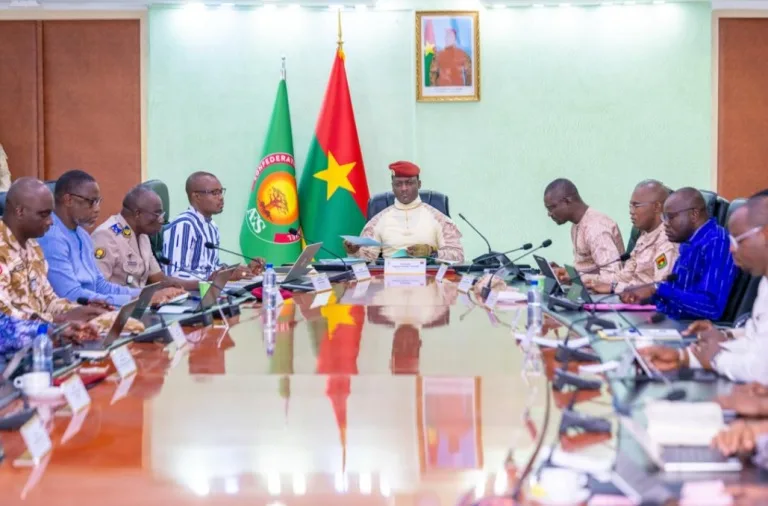
The president of Burkina Faso, Captain Ibrahim Traoré, completed his four years in charge of the country by inaugurating Raffinor-BF, the country’s first national gold refinery. “Burkina Faso’s gold must no longer just be extracted in Burkina Faso. It must be transformed, controlled, valued and certified in Burkina Faso”, declared Captain Traoré.
The initiative is financed by the State in partnership with the national private sector and has an announced capacity to process 164 tons of gold per year. The country has been reorganizing its mineral sector: in 2024, Burkina Faso approved a new mining code that expands the State’s participation in companies in the sector, establishes contributions to national development funds and introduces new tax obligations.
This movement is accompanied by a real war against jihadist groups, mainly organizations linked to Al-Qaeda and the Islamic State, which terrorize large areas of the country, leading to displacement across the country and intensifying supply difficulties.
Tibin, a village located 75 km from the capital Ouagadougou, has been suffering from this process. According to Salfo Sawadogo, resident of the village and founder of the Tibin Mebo Association (ATB), before the attacks, the village’s population was around 1,500 residents. Now there are more than two thousand.
“Many have already returned to their original homes, but nature has suffered an impact. Including some displaced people who were unable to return, we are more than 2,000 inhabitants”, he points out. Tibin, Sawadogo details, has only two wells, a three-grade school and no health center. “The closest is 6 km away”, he says.
His entity was created around four or five years ago to combat the difficulties created by the drought in the region. “The irregular distribution of rainfall in space and time causes periods of drought and the consequences are bad harvests, death of domestic animals, acceleration of erosion”, reports Sawadogo.
In view of this, he organizes training campaigns in the areas of health, sanitation, environmental protection and also activities aimed at generating income. The organization works “in close collaboration with the aspirations of the current government” and there is collaboration with the authorities.
“My village, like many others, finds itself in this situation. But the central government has been making efforts to boost development, although we have a lot to do”, he explains.
Terrorism
“Currently, terrorism is the only evil that plagues Burkina Faso. If we can, and I firmly believe we can, defeat this scourge, the development at all levels of activities that comrade president promised will be a reality”, he assesses.
Sawadogo reports that the fight intensified considerably with the expansion of the National Defense Force (VDP), the supply of state-of-the-art weapons, the mobilization of combat troops and the Burkinabe population in general.
Official data show that more than 1.3 million people displaced by violence managed to return to their cities; and more than 74% of the territory was recovered by the government.
“We have made very significant progress. Many locations under the control of terrorists have been liberated. Displaced populations have returned and the public administration, which was absent, has been reestablished”, confirms the activist.
“Currently, the situation is under control. Development goes hand in hand with the defense of the territory, and many works are underway”, he pointed out. About Traoré, in particular: “he has the support of the local population and is acclaimed from all sides, implementing a policy of mutual respect, as equals”.
In June 2026, Burkina Faso accused France of providing active support to terrorist networks operating in the Sahel. This was one of the main reasons for the definitive break in the country’s diplomatic relations with France. On June 26, 2026, the Burkinabe government accused the Élysée Palace of maintaining neocolonial ambitions.
“Faced with these imperialist plans to dominate our country and subjugate our people, we have chosen the path of responsibility and sovereignty,” declared Burkina Faso’s Minister of Communications, Gilbert Ouédraog.
Sawadogo summarizes the relationship between the two countries: “France does not just support terrorism, it is terrorism itself in the Sahel”. “It is a really good initiative to break with this France that is harming us”, he assesses.
The rupture escalated in the first year of government, in January 2023, when Traoré expelled the French ambassador Luc Hallade, accused of interfering in the country’s internal affairs. He demanded the withdrawal of French troops from the country and three other diplomats were expelled the following year. Bilateral military agreements have been suspended.
“Instead of letting us experience our true independence, France continues to impose many things on us. It interferes even at the highest levels of the State, to the point of imposing presidents on us to the detriment of others. Are we, Burkinabe, who live here, or is it France, located thousands of kilometers away, that should know what is good or bad for us?”, questioned the activist.
The diplomatic turn also affected the French media, which were expelled from the country, opening a flank for criticism regarding press freedom and human rights.
When asked about the topic, Sawadogo is categorical: “We, Burkinabe, are currently working and striving, first and foremost, to preserve our fundamental right: the right to life. The rest is just words, as we have to live before thinking about anything else.”
Relations with other countries
In December 2023, Moscow reopened its embassy in Ouagadougou, after 31 years of closure, marking a new phase of military and energy cooperation, including the construction of a nuclear power plant using Russian technology.
Along with Mali and Niger, Burkina Faso formalized, in July 2024, the Alliance of Sahel States, which provides for military cooperation, free movement of people and goods, and the creation of its own financing and development mechanisms.
The three countries were part of French West Africa (AOF) until they entered the war of independence in 1960: Niger on August 3, Burkina two days later, and Mali the following month. In 1984, the revolutionary government of Thomas Sankara renamed the country from Haute Volta to Burkina Faso, meaning “land of men of integrity”.
For the activist, the arrival of Traoré, who claims Sankara’s legacy, represented a change in security conditions and prospects for national development. “A large part of Burkina Faso was liberated with the arrival of Comrade Captain Ibrahim Traoré. The situation was chaotic before his arrival, with mass displacements of the population and loss of human life.”
Sawadogo also made a point of highlighting that, although the international press focuses on wars, violence is not part of Burkina Faso’s culture. “We are a country of peace, of honest, dignified and hard-working people. Burkina Faso is a hospitable country that respects others as itself”, he stated.
There is no shortage of tourist and cultural attractions for Brazilian tourism, he said, citing the Ouagadougou Pan-African Film and Television Festival (FESPACO), the Ouagadougou International Crafts Show (SIAO), the National Culture Week (SNC) and the best known: the Burkina Faso cycling tour. “These are big events, everyone is invited”, he concluded.
Source: www.brasildefato.com.br