More than an artistic expression, for this group of Venezuelan community members, theater is a political tool for transformation.
The play “Bolívar Didn’t Plow in the Sea” is an adaptation of an unpublished text by the playwright and writer, promoter of Brazilian political theater, Augusto Boal. The production, which brings together a group of ten activists from five socialist communes across Venezuela, is directed by Luciano Carvalho, theater director and member of the Culture sector of the Landless Rural Workers Movement (MST).
“We adapted and condensed the text into a piece of agitation and propaganda, updating the figure of Bolívar in the current context of kidnapping, international violence and imperialism in Venezuela”, says the director.
Check out the video report:
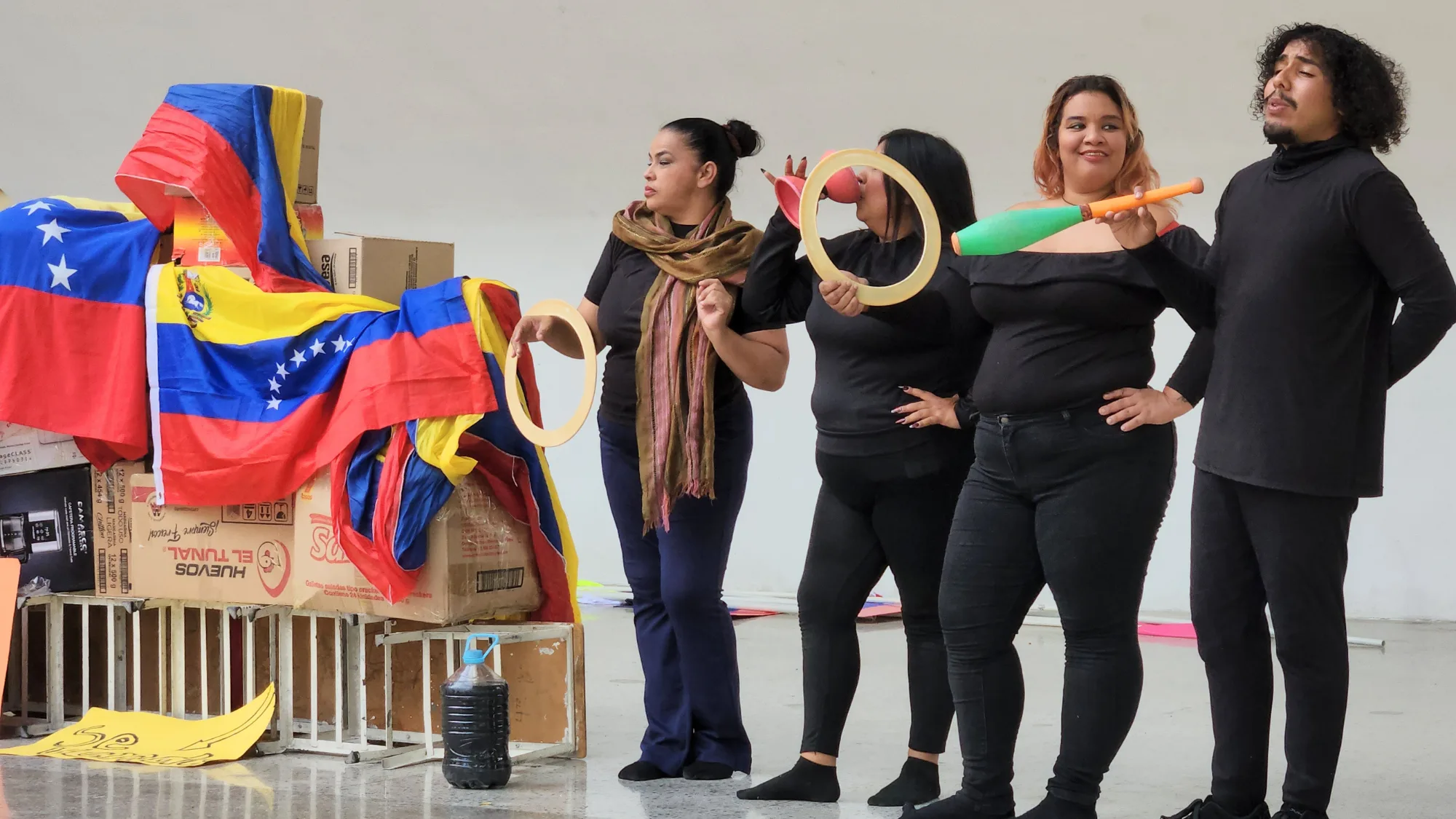
“We are working with ruptures. Venezuela has a theatrical tradition very much based on characters and melodrama, with costumes and sets that mimic historical eras. We work without period costumes or figurative scenarios. We adopt the perspective of an epic, dialectical, popular, political and poetic theater, simple and beautiful, using objects and clothing available in the communes themselves. We apply rupture procedures on a large scale, deconstructing the vision of the sacralized individual and addressing Bolívar based on his ideas and actions, which serve as a reference for the population and for all of Latin America”, explains Carvalho.
Breaking with traditional historical melodrama and the use of period costumes, the show adopted an epic, popular and poetic aesthetic, incorporating circus elements and clown language (a form of scenic expression based on exposing the body to ridicule, emotional truth and a direct and immediate relationship with the audience).
The proposal sought to deconstruct Simón Bolívar’s static vision, bringing his trajectory of struggles to the daily reality of the Venezuelan people. As Oliver Borges, a circus artist who makes up the cast of the play, tells us.
“I was very impacted by the traditional historical and artistic way of representing Bolívar. One of my fears was the public’s reaction to seeing Bolívar represented through the clown. However, this approach brings Bolívar closer to the people, removing him from pedestals and statues, showing that Bolívar is not an isolated individual, but that we are all Bolívar in some way. Politically, the main message is that Bolívar is still alive, he is not restricted to books or a statue, and if reproduces in our daily lives”, reports the actor.
For communal activists and educators in territories such as Comuna El Maizal and Comuna Carubarigua, popular theater acts as a strategic tool for communication and formation of political awareness. Paolis Casmirri says that the initiative aims to create multiplier centers in communes to train new generations of young people in political theater.
“I have always believed that theater profoundly influences people’s consciousness. Through images and voice, in addition to entertaining and awakening feelings, theater allows the message to be transmitted in a subtle and strategic way. Theater is a clean and strategic way of doing politics”, says Casmirri.
“It is essential that every left-wing activist is clear that this is a moment of firmness in the fight”, he adds.
The presentation at the Concha Acústica of Comuna Panal 2021 seems to have pleased the audience present. Yéssica Rodríguez, a teacher at the commune, highlighted the pedagogical nature of the work.
“Beautiful, attractive and pedagogical. It is attractive to children because it is dynamic. As a teacher, I consider it very beautiful to transmit the story to reach the hearts and minds of our children”, he said.
Niurka González came from far away to see the play, which, for her, is a powerful instrument for mobilizing youth.
“I thought it was brilliant and magnificent. These are initiatives that need to be revived for our children, especially nowadays, when many young people focus on other things.”
The project now intends to cover new territories with the message that culture and history belong to the organized people. Despite the nervousness of the debut, for Rosanesys Capielo, every minute was worth it.
“It was worth every minute, every frustration, every joy and every sleepless night. I feel proud and very happy to have been invited to join this multidisciplinary team. Although we come from different states, we managed to create a work dynamic in which we function as one body, and that is what we seek in the commune”, he exalts.
Source: www.brasildefato.com.br