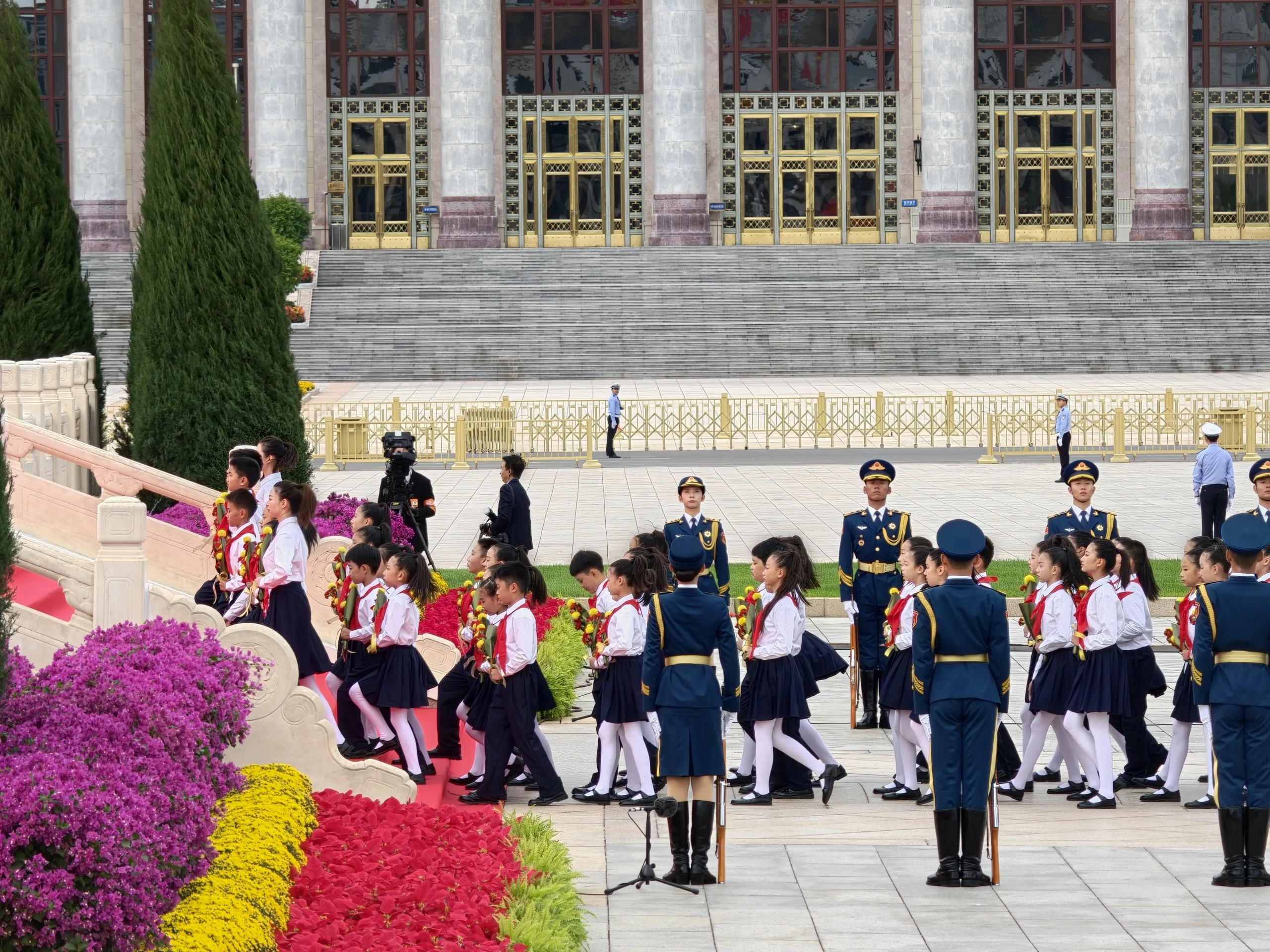
Chinese President Xi Jinping and other leaders of the Communist Party of China (CCP) and the State, along with hundreds of people from different sectors of the country, participated in the ceremony to pay homage to the martyrs of Chinese struggles in the modern period, laying flowers at the Monument to the People’s Heroes, in Tiananmen Square (Tiananmen), in Beijing, on the morning of this Wednesday (30), officially Martyrs’ Day in the country.
The monument is dedicated to the martyrs of the battles and wars of resistance fought between 1840, when the United Kingdom unilaterally attacked China, in what later became known as the First Opium War, and 1949, when the People’s Republic of China was founded.
China calls this period the Century of Humiliation. The monument, a large block of stone, has an inscription that marks three phases of resistance: the final stage of the War of Liberation, between 1946 and 1949, after the victory against Japanese aggression; the three decades from the May 4th Movement of 1919 to the founding of the People’s Republic; and the period beginning with the first British attack in 1840.
All seven members of the Standing Committee of the CPC Political Bureau, which is its core of day-to-day leadership, and of which Xi is also a member, participated in the ceremony.
Among the approximately 2,400 participants, there were representatives of youth, military personnel, workers from state-owned companies and even app delivery people. Among them, the Young Pioneers, a mass organization of Chinese children, which, according to official definition, serves as a reserve force for the cause of socialism and communism and for national rejuvenation, and which this year reached 112 million members.
From the cornerstone to Martyrs’ Day
On September 30, 1949, the eve of the proclamation of the People’s Republic of China, the memorial’s cornerstone was laid in Tiananmen Square and Mao Zedong read the text he wrote for the inscription, which calls on the people’s heroes to be eternally remembered “since the year 1840.” Construction of the monument began in August 1952 and was completed in April 1958.
In August 2014, the Standing Committee of the 12th National People’s Congress (ANP) approved the creation of Martyrs’ Day on September 30, the eve of the founding anniversary of the People’s Republic of China.
The Century of Humiliation
In 1840, at the height of its economic and naval power, the United Kingdom decided to attack China, ruled by the Qing Dynasty, which had banned opium smuggled into the country by the British. After defeating it, the United Kingdom imposes the first of unequal treaties on the dynasty: the cession of Hong Kong, the forced opening of five ports to foreign trade and the payment of heavy “indemnities” to the British government.
In the Second Opium War (1856–1860), France joined the United Kingdom, which resulted, among others, in the destruction and looting of the Summer Palace in Beijing, an episode that still remains alive in China’s memory, because thousands of pieces stolen in that invasion are still in the British Museum and the Palace of Fontainebleau, in France. Soon, the Sino-French War (1883–1885) consolidated French rule over Vietnam and paved the way for the creation of Indochina under its control.
Toward the end of the century, Japan, under the Meiji Restoration, also began attacks between 1894 and 1895, emerging victorious and forcing China to cede Taiwan and the Penghu Islands, in addition to million-dollar compensation at the time. Taiwan remained under Japanese colonial rule until it was defeated in 1945 in World War II or the Anti-Fascist World War.
In 1900, an alliance between troops from eight countries (United Kingdom, USA, France, Italy and the Russian, German, Austro-Hungarian and Japanese Empires) managed to occupy Beijing, in response to a Chinese nationalist uprising. The Boxer Protocol (1901) again imposed million-dollar “indemnities” and made the presence of foreign troops in the Chinese capital permanent.
On September 18, 1931, a false flag attack marked the beginning of the Japanese invasion of Manchuria, which ended with the occupation of the entire Chinese Northeast, where around 30 million people lived.
On July 7, 1937, Japan claimed that a soldier was lost in Wanping, near Beijing. The claim was false and was used as a trigger for a full-scale invasion that led to an eight-year war that ended in 1945 with the surrender of Japan.
Source: www.brasildefato.com.br