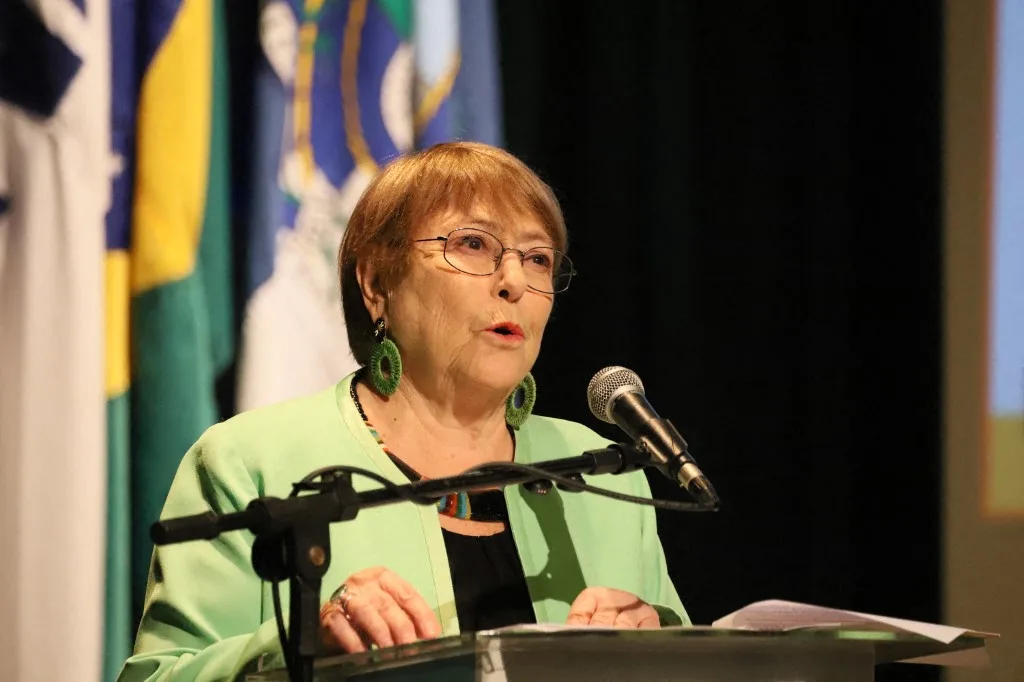
The former president of Chile Michele Bachelet announced, this Saturday (19), on her Instagram account, that she will not continue with her candidacy for Secretary-General of the United Nations (UN). In a video informing the decision, she states that the candidacy went “against the grain” by defending progressive principles and that she does not regret taking on the challenge.
“Some may believe that the moment was not opportune for a candidacy like the one I sought to represent, when the winds are blowing strongly against principles such as multilateralism; against international law, which is constantly violated; against the existence of climate change, which some deny despite scientific evidence; and against democracy and human rights, which are in danger,” he said.
She also thanked presidents Luiz Inácio Lula da Silva and Claudia Sheinbaum for their support. “I express my deepest gratitude to the presidents of Brazil, Luiz Inácio Lula da Silva, and of Mexico, Claudia Sheinbaum, who generously and wholeheartedly supported this candidacy from the beginning,” he declared.
In her speech, Bachelet did not mention the reasons for the move, but, in March, the recently inaugurated president of Chile, José Antonio Kast, withdrew his support for the candidacy, which had been presented the previous month with the support of former president Gabriel Boric. Last Friday (19), a sequence of informal consultations between members of the Security Council indicated that Bachelet had received only one vote of encouragement, while 11 members took a stand against her candidacy.
Former president of Chile for two terms, Bachelet was also the first deputy secretary and executive director of UN Women from 2010 to 2013. Through her work, UN Women led, supported and coordinated work aimed at gender equality and women’s empowerment globally. She also served as the United Nations High Commissioner for Human Rights from 2018 to 2022.
Now, the election continues between the former president of Costa Rica and leader of the UN Conference on Trade and Development, Rebeca Grynspan; the director general of the International Atomic Energy Agency (IAEA), Rafael Mariano Grossi, appointed by Argentina; and former president of Senegal Macky Sall, nominated by Burundi.
Source: www.brasildefato.com.br