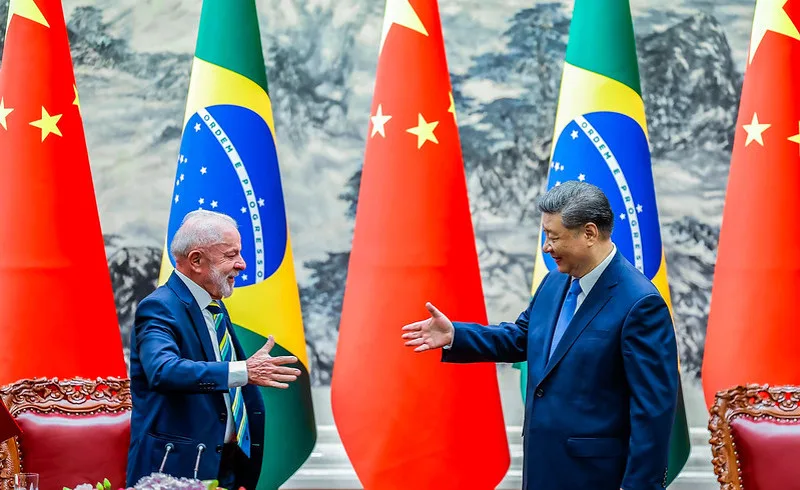
This week, the Chinese government received a letter from the Brazilian government, but did not reveal its content nor confirm whether there was a specific response from Xi Jinping to President Lula. Questioned by Brazil in fact This Thursday (17), during the regular press conference held by the Chinese Ministry of Foreign Affairs, spokesperson Guo Jiakun highlighted the communication between the two leaders and classified the current level of political trust between the two countries as high.
“In recent years, under the strategic guidance of the two presidents, China-Brazil relations have advanced by leaps and bounds, evolving from a comprehensive strategic partnership to a community with a shared future. President Xi Jinping and President Lula maintain close communication through different means, demonstrating the high level of political trust between our two countries,” said Guo.
The letter was delivered the day before by President Lula’s special advisor, Celso Amorim, to Xi Jinping, during Amorim’s meeting with Chinese Foreign Minister, Wang Yi, in Beijing.
At the meeting, Wang conveyed Xi’s greetings to Lula and defended the strengthening of strategic coordination between the two countries, highlighting bilateral cooperation as part of efforts to strengthen the unity of the Global South.
The second question asked by Brazil in fact dealt with pressure from the United States on Brazil. The question mentioned Washington’s criticism of the way the Brazilian government confronts organized crime, the possibility of sanctions against ministers of the Federal Supreme Court and the proximity of the 2026 Brazilian presidential elections.
Guo responded directly, reiterating the Chinese position on non-interference in the internal affairs of other countries: “China upholds the principle of non-interference in the internal affairs of other countries. We hope that the Brazilian elections will take place in a stable and peaceful manner.”
The declaration comes at a time of intensifying discussions about sovereignty, international relations and external interference in Latin America. For China, non-interference in the affairs of other countries is presented as a principle of its foreign policy.
Artificial intelligence and technological autonomy
The position expressed by Guo at the press conference is in line with one of the themes addressed by Amorim during his visit to Beijing. In an exclusive interview with Brazil in fact this Thursday, Lula’s special advisor highlighted the possibility of expanding cooperation with China in areas such as artificial intelligence, supercomputing, space technology and satellites, topics that were among the subjects discussed in his meeting with Wang Yi.
According to the Chinese Ministry of Foreign Affairs, Wang stated that China values Brazil’s decision to join the World Organization for Cooperation in Artificial Intelligence (Waico) and expressed a willingness to expand bilateral cooperation in the area.
Created in July, in Shanghai, Waico is an independent intergovernmental organization focused on international cooperation in artificial intelligence. Among its objectives are the promotion of safe, ethical, trustworthy and people-centered AI, as well as scientific and technological cooperation and the development of open source ecosystems.
For Amorim, the open nature of technology can increase the autonomy of countries in the Global South, reinforcing that there are still differences between countries regarding the development and regulation of artificial intelligence, but this does not prevent advances in areas of common interest.
Amorim also highlighted the multilateral dimension of the initiative, mentioning the presence of the secretary-general of the United Nations (UN) at the Waico founding ceremony: “I want to emphasize that, in the case of Waico, the UN secretary-general was present, who gave Waico, in a certain way, a kind of multilateral blessing to the event.”
Critical minerals and rare earths
Another axis of the conversations was the need to expand technological cooperation based on critical minerals and rare earths. In Brazil, Law No. 15,506, sanctioned on September 16, created the National Policy for Critical and Strategic Minerals (PNMCE) and the National Council for the Industrialization of Critical and Strategic Minerals (Cimce), with measures aimed at research, mining, processing and mineral transformation.
Amorim related the topic to the Brazilian technological development strategy and the need to add value to mineral resources. “In the case of Brazil, President Lula has always reiterated that we don’t just want to be exporters of minerals. I think it’s another aspect: we want to benefit, value, use scientifically.”
Lula’s advisor also highlighted that the country needs to identify its own strategic needs, including defense, science, space, supercomputing, energy and the automobile industry.
“I think we need to exchange experiences with China, which is also very rich in this material. It’s not that it needs ours, nor will we necessarily need itss. It’s more a matter of exchanging experiences on how to carry out this processing and how to use it for technological development. It can be cooperative, but it has to maintain a large degree of autonomy.”
Multilateralism
The same concern appears in Amorim’s assessment of multilateralism and financial cooperation. According to him, Brazil and China have an important convergence in defending the multilateral system and can expand cooperation within the scope of BRICS and its institutions.
“China, like Brazil, has a natural vocation for multilateralism. I even quoted a phrase I had read from Xi Jinping, that it is necessary to carry the torch of multilateralism, because it is fundamental for them, for the country that has progressed, as it has progressed, within a multilateral system of respect, at least some respect for international rules. And Brazil, ditto, also needs this to be able to move forward.”
The 18th BRICS Summit was held on September 12 and 13, in New Delhi, India. The New Development Bank (NDB), created by the group, participated in the meeting and had its role in financing sustainable development and infrastructure recognized in the summit declaration.
For Amorim, financial and monetary cooperation is an area that can gain space in relations between countries in the Global South. “I think this is also a field in which China can, without a doubt, help and also help the BRICS Bank to be increasingly active.”
Source: www.brasildefato.com.br