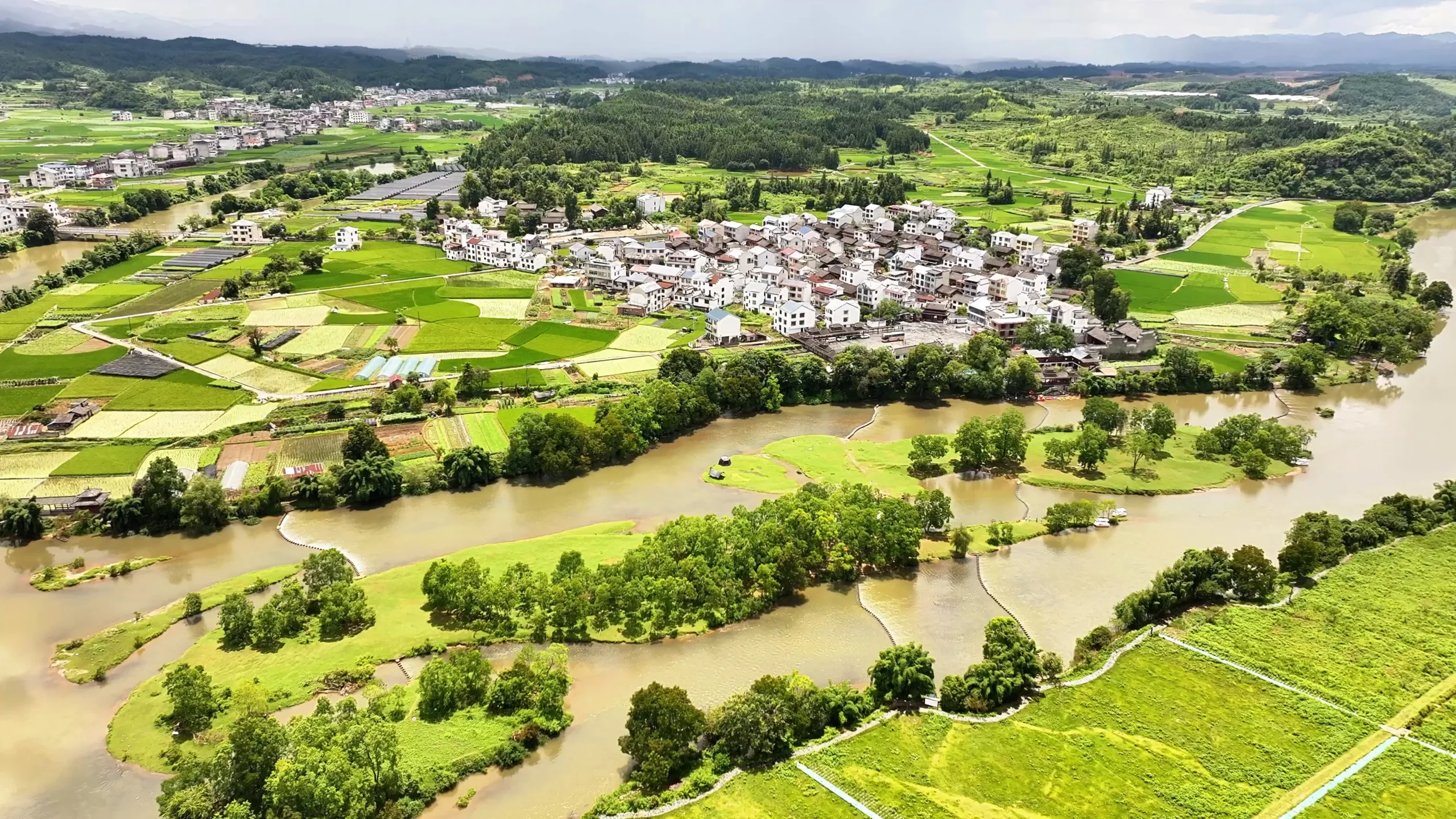
Leitun is one of 15 pilot villages in Jinping County chosen for Guizhou Province’s integrated rural revitalization program. With 3.5 million yuan (about R$2.8 million) invested, almost four kilometers of irrigation canals were built, three hydraulic pumps were replaced and 1.6 kilometers of roads were paved.
Among the results are an increase in rice production by 20% compared to the period before the works and an increase in the per capita income of residents from 8,000 yuan (around R$6,320) to 27,300 yuan (around R$21,600) between 2021 and 2025. Tourism income in the 648-year-old village was also boosted, which, in turn, increased as a result of the works.
Long Haiyuan, secretary of the Communist Party of China (CPC) committee in the village, told the Brazil in fact that “the most significant improvements were in the sewage treatment system, the paved road network and the irrigation canals”.
The paving of roads also transformed the flow of production. “When we built the first residential access roads, some residents voluntarily gave up part of their land whenever the road needed to pass through part of their land,” says Long. “With improved transportation, vegetable cultivation flourished: outside traders started to come and buy local production directly.”
Zhu Xiang, a resident of Leitun, says that residents have always dedicated themselves to the traditional cultivation of vegetables and fruits. “Cucumber is the most famous vegetable here. We supply Jinping and Liping counties, which is why we have a reputation as a land of plenty.” The cultivated area exceeds 400 mu, about 27 hectares. With little land available for expansion, rural tourism began to become the main economic activity.
A sandbank as a tourist attraction
The main tourism asset is a nearly 7-hectare natural sandbank in the middle of the Liangjiang River. In the 1990s, residents extracted and sold sand from the site to guarantee income. The degradation led then-Party committee secretary Long Xiangyuan to convene an assembly in 2002, which approved a community ordinance banning logging and created a watchdog group to curb it. After more than two decades of ecological recovery, the bank has become the hub of Leitun’s tourism.
“Over the course of one or two decades, the country has invested heavily in supporting rural tourism here, with significant social results. Tourist arrivals remain high in three of the four seasons, with winter being the only low season. Tourism has brought stable and significant income growth for all residents”, says Zhu Xiang. Leitun receives almost 200,000 visitors per year, offering camping, water sports and cultural tourism.
East-West Cooperation
Part of the investment in Leitun came from outside Guizhou province. The East-West Cooperation program allocates resources from more developed municipalities on the coast to municipalities in the interior of the country. Since 2021, Jinping County receives 55 million yuan per year (about R$42 million) from Foshan, an industrial city in Guangdong province. More than half goes to productive projects.
One of the projects financed by the program is the Jianglu Gengdu Di guesthouse, built with 16.8 million yuan (about R$13.3 million). The inn transfers 25% of the room rent and 10% of the food area rent to the village’s collective fund.
In 2021, a master plan established that all new constructions must follow the traditional style of the place. “The traditional architecture of Leitun is dominated by the Huizhou style, with dark gray tiles, white walls and trestle-shaped walls,” explains Long.
Leitun was founded as a military garrison in the Ming dynasty in the 14th century and has since been home to the Han, Miao and Dong ethnicities. “Our prefecture, Qiandongnan Miao and Dong Autonomous Prefecture, has deep Miao and Dong traditional cultures and very particular folk customs,” says Long. “The interethnic marriage between Han, Miao and Dong residents mixed and reconfigured local customs, forming unique integrated cultural characteristics,” he highlights.
The central government has awarded Leitun five national titles: model village, rural tourism, forestry, ecological culture and 3A level tourist area. The Guizhou provincial government included Leitun among the ten most beautiful villages in the region.
“We launched rural tourism in 2021, and it has become one of the main drivers of income growth, mainly through two paths: vegetable cultivation and sales to tourists who visit the village for cultural experiences,” says Long Haiyuan.
Source: www.brasildefato.com.br