Few stories from the early history of North America have captured the imagination quite like the mystery of the Roanoke Colony. In the late 16th century, English settlers established a small community on Roanoke Island, off the coast of what is now North Carolina. Within a few years, the settlement had disappeared.
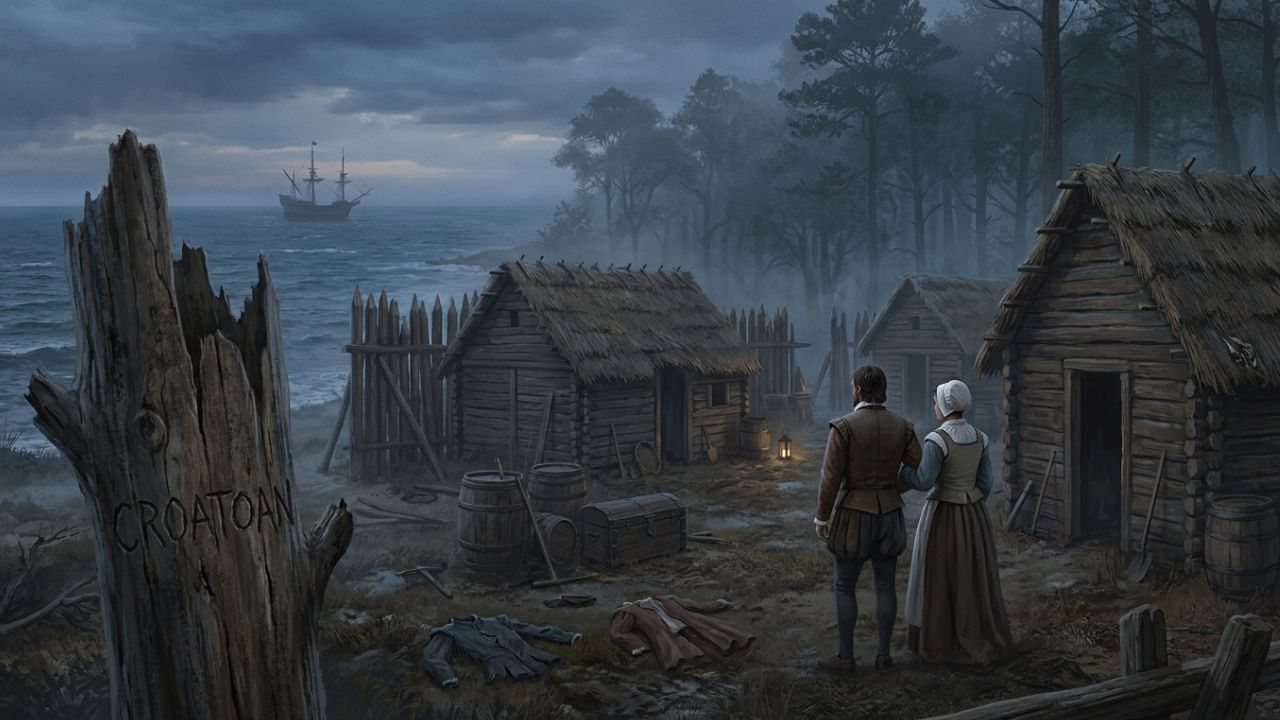
There was no clear record of a massacre. No bodies were found. No detailed account explained what had happened. Instead, investigators discovered a handful of cryptic clues, including the word “CROATOAN” carved into wood.
More than four centuries later, the fate of the colonists remains uncertain. Historians, archaeologists, and researchers have proposed numerous explanations, from integration with nearby Indigenous communities to starvation, disease, conflict, and relocation. The Roanoke mystery has also become one of the most enduring legends in American history.
To understand how the settlers disappeared, however, it is necessary to begin with the ambitious English project that brought them across the Atlantic.
🌊 England’s Gamble in the New World
During the reign of Queen Elizabeth I, England was increasingly interested in establishing colonies in North America. Spain had already built a powerful empire across much of the Americas, while France was also exploring and claiming territory.
English privateer and explorer Sir Walter Raleigh became one of the leading figures behind England’s colonial ambitions. In 1584, Raleigh received a royal charter allowing him to explore and establish settlements in lands that England claimed.
The first expeditions surveyed the North American coastline and encountered the region now known as North Carolina. English explorers were impressed by its natural resources and saw the possibility of establishing a permanent settlement.
In 1585, an English colony was established on Roanoke Island. The settlement struggled almost immediately. Relations with some Indigenous groups deteriorated, supplies were limited, and the colonists found the challenges of maintaining a permanent community far greater than expected.
The first colony eventually abandoned the island and returned to England in 1586.
But the English did not give up.
⛵ The 1587 Expedition
A second major attempt began in 1587 under the leadership of John White, an artist, mapmaker, and governor of the new colony.
Unlike the earlier expedition, this group included families and children. The intention was no longer simply to explore or establish a temporary military outpost. The English wanted to create a permanent settlement.
The expedition reached Roanoke Island in July 1587.
Among the settlers were John White’s daughter, Eleanor Dare, and her husband, Ananias Dare. Soon after arriving, Eleanor gave birth to a daughter named Virginia Dare, who became the first English child known to have been born in the territory that would later become the United States.
Virginia’s birth was celebrated as a symbol of the colony’s future.
But the settlement’s prospects were far from secure.
The colonists needed food, tools, weapons, agricultural supplies, and reinforcements. Their survival depended heavily on relationships with Indigenous communities and on continued support from England.
That support would soon be interrupted.
👶 The Birth of Virginia Dare
Virginia Dare’s birth on August 18, 1587, was an important event in the colony’s history.
She was born at a moment when the English settlement was attempting to establish itself permanently in an unfamiliar environment. Her birth represented the possibility that an English-speaking community could develop in North America.
Yet the colony faced serious difficulties. The settlers had arrived late in the growing season, and food supplies were limited. Some earlier relationships with Indigenous communities had already deteriorated.
John White eventually made the difficult decision to return to England to obtain additional supplies.
He expected to come back quickly.
Instead, circumstances in Europe would keep him away for years.
⚔️ War With Spain Changes Everything
In 1588, England faced the threat of the Spanish Armada, a massive Spanish naval force sent against England.
Because of the looming conflict, English ships and resources were redirected toward national defense. John White’s return to Roanoke was delayed.
The delay proved disastrous for the settlement.
White eventually returned to the colony in 1590, roughly three years after leaving. By then, Roanoke Island had been transformed.
The settlers were gone.
There was no obvious sign of a battle. No large group of bodies. No abandoned settlement containing evidence of a sudden catastrophe.
Instead, White found clues that would become central to the mystery.
🌲 The Strange Word “CROATOAN”
One of the most famous discoveries at Roanoke was a word carved into a wooden post: CROATOAN.
Another location reportedly contained the letters “CRO”, suggesting that the settlers may have begun leaving a message elsewhere before completing it.
The word Croatoan was significant.
Croatoan referred to an Indigenous people and also to an island located south of Roanoke Island, associated with the modern-day Outer Banks region. According to accounts from the period, White had instructed the colonists to leave a message indicating where they had gone if they were forced to abandon the settlement.
There was apparently also an agreed symbol that would indicate if the colonists had left because of danger.
White found no such symbol.
Instead, he found “CROATOAN.”
This led him to believe that the colonists may have relocated voluntarily toward Croatoan Island.
But before White could investigate, a storm and difficult conditions forced him to abandon the search.
The mystery deepened.
🧭 What Happened to the Colonists?
Over the centuries, several major theories have emerged.
🏕️ Theory One: The Colonists Joined Indigenous Communities
One of the most widely discussed possibilities is that the Roanoke settlers gradually integrated into neighboring Indigenous communities.
The colony was small and vulnerable. By joining established communities, the settlers could have gained access to food, shelter, agricultural knowledge, and protection.
This theory is especially attractive because “CROATOAN” appears to indicate a destination rather than a warning.
The colonists may simply have moved.
There are also later accounts and archaeological findings that have encouraged researchers to investigate possible English influence among Indigenous communities in the region.
However, proving that the entire Roanoke population integrated into another community remains difficult.
No single archaeological discovery has definitively identified the missing colonists.
🌾 Theory Two: Hunger and Environmental Pressure
Another possibility is that the settlers were unable to survive independently.
The colony was established under difficult circumstances. The settlers depended on supplies from England, yet those supplies were delayed. Agriculture required knowledge of the local environment, while weather, crop failures, disease, and food shortages could create enormous risks.
Rather than dying in one dramatic event, the colonists may have dispersed in smaller groups.
Some could have moved inland. Others may have joined Indigenous communities. Still others could have died from disease or starvation.
A gradual disappearance would explain why no mass grave or obvious battlefield was discovered.
⚔️ Theory Three: Conflict With Indigenous Groups
Conflict is another possible explanation.
The English colonists entered a region inhabited by established Indigenous societies with their own political relationships, territories, resources, and rivalries. European settlement inevitably created tensions.
Some historians have therefore considered the possibility that the colonists were attacked or killed.
However, the absence of clear archaeological evidence for a large-scale massacre makes this theory less convincing as a complete explanation.
It remains possible that some settlers died violently while others escaped or relocated.
🌧️ Theory Four: A Combination of Events
The most realistic explanation may involve several factors rather than a single dramatic event.
The Roanoke settlers faced shortages, isolation, disease, political uncertainty, Indigenous conflicts, and an unreliable supply system.
A community under those conditions could fragment quickly.
Some settlers may have moved toward Croatoan. Others could have traveled inland. Some may have died. Others may have assimilated into Indigenous communities.
If that happened, the mystery exists partly because there was never one single disappearance.
Instead, the colony may have gradually dissolved.
🧬 Archaeology Searches for Answers
Modern archaeology has transformed the investigation.
Researchers have examined Roanoke Island and surrounding areas for evidence of European settlement, Indigenous interaction, trade, and migration.
One important area of research has involved Hatteras Island, historically associated with the Croatoan people. Archaeologists have found European artifacts in Indigenous contexts, including objects that demonstrate contact between Europeans and Native communities.
Such discoveries do not prove that the entire Roanoke colony settled there. But they demonstrate that Europeans and Indigenous populations interacted in the region.
Researchers have also investigated inland locations, including areas around the Albemarle Sound and other parts of present-day North Carolina.
The search continues because the colonists did not necessarily remain in one place.
If they relocated, evidence of their lives could be scattered across a large geographic area.
🔎 The Dare Stones and a Famous Hoax
The Roanoke mystery has attracted not only serious historical research but also elaborate hoaxes.
In 1937, a stone supposedly containing a message from Eleanor Dare was presented as evidence that members of the colony had survived.
The stone described a dramatic story involving violence, death, and migration.
The discovery initially generated considerable excitement. However, scholars eventually determined that the stone was almost certainly a modern forgery.
The episode demonstrates why the Roanoke mystery is so difficult to investigate.
Because the original evidence is limited, almost any apparent discovery can attract enormous attention.
Separating authentic archaeological evidence from fabricated stories remains one of the central challenges surrounding the colony.
🧩 The Mystery of “CROATOAN”
The word carved into the post remains the most intriguing clue.
If the settlers intended to tell John White where they had gone, “CROATOAN” may have been a straightforward message.
But there are unanswered questions.
Why did the colonists leave no more detailed explanation?
Why did White find no clear sign indicating that they had left voluntarily?
Did the settlers actually reach Croatoan?
Did everyone go together?
What happened to Virginia Dare?
Did some settlers remain behind while others moved?
And why has no definitive settlement associated with them been identified?
These questions have allowed the mystery to survive for generations.
📜 Why the Roanoke Mystery Endures
The disappearance of Roanoke is compelling because it sits at the intersection of exploration, colonial ambition, Indigenous history, archaeology, and legend.
It is tempting to imagine a single dramatic night in which an entire settlement vanished.
The historical reality was probably more complicated.
The colony was small. Its inhabitants lived in a dangerous and uncertain environment. They were separated from England by thousands of miles of ocean and depended on irregular communication and supplies.
The settlers also entered a landscape that already contained complex Indigenous societies. Their survival depended on relationships with people who possessed knowledge of the land that the English did not.
Seen in this context, Roanoke may not have been a mysterious disappearance in the supernatural sense.
It may have been the story of a struggling community that adapted, relocated, fragmented, or disappeared into other populations.
🕯️ A Mystery Without a Final Answer
More than 400 years after John White returned to Roanoke Island, the ultimate fate of the colonists remains unresolved.
The evidence suggests several possibilities, but none has been universally accepted as the complete answer.
The word “CROATOAN” remains the most famous clue, and it continues to support the possibility that at least some settlers moved southward and interacted with Indigenous communities.
Other colonists may have traveled inland. Some may have died from disease, hunger, or conflict. Their descendants, if they survived and integrated into other communities, may have left no obvious archaeological signature.
The mystery therefore remains open.
Roanoke reminds us that history is not always a complete record of the past. Sometimes the surviving evidence consists of fragments: a carved word, an abandoned settlement, a delayed expedition, and generations of unanswered questions.
That uncertainty is precisely what has made the Lost Colony one of America’s most enduring historical mysteries.
The colonists left behind no definitive final message.
They left only a word.
CROATOAN.
And four centuries later, that word still invites the same question: Where did the people of Roanoke go?