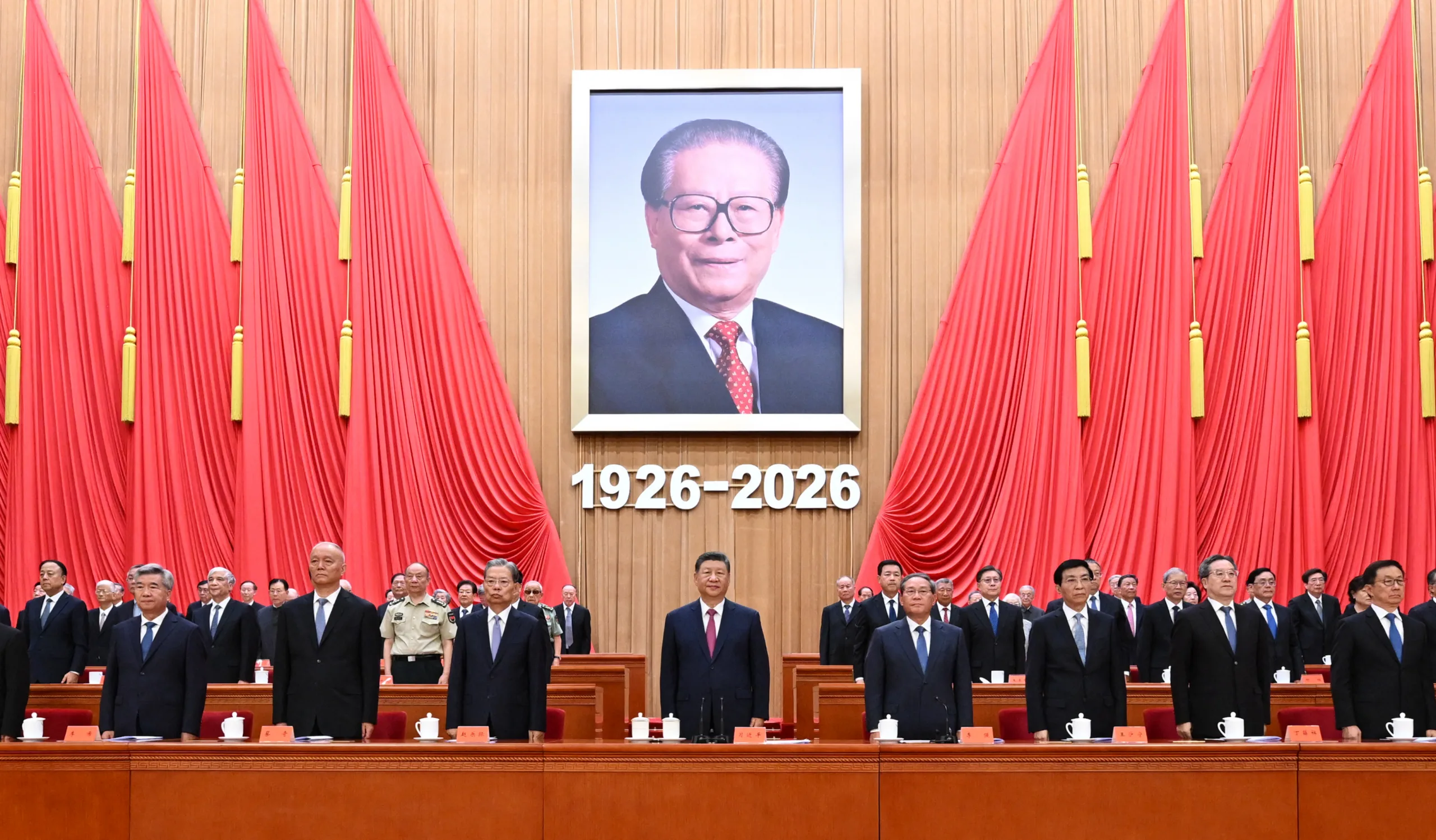
Chinese President Xi Jinping paid tribute to Jiang Zemin this Monday (17), the centenary of his birth. In a speech at the Great Hall of the People, Xi said Jiang Zemin had created “a new scenario of comprehensive reform and opening up, achieving a moderately prosperous society for the people and successfully pushing socialism with Chinese characteristics into the 21st century.”
Xi praised the leader’s resistance to the 1997 Asian financial crisis and the trade openness model that maintained public ownership as the basis of the economic system.
The Chinese leader defined the leader as a “great Marxist, a great proletarian revolutionary, statesman, military strategist and diplomat, a long-time communist fighter, an exceptional leader of the great cause of socialism with Chinese characteristics”.
Xi also highlighted that Jiang led the return of Hong Kong, in 1997, and Macau, in 1999, to China. He also highlighted his role in implementing the “1992 Consensus” between the island of Taiwan and mainland China, which consolidated the One China principle between both parties.
During the speech, Xi took the opportunity to talk about China’s current challenges and objectives: “In this new journey, we must adhere to the combination of the basic principles of Marxism with the specific realities of China and its rich traditional culture, responding scientifically to the questions posed by China, the world, the people and the era, constantly opening new horizons for the sinization and modernization of Marxism and always maintaining its vigorous vitality and dynamism.”
1997 crisis and access to the global market
When the Asian financial crisis broke out in 1997, Thailand, Indonesia and South Korea turned to the International Monetary Fund (IMF) under conditions of severe cuts in public services and forced currency devaluation. China maintained the yuan’s parity and did not follow the rules. Xi credited Jiang with “successfully resisting the impact of the Asian financial crisis.”
Joining the World Trade Organization (WTO), concluded in December 2001 after 15 years of negotiations, opened foreign markets on a massive scale for Chinese industry. “It insisted on the combination of ‘drawing in’ and ‘going out’, using openness to promote reform and development, and led us to successful entry into the WTO, forming a new pattern of opening up to the outside world,” Xi said.
The “Three Representations” and the renewal of the Party
Xi described Jiang as the creator of the “Three Representations,” a doctrine that defined the Communist Party of China (CPC) as representing advanced productive forces, advanced culture and the fundamental interests of the majority of the population. The formulation responded, said the Chinese president, to the question of “what kind of party to build and how to build it”, deepening the understanding of socialism with Chinese characteristics.
Jiang Zemin was born on August 17, 1926, in Yangzhou, Jiangsu province (in eastern China), into a family of intellectuals. He joined the Party in April 1946. As secretary of the CCP in Shanghai between 1987 and 1989, he promoted planning for the development of Pudong, which in the following decades would become one of the main financial centers in the world. In June 1989, he was elected general secretary of the CPC Central Committee. In 1993, he also assumed the presidency of the People’s Republic of China, positions he held for 13 and 10 years, respectively, until voluntarily stepping away from the central leadership at the 16th National Congress, in 2002. He died in November 2022, aged 96.
Xi said Jiang Zemin was “steadfast in his communist ideals, infinitely loyal to the Party and the people, and tirelessly dedicated to the cause of the Party and the people.” And he quoted a phrase from him: “Our fundamental political beliefs as communists are socialism and communism, and our worldview is Marxist dialectical materialism and historical materialism. This must never be shaken, not even in the slightest.”
Source: www.brasildefato.com.br