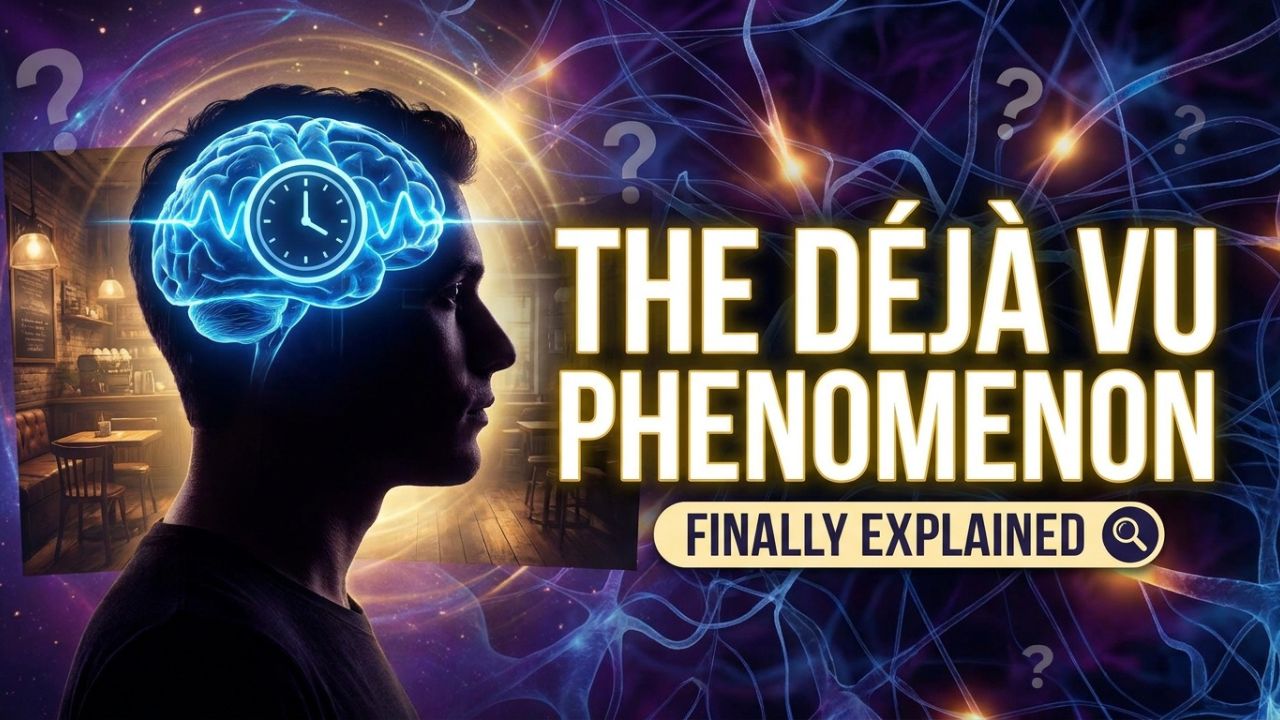
For centuries, déjà vu has fascinated philosophers, psychologists, and neuroscientists alike. That strange sensation that you’ve lived through a moment before has inspired countless theories, from supernatural explanations to ideas about parallel realities. Today, modern science offers a far more compelling answer.
What Is Déjà Vu?
Déjà vu is a French term meaning “already seen.” It describes the uncanny feeling that a current experience has happened before, even though logic tells you it has not.
Most people experience déjà vu at least once in their lifetime, with episodes typically lasting only a few seconds. While the sensation can feel profound, it rarely indicates anything unusual or dangerous.
Why Does It Happen?
Researchers believe déjà vu is the result of a brief mismatch in the brain’s memory processing system.
Normally, the brain distinguishes between new experiences and stored memories. During a déjà vu episode, a small communication error may cause a brand-new event to be mistakenly processed as something familiar.
Instead of retrieving an actual memory, the brain generates a powerful illusion of familiarity.
This split-second error disappears almost immediately, leaving people puzzled by what they just experienced.
The Brain Regions Involved
Scientists have identified several brain areas that appear to contribute to déjà vu, particularly the temporal lobe and the hippocampus.
These regions play a crucial role in memory formation, recognition, and recall.
Brain imaging studies suggest that tiny disruptions in these networks can temporarily activate the feeling of familiarity without retrieving a genuine memory.
Is Déjà Vu a Sign of a Healthy Brain?
Surprisingly, yes.
Occasional déjà vu is generally considered a normal cognitive phenomenon. It is especially common among teenagers and young adults, gradually becoming less frequent with age.
People who travel often, encounter new environments, or have vivid imaginations may report experiencing it more frequently.
When Should You Be Concerned?
Although occasional episodes are harmless, unusually frequent or intense déjà vu can sometimes be associated with neurological conditions, particularly certain forms of temporal lobe epilepsy.
If déjà vu is accompanied by confusion, loss of consciousness, unusual movements, or memory problems, medical evaluation is recommended.
For the vast majority of people, however, the experience is simply one of the brain’s fascinating quirks.
Common Myths
Many popular explanations suggest déjà vu is evidence of past lives, psychic abilities, alternate universes, or glitches in reality.
While these ideas remain culturally fascinating, scientific evidence has not supported them.
Current research consistently points toward normal memory mechanisms as the most likely explanation.
Why the Mystery Still Fascinates Us
Even though neuroscience has uncovered much about déjà vu, the experience remains deeply personal.
For a few brief seconds, reality feels strangely familiar in a way that is difficult to describe. That emotional impact explains why the phenomenon continues to inspire books, films, and scientific research alike.
As scientists learn more about how memory works, déjà vu serves as a reminder that the human brain is still one of the greatest mysteries we have yet to fully understand.