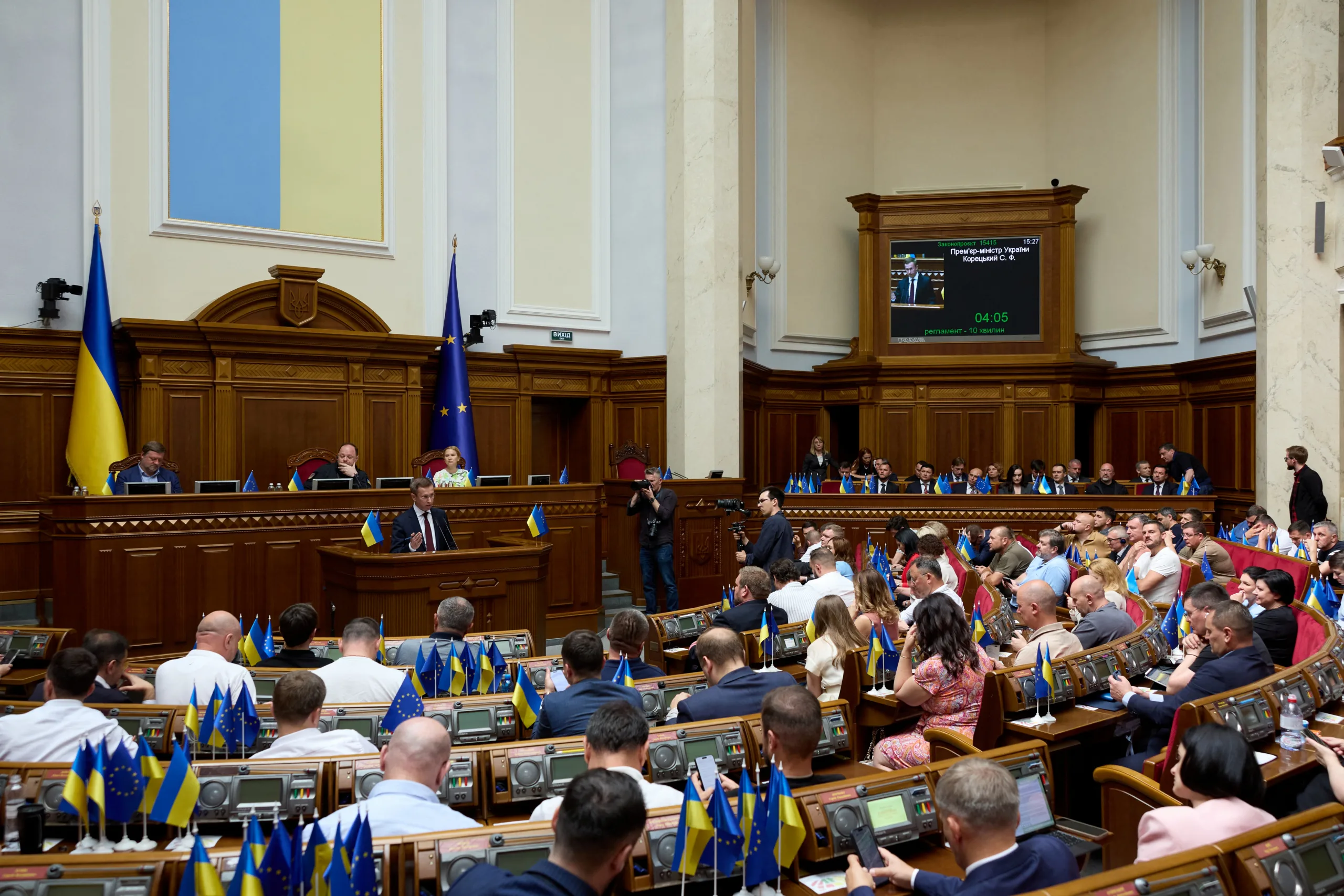
Volodymyr Zelensky’s Ukrainian government is undergoing a general overhaul with the change of high-ranking positions. Prime Minister Yulia Svyrydenko and Defense Minister Mikhaylo Fedorov have left their posts. The reform sparked protests in several cities across the country and exposed weaknesses in the Ukrainian government.
The restructuring comes amid an escalation of the war in Ukraine, with attacks on both sides intensifying. Ukrainian President Volodymyr Zelensky removed important names from his cabinet. In particular, the resignation of the Minister of Defense, announced last Thursday (16), sparked protests in several Ukrainian cities and raised the alarm of a political crisis in the country.
Fedorov was seen by a portion of the Ukrainian population as an efficient leader of the Ministry of Defense and associated with the fight against corruption in the country.
In an interview with Brazil in factthe director of the Ukrainian Institute of Politics, Ruslan Bortnik, points out that the government’s changes are against the backdrop of an attempt to improve a worn-out image of Zelensky’s government amid a series of scandals involving figures close to the head of state.
“The change has several reasons. The main one is that the government lost the president’s trust, and in several ways. First, there is the government itself. It went through a serious corruption scandal, as a result of which three members of the government, now former members, are under investigation, and some others still appear in investigative reports. It is a government with a seriously damaged reputation, a government that is very toxic for the president and unpopular in Ukrainian society,” he explains.
Furthermore, according to the political scientist, Volodymyr Zelensky began to identify a loyalty problem among certain members of the government and “many began to flirt and establish connections with the anti-corruption movement, which continues to fight the government within Ukraine”.
“The internal struggle continues, and this is linked to a certain distrust towards the [ex-primeira-ministra] Svyrydenko. His behavior during Yermak’s resignation and the conflict surrounding the Minister of Defense contributed to the emergence of autonomous members in the government, increasingly less dependent on the presidential line, on the president himself. And the president, naturally, wanted to replace them”, says the analyst.
In this context, a protest took place in Kiev last Thursday morning (16). Hundreds of protesters gathered in the city center, displaying signs supporting the ousted defense minister and criticizing Zelensky. Similar demonstrations took place in 13 other cities, including Lvov, Odessa and Kharkov.
The Kremlin’s reaction was cautious, without presenting forceful positions. Commenting on the changes in the Ukrainian government, Kremlin spokesman Dmitry Peskov stated that Moscow attaches greater importance to resolving the conflict and ensuring its own interests, but highlighted that Russia monitors the situation closely.
“You know, we, of course, monitor all news related to the Kiev regime, especially considering the special military operation [nome oficial usado para guerra da Ucrânia na Rússia] ongoing. But generally speaking, it doesn’t matter who the Minister of Defense is. For us, the important thing is that there is someone in the Kiev regime who takes responsibility and makes a responsible decision that allows for a peaceful solution. Or that allows the conclusion of the special military operation. In Kiev, they know very well what decisions need to be made in this regard. It’s important for us that these people show up,” he added.
With the current restructuring, the Ukrainian Ministry of Defense will have the fourth change of command since the start of the war with Russia, in February 2022. Former minister Mykhailo Fedorov was seen as a figure associated with the fight against corruption and enjoyed prestige in public opinion.
According to the director of the Ukrainian Institute of Politics, Ruslan Bortnik, Fedorov built an image as a fighter against corruption within the army, garnering support from liberal circles in society. “In this aspect, he has a good reputation. Furthermore, he has already served as Deputy Prime Minister for Digital Transformation, where he launched cutting-edge services, such as a digital tool, among many others, which are widely used by citizens”, he adds.
Popular dissatisfaction
Popular dissatisfaction in Ukraine regarding government corruption problems is not new. In November 2025, Ukraine’s National Anti-Corruption Bureau (NABU) and the country’s Specialized Anti-Corruption Prosecutor’s Office (SAPO) reported the discovery of a large-scale corruption scheme at the Ukrainian state-owned nuclear power generation company, Energoatom. According to investigators, the company was controlled by an organized group that demanded bribes of 10% to 15% of the contracts awarded.
The investigation identified businessman Timur Mindich as the central figure in the major corruption scheme. He was seen as a close ally of President Volodymyr Zelensky. The businessman left the country a few hours before the anti-corruption agencies’ operation. The scandal also involved the then Minister of Justice, Herman Galushchenko.
At the time, Kremlin spokesman Dmitry Peskov stated that Kiev’s European allies had reason to be concerned about the outbreak of the scandal, as, according to him, the corruption scheme involved foreign money. Now Zelensky seeks reform as he lobbies for more EU financial and military support in the war with Russia. However, internally the measures were met with controversy, given the recent history of scandals and the ties between the dismissed politicians and supporters of the fight against corruption in the country.
This scenario creates a dilemma for President Volodymyr Zelensky, as the dynamics of foreign policy should not change, and, internally, the reform has so far only fueled distrust in the Ukrainian leader’s political movements.
As political scientist Ruslan Bortnik states, the government’s direction should not change with the recent changes. At the same time, according to him, “perhaps this government will place greater emphasis on domestic policy, guaranteeing energy supply and combating destabilization attempts”.
“Ukraine has recently seen protests, for example, the uprising in Lvov against the mobilization of civilians for the war. In other words, there was a feeling that the internal situation was destabilizing, deteriorating. In other words, there is a certain focus on internal stabilization, on combating internal destabilization. But, in general, the course will remain unchanged: continuation of the war, continuation of European integration, strengthening of the alliance with Ukraine’s Western allies”, he adds.
Source: www.brasildefato.com.br