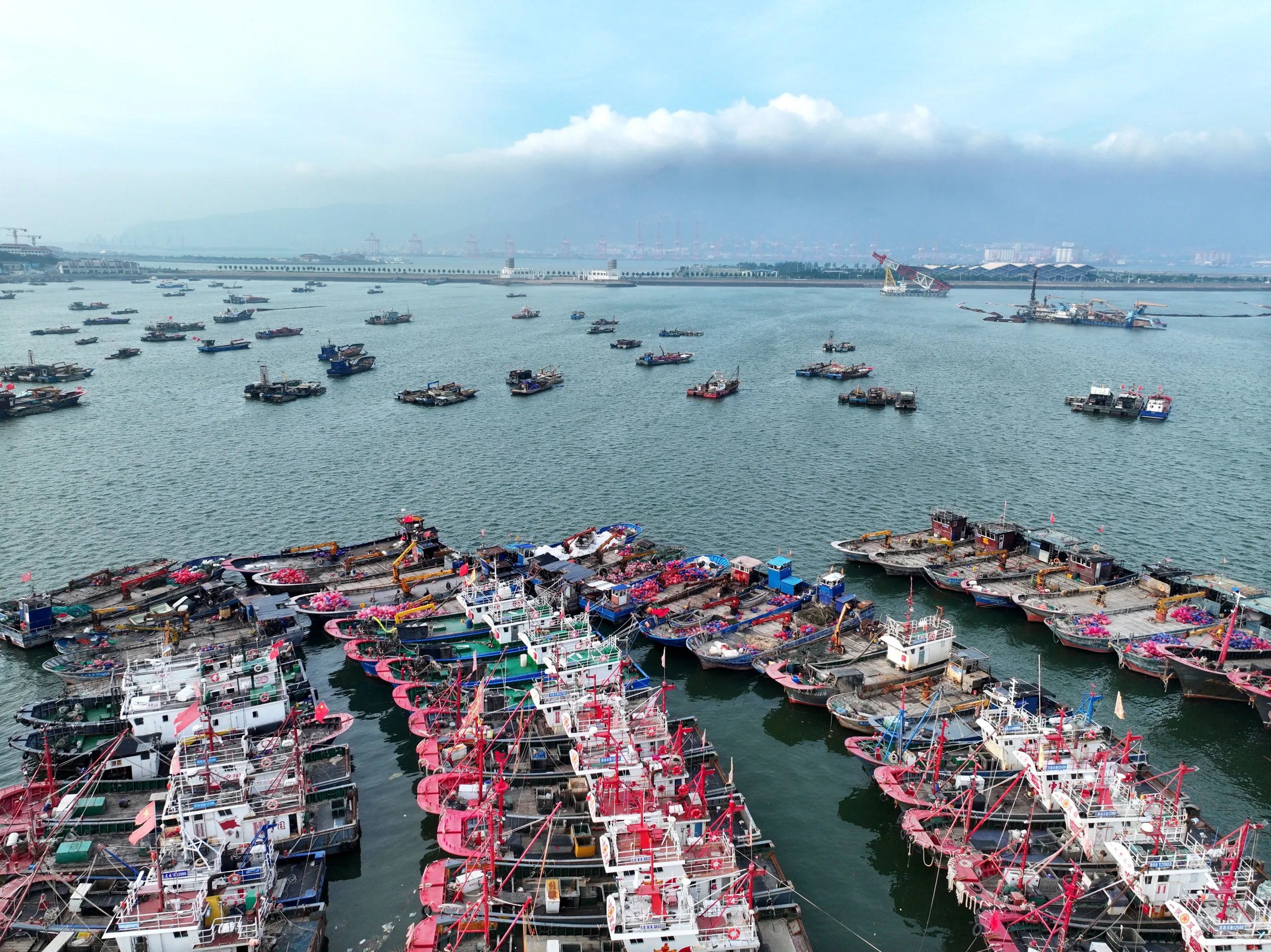
The provinces on the east coast of China have accelerated preparations for the arrival of Typhoon Bavi, the ninth of the year, which is expected to make landfall between Saturday night (11) and Sunday morning (12) on the coast between the provinces of Zhejiang and Fujian.
The most recent forecast from the Shanghai meteorological service indicates a greater likelihood that the typhoon will hit the stretch between Wenling and Pingyang, in southern Zhejiang, with maximum winds between 134 km/h and 166 km/h. The National Meteorological Center projects arrival in the range between Fuqing, in Fujian, and Wenling.
The National Flood Control and Drought Combat Command raised, on Thursday (9), the emergency response from level IV to level III, on a scale of four degrees in which level I is the highest, according to the CCTV.
Bavi remained in the maximum super typhoon category for more than 135 hours, until it lost strength on Thursday night. This Friday (10), the waters east of Taiwan, most of the East China Sea, the area of the Diaoyu islands and the coasts of Taiwan and Zhejiang record winds of 75 km/h and 117 km/h, with gusts of up to 149 km/h.
The trajectory was recalculated to the north throughout the day, and heavy rain is expected to reach more than ten provinces. Before the mainland, the typhoon is expected to hit or graze the north of the island of Taiwan during Saturday, with gusts that could approach historical records for this time of year, both in Taiwan and in northern Fujian and Zhejiang.
The eye of the typhoon, the zone of lowest atmospheric pressure in the center of the system, works as a thermometer of its strength: the smaller and rounder the eye, the more intense the phenomenon.
An entire city transferred in Zhejiang
To date, 6,050 people have been transferred in Zhejiang, according to a report by provincial authorities. The number will grow: the coastal city of Xiaguan in Cangnan County, within the typhoon’s most likely arrival zone, was ordered to relocate its entire resident population, 11,614 people, by 7pm (Beijing time) today.
In Cangnan, the water resources department opened the floodgates of 20 reservoirs to lower water levels and free up capacity for forecast rains.
Further north in Ningbo, the Shanhuang pumping station in Fenghua District has fully opened its two floodgates to drain water from inland rivers toward the Dongjiang River. “We carried out preventive water discharge at all the main flood control gates in the district and managed to keep the river at a low level,” said Huang Tao, an official at the river and lake management center of the Fenghua water resources office.
In Taizhou, maritime inspectors check the safety of moored boats; 33 works in floodplain areas and 18 coastal passenger ferry lines were stopped, and more than 2 thousand people left the city’s islands. In the island county of Shengsi, more than 9 thousand tourists have already left the islands, and the ferries are expected to stop starting this Friday (10).
Yangtze emptied
In Jiangsu province (which is next to Zhejiang), the maritime security administration raised the alert to level III on Thursday night, which requires the suspension of operations and the withdrawal of personnel from exposed areas. All traffic on the stretch of the Yangtze River in the province was stopped, vessels of less than 80 meters entered a control regime and the rest sought shelter in inland waterways and anchorages.
By noon today (local time), all work on and under water had been halted, fishing authorities ordered the return of coastal boats to ports by 6pm and 1,149 workers from 267 construction vessels were removed.
Work on the Zhangjinggao bridge, designed to have the largest suspended span in the world, was stopped at 4pm on Thursday, and the more than 600 workers working on the construction islands were taken by ferry to reception locations until midnight.
Parks closed and events postponed in Shanghai
In Shanghai, the effect of Bavi should be more wind than rain between Saturday (11) and Monday (13), with gusts of 62 km/h to 88 km/h in most of the city, stronger in tall buildings and on the waterfront, and up to 133 km/h in Yangshan port, according to the municipal meteorological service. Accumulated rain can reach 110 millimeters, with peaks of 50 millimeters in one hour.
After reaching the coast, Bavi is expected to head northwest and lose strength, but may bring moisture to the north of the country, with heavy rains forecast in the Beijing, Tianjin and Hebei regions.
The Maysak Trail in Guangxi
Bavi approaches while the south of the country is still calculating the impacts of the previous typhoon. Maysak, the tenth of the year as it was formed before Bavi, touched the island of Hainan on July 3, passed through Vietnam and entered the Guangxi Autonomous Region in the early hours of the 5th, causing floods of rare proportions in the history of the region: 65 rivers passed the alert level.
As of Thursday (9), 39 people had died and nine were missing, according to the agency China News Service (CNS)most of it in the collapse of the Liulan Reservoir dam, near Nanning, which left 26 dead and seven missing.
Source: www.brasildefato.com.br