For more than 4,500 years, the pyramids of Egypt have dominated the desert landscape, inspiring awe, fascination, and endless speculation. Millions of visitors travel each year to stand before these colossal monuments, wondering how an ancient civilization managed to create structures so immense, precise, and enduring.
The largest and most famous of them all, the Great Pyramid of Giza, remains one of humanity’s greatest engineering achievements. Built during the reign of Pharaoh Khufu around 2560 BCE, it originally stood approximately 146 meters (481 feet) tall and was composed of an estimated 2.3 million stone blocks.
Yet despite centuries of research, the question continues to captivate people around the world: Why were the pyramids really built?
The answer may seem straightforward. Most Egyptologists agree that the pyramids served as monumental tombs for powerful pharaohs. However, the story is far more complex than a simple burial site. These structures represented political power, religious beliefs, cosmic symbolism, economic organization, and the extraordinary ambitions of one of history’s greatest civilizations.
Understanding why the pyramids were built requires examining ancient Egyptian society itself, a culture where religion, government, and daily life were inseparable.
🌞 The Pharaoh’s Journey to Eternity
To understand the pyramids, one must first understand the Egyptian view of death.
Ancient Egyptians did not see death as an ending. Instead, they believed it was a transition into another existence. The afterlife was considered a continuation of earthly life, where the deceased would require food, possessions, servants, and protection.
For pharaohs, the stakes were even higher.
Egyptian rulers were not merely political leaders. They were considered divine beings, intermediaries between the gods and humanity. During life, they maintained cosmic order. After death, they were expected to join the gods and continue protecting Egypt from the spiritual realm.
This belief created an enormous challenge. The pharaoh’s body had to be preserved, protected, and honored so that his spirit could successfully complete its journey into eternity.
The pyramid became the ultimate solution.
Rather than constructing simple graves, Egyptian rulers commissioned vast stone monuments designed to safeguard their remains and ensure their eternal survival. Every chamber, passageway, and architectural feature was connected to this sacred mission.
The pyramid was not simply a tomb.
It was a machine for immortality.
🔺 Why the Pyramid Shape Was Chosen
One of the most intriguing aspects of the pyramids is their distinctive shape.
Why did the Egyptians choose a massive triangular structure instead of a palace-like mausoleum or a giant temple?
Researchers believe the answer lies in Egyptian solar religion.
The sloping sides of the pyramid may have symbolized rays of sunlight descending from the heavens. The sun god Ra occupied a central role in Egyptian spirituality, and pharaohs were closely associated with him.
Some scholars argue that the pyramid shape represented a stairway or ramp allowing the ruler’s soul to ascend into the sky and join the gods.
Another theory connects the pyramid to the “benben,” a sacred stone associated with the creation of the world. According to Egyptian mythology, the benben emerged from the primordial waters at the dawn of creation.
By constructing enormous stone mountains, the Egyptians may have been recreating this cosmic event on a monumental scale.
The pyramid therefore carried both practical and symbolic functions. It protected the ruler’s body while also expressing profound religious concepts about creation, resurrection, and divine power.
👑 More Than a Tomb
Although pyramids served as royal burial monuments, reducing them solely to tombs overlooks their broader significance.
These structures were political statements.
Every pyramid announced the authority, wealth, and legitimacy of a ruler. Building one required enormous resources, advanced planning, and a highly organized government.
The ability to mobilize tens of thousands of workers demonstrated the pharaoh’s power over the kingdom. Each completed pyramid became a permanent reminder of royal authority.
In many ways, pyramids functioned as ancient public relations campaigns.
They communicated a clear message to the population:
The pharaoh possesses the power of the gods.
The pharaoh controls vast resources.
The pharaoh’s rule will endure forever.
Even today, thousands of years later, those monuments continue delivering that message.
🛠️ Who Actually Built the Pyramids?
One of the most persistent myths claims that pyramids were built by enslaved workers.
Modern archaeological discoveries tell a different story.
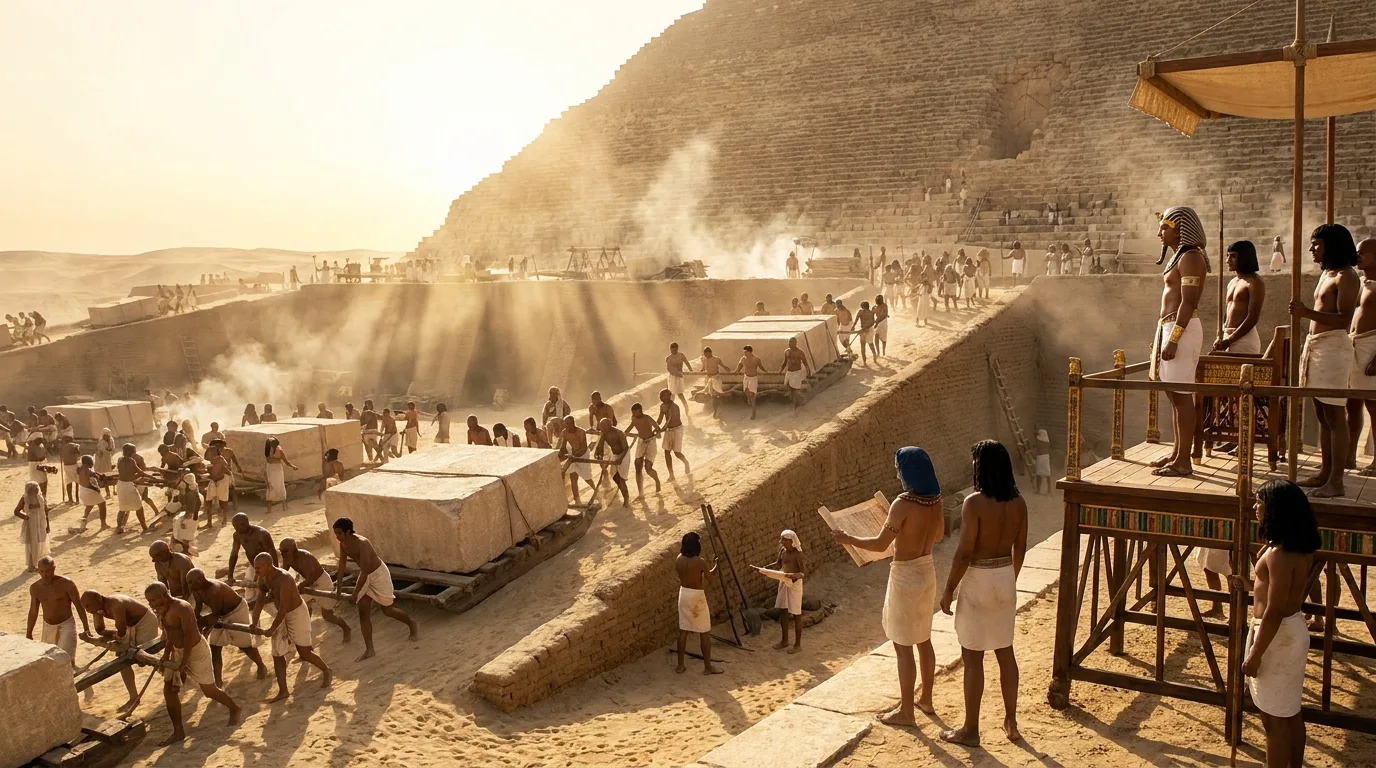
Excavations near Giza have uncovered workers’ villages, bakeries, sleeping quarters, medical facilities, and cemeteries. Evidence suggests many laborers were skilled workers who received food, housing, and medical care.
These findings indicate that pyramid builders were not primarily slaves but organized laborers, craftsmen, engineers, stonecutters, and seasonal workers recruited from across Egypt.
Many worked during the annual flooding of the Nile River, when agricultural activities slowed and farmers became available for state projects.
The construction process itself became a powerful expression of national unity.
Communities from different regions contributed labor, materials, and expertise. In doing so, they participated in a project that reinforced the central authority of the pharaoh while creating a shared sense of purpose.
The pyramids were not only monuments to kings.
They were monuments to collective human effort.
🌍 Engineering Beyond Its Time
The construction of the pyramids remains one of history’s greatest technical achievements.
Without modern machinery, cranes, steel tools, or motorized transportation, ancient Egyptians moved millions of tons of stone with remarkable precision.
Researchers continue debating the exact methods used.
Most evidence suggests workers transported limestone blocks using sledges pulled across specially prepared surfaces. Ramps likely played a crucial role in raising stones to higher levels during construction.
The alignment of the Great Pyramid is particularly astonishing. Its sides are oriented with extraordinary accuracy toward the cardinal directions of north, south, east, and west.
Such precision required advanced knowledge of astronomy, surveying, and mathematics.
Far from being primitive builders, the pyramid architects demonstrated sophisticated technical expertise that continues to impress modern engineers.
✨ The Pyramids and the Stars
The relationship between the pyramids and the night sky has generated intense interest among researchers.
Ancient Egyptians closely observed celestial movements. The stars, planets, and sun played vital roles in religion and timekeeping.
Certain internal passages within the Great Pyramid appear aligned with specific stars that held religious significance.
Some scholars believe these alignments symbolized the pharaoh’s spiritual journey into the heavens.
The Egyptians viewed the sky as a divine realm inhabited by gods and immortal beings. By connecting the pyramid to celestial phenomena, builders may have been creating a cosmic bridge between Earth and the afterlife.
While sensational theories often exaggerate these connections, there is little doubt that astronomy influenced pyramid design in meaningful ways.
The monuments were intended not merely to exist on Earth but to connect with the universe itself.
🔍 Why Conspiracy Theories Persist
Few ancient structures have generated as many alternative theories as the pyramids.
Claims involving lost civilizations, advanced technologies, extraterrestrial visitors, and hidden energy systems continue to attract attention worldwide.
Several factors explain why these ideas remain popular.
First, the pyramids are genuinely extraordinary. Their scale and precision challenge modern assumptions about ancient societies.
Second, many people underestimate the capabilities of early civilizations. When confronted with remarkable achievements, they sometimes assume outside intervention must have occurred.
Third, mysteries naturally attract speculation.
However, decades of archaeological research have produced extensive evidence showing that the pyramids can be explained through known Egyptian technologies, labor systems, and engineering methods.
The real story is arguably more impressive than the myths.
Human beings, using determination, organization, intelligence, and cooperation, created monuments that have survived for millennia.
No aliens required.
💰 An Economic Engine for Ancient Egypt
Pyramid construction also played a major economic role.
These projects stimulated activity across numerous sectors.
Stone quarries supplied building materials.
Boat crews transported massive blocks along the Nile.
Artisans produced tools and decorative elements.
Farmers supplied food for workers.
Administrators managed logistics and resources.
Priests oversaw religious ceremonies.
The pyramid industry effectively mobilized the entire state.
Large construction projects strengthened government control while generating employment and economic activity throughout the kingdom.
In this sense, pyramids functioned as both religious monuments and national infrastructure programs.
Their influence extended far beyond the burial chamber hidden deep within their interiors.
📜 The Evolution of Pyramid Building
The pyramids did not appear suddenly.
They evolved over centuries through experimentation and innovation.
Early royal tombs known as mastabas were rectangular structures with flat roofs. Over time, architects sought more ambitious designs.
A major breakthrough occurred during the reign of Pharaoh Djoser.
His architect, Imhotep, created the Step Pyramid at Saqqara, widely regarded as the world’s first large-scale stone monument.
This revolutionary structure paved the way for later developments.
Subsequent rulers experimented with different forms, including the Bent Pyramid and the Red Pyramid.
Eventually, architects perfected the smooth-sided pyramid design seen at Giza.
Each monument represented a step in an ongoing process of technological advancement.
The pyramids therefore tell a story not only about death and religion but also about innovation and human creativity.
🧭 What Archaeologists Have Learned
Modern archaeology has transformed our understanding of pyramid construction.
Advanced technologies such as satellite imaging, ground-penetrating radar, 3D scanning, and digital reconstruction allow researchers to study these monuments in unprecedented detail.
Excavations have revealed worker settlements, administrative records, construction tools, and transportation systems.
Papyrus documents discovered near the Red Sea include accounts from officials involved in transporting limestone for the Great Pyramid.
These records provide rare firsthand evidence of how the construction process operated.
Rather than deepening the mystery, recent discoveries increasingly reveal the practical realities behind pyramid building.
The monuments remain awe-inspiring, but they are becoming less mysterious and more human.
🌟 The Real Purpose of the Pyramids
So why were the pyramids really built?
The simplest answer is that they served as royal tombs designed to ensure the pharaoh’s successful transition into the afterlife.
Yet that explanation captures only part of the story.
The pyramids were simultaneously:
• Religious monuments dedicated to eternal life.
• Symbols of divine kingship.
• Demonstrations of political power.
• Expressions of cosmic beliefs.
• Engines of economic activity.
• Achievements of engineering innovation.
• Statements of national unity.
These functions were not separate.
In ancient Egypt, religion, government, economics, and society formed a single interconnected system.
The pyramid stood at the center of that system.
🏛️ A Legacy That Still Shapes the World
More than four millennia after their construction, the pyramids continue to influence architecture, culture, tourism, and popular imagination.
They have inspired explorers, scientists, writers, filmmakers, and historians.
Millions still travel to Egypt to witness them firsthand.
What makes the pyramids remarkable is not merely their size.
It is what they reveal about humanity.
They demonstrate our desire to leave a lasting legacy, to confront mortality, to seek meaning beyond death, and to accomplish feats that seem impossible.
The real purpose of the pyramids was never just to house the dead.
They were built to express an entire civilization’s understanding of life, death, power, and eternity.
That is why they still matter today.
The pyramids are not simply relics of the past.
They are enduring symbols of what human beings can achieve when vision, belief, organization, and ambition come together on a monumental scale.