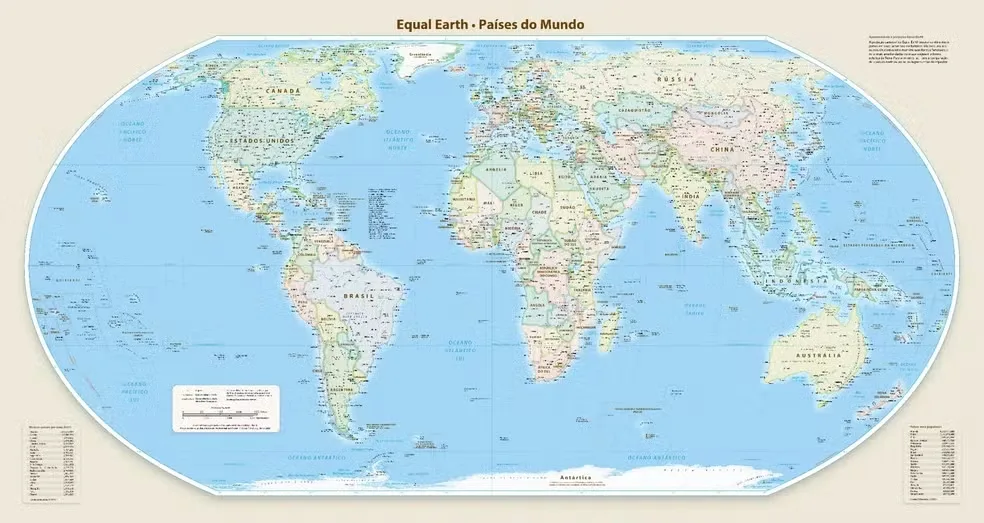
The United Nations voted to adopt a resolution to change the traditional 16th-century Mercator world map to the 2018 Equal Earth model, which more accurately shows the size of Africa.
In a session held at its headquarters in New York this Friday (04/09), 164 countries voted in favor. Only the US was against it, with its representative stating that the resolution was “superfluous”. There were six abstentions.
Togo, which led a campaign for the resolution on behalf of the African Union, stated that the resolution “recognizes and affirms that disproportionate cartographic representations, particularly those resulting from the Mercator projection, have had lasting cognitive, educational, cultural, geopolitical and socioeconomic effects, contributing to a drastic reduction in the perception of the size of Africa and other regions of the world in the global collective imagination.”
Speaking before the resolution’s approval, Robert Dussey, Togo’s foreign minister, said: “This discussion is not political, [mas sim] scientific, because there is scientific proof, so we all have to accept reality.”
“Togo will be the first country to change our own geography textbooks,” Dussey told Reutersadding that “the widespread use of the Mercator map is a consequence of colonization.”
Map
The Mercator map was created in 1569 by Flemish cartographer Gerardus Mercator to help European explorers navigate the world. The distortion of your map results from the fact that it is impossible to accurately represent the surface of a globe on a two-dimensional map.
In an attempt to correct this, a team of cartographers created, in 2018, a map of equal areas that they called Equal Earth Projection. In February, the 54 AU member states adopted the measure and stated that it “more accurately represents the size of all continents, in particular Africa”.
UN resolutions are not binding, so countries and institutions will not be forced to use only the new projection nor prohibited from using the old one. However, the result is expected to lead to an update of school curricula and everyday technology, given the wide use of the Mercator projection in education, technology and governance.
Source: www.brasildefato.com.br