Few maritime disasters have captured the world’s imagination as profoundly as the sinking of the RMS Titanic. More than a century after the tragedy unfolded in the icy waters of the North Atlantic, the story continues to fascinate historians, engineers, filmmakers, and the general public alike. The disaster has inspired countless books, documentaries, and one of the most successful films ever produced. Yet despite its fame, many misconceptions continue to surround what really happened on the night of April 14 and the early morning of April 15, 1912.
The truth is far more complex than the popular legends. The Titanic did not simply strike an iceberg because of arrogance or bad luck alone. A combination of technological limitations, human decisions, environmental conditions, and insufficient safety regulations created the perfect conditions for one of history’s deadliest peacetime maritime disasters.
This article explores the facts behind the Titanic’s sinking, separating historical evidence from enduring myths.
The World’s Largest Passenger Ship
When the Titanic was launched in 1911, she represented the pinnacle of early twentieth-century engineering. Built by Harland and Wolff in Belfast for the White Star Line, the ship measured nearly 269 meters in length and displaced over 46,000 tons.
She was designed to provide luxury, comfort, and reliability rather than speed. Although often remembered as the largest ship in the world at the time, the Titanic’s primary selling point was elegance. First-class passengers enjoyed lavish dining rooms, swimming pools, Turkish baths, libraries, and luxurious suites that rivaled the finest hotels of Europe.
Contrary to popular belief, the Titanic was never officially advertised as “unsinkable.” Instead, trade publications and public commentary described her as “practically unsinkable” because of her advanced watertight compartment system. Over time, this description evolved into one of history’s greatest myths.
The Fatal Voyage
The Titanic departed Southampton, England, on April 10, 1912, bound for New York City. Along the way, she stopped briefly in Cherbourg, France, and Queenstown, Ireland, now known as Cobh.
On board were approximately 2,224 passengers and crew members representing every level of society. Wealthy industrialists traveled alongside immigrants seeking new opportunities in America.
The crossing progressed smoothly during the first several days. However, wireless operators aboard the ship received numerous ice warnings from nearby vessels. These messages informed the crew that large fields of drifting ice lay directly in the Titanic’s intended route.
Although some warnings reached the bridge, others were delayed or not given the level of attention they deserved. This would later become one of the most heavily scrutinized aspects of the disaster.
The Collision
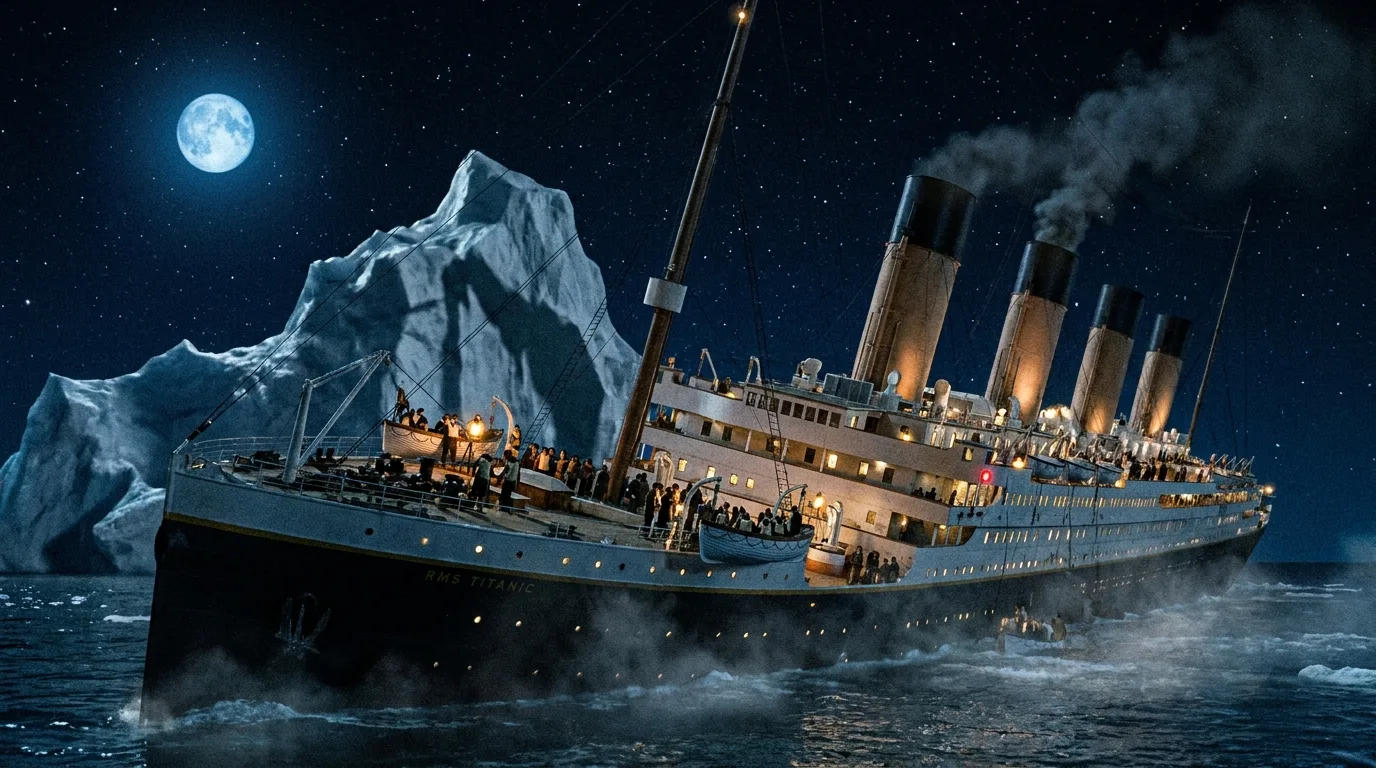
At approximately 11:40 p.m. on April 14, lookouts Frederick Fleet and Reginald Lee spotted an iceberg directly ahead.
The crew immediately sounded the warning bell and contacted the bridge. First Officer William Murdoch ordered a hard turn while simultaneously attempting to slow the ship.
The maneuver almost succeeded.
Instead of a direct head-on collision, the iceberg scraped along the starboard side of the vessel. While this seemed less severe initially, the glancing impact opened several narrow breaches below the waterline across multiple watertight compartments.
Although none of the openings were exceptionally large individually, together they proved catastrophic.
Water began flooding six forward compartments, exceeding the ship’s design limit.
Why the Watertight Compartments Failed
One of the Titanic’s greatest engineering innovations ultimately became one of its weaknesses.
The vessel contained sixteen major watertight compartments separated by bulkheads. Engineers believed the ship could remain afloat with four compartments flooded.
Unfortunately, the iceberg damaged six.
As water filled the forward compartments, the ship’s bow gradually lowered into the ocean. Because many bulkheads did not extend high enough, water spilled over their tops like liquid flowing between connected containers.
This progressive flooding continued until the ship could no longer remain buoyant.
Modern computer simulations conducted over recent decades have confirmed that the damage pattern closely matches survivor testimony and the wreck itself.
Was the Steel Too Weak?
One long-standing theory suggested that poor-quality steel caused the Titanic to break apart.
Modern metallurgical analysis paints a more nuanced picture.
The steel used in the ship reflected the industrial standards of the early twentieth century. While it became more brittle in freezing temperatures than modern shipbuilding steel, it was not uniquely defective.
Similarly, some of the wrought-iron rivets used near the bow may have failed under extreme stress, contributing to the spread of structural damage.
However, experts generally agree that even a vessel built with stronger modern materials would likely have suffered devastating damage after striking the iceberg under similar circumstances.
The Lifeboat Controversy
Perhaps the most tragic aspect of the disaster was the shortage of lifeboats.
The Titanic carried only twenty lifeboats with capacity for approximately 1,178 people, barely enough for half those aboard.
Remarkably, this complied with British maritime regulations at the time.
Safety rules based lifeboat requirements on a ship’s tonnage rather than the number of passengers carried. Regulations had failed to keep pace with the rapid growth of ocean liners.
The situation worsened because many lifeboats left the ship only partially full.
Crew members feared overcrowding might cause boats to collapse during launching, while confusion and poor communication delayed efficient evacuation.
As a result, hundreds of available seats floated away empty while people remained on the sinking vessel.
Human Decisions Under Pressure
Disasters rarely result from a single mistake.
Investigations identified numerous human factors that contributed to the tragedy.
The ship maintained relatively high speed despite multiple iceberg warnings.
Visibility was unusually poor because the sea was exceptionally calm, making it difficult to spot waves breaking around icebergs.
The moonless night reduced contrast between the iceberg and the surrounding ocean.
Radio operators were overwhelmed with passenger messages and did not always prioritize incoming navigation warnings.
Nearby ships were not always monitoring wireless communications continuously.
Each factor alone may not have caused catastrophe, but together they formed a chain of events that proved impossible to reverse.
Why So Many People Died
The Titanic remained afloat for approximately two hours and forty minutes after striking the iceberg.
Many assume this provided ample time for evacuation.
In reality, the situation unfolded amid confusion, disbelief, and uncertainty.
Initially, many passengers did not believe the ship was in serious danger.
The luxurious liner appeared stable even as water entered below deck.
Crew members struggled to organize passengers according to the “women and children first” policy.
Language barriers complicated communication with many third-class passengers.
Some areas of the ship were difficult to navigate, particularly for those unfamiliar with the vessel’s layout.
By the time the severity of the situation became obvious, precious minutes had already been lost.
The Ship Breaks Apart
For decades, historians debated whether the Titanic sank intact.
Survivors reported hearing tremendous cracking noises before the ship disappeared beneath the waves.
When explorer Robert Ballard discovered the wreck in 1985, the mystery was finally resolved.
The ship had indeed broken into two large sections before sinking.
The bow descended first, followed by the stern after catastrophic structural failure.
Today the two sections lie hundreds of meters apart on the ocean floor, surrounded by thousands of artifacts that tell the story of the disaster.
Lessons That Changed Maritime History
Although the Titanic disaster claimed more than 1,500 lives, it permanently transformed maritime safety.
International regulations introduced mandatory lifeboat capacity for everyone aboard.
Continuous radio monitoring became standard practice.
Regular emergency evacuation drills became compulsory.
The International Ice Patrol was established to monitor iceberg movement in the North Atlantic shipping lanes.
Modern passenger ships also feature improved compartmentalization, advanced radar systems, satellite navigation, and sophisticated emergency response procedures.
Many of today’s maritime safety standards trace their origins directly to lessons learned from the Titanic.
Myths That Refuse to Disappear
Several myths continue circulating despite overwhelming historical evidence.
One common claim suggests the Titanic was switched with her sister ship, the Olympic, as part of an insurance fraud. Historians have found no credible evidence supporting this theory.
Another myth insists that the ship was doomed because of a cursed Egyptian mummy supposedly carried on board. No such artifact was present during the voyage.
Some stories claim Captain Edward Smith ignored every iceberg warning. In reality, several warnings reached the bridge, although communication failures and decision making under uncertain conditions complicated the response.
Perhaps the biggest misconception remains the belief that a single mistake caused the sinking. Modern investigations consistently conclude that the tragedy resulted from multiple interconnected failures rather than one catastrophic decision.
The Legacy of the Titanic
The Titanic continues to symbolize both extraordinary human ambition and the importance of humility in the face of nature.
The ship represented the technological confidence of an era convinced that engineering could overcome nearly any obstacle. The disaster demonstrated that even the greatest achievements remain vulnerable to unexpected circumstances.
More than one hundred years later, researchers continue studying the wreck using advanced underwater robotics, high-resolution mapping, and digital reconstruction techniques. Each new expedition provides additional insight into the ship’s final hours while helping preserve one of history’s most significant archaeological sites.
The Titanic is no longer merely a story about a famous ship. It has become a lasting reminder that progress must always be accompanied by preparation, safety, and respect for the limits of technology.
Final Thoughts
The truth about the Titanic’s sinking is neither as simple nor as dramatic as many fictional portrayals suggest. The disaster was not caused by a single act of arrogance, one defective component, or an unavoidable twist of fate. Instead, it emerged from an unfortunate convergence of environmental conditions, engineering limitations, regulatory shortcomings, and human decisions made under extraordinary pressure.
Understanding the real story does more than satisfy historical curiosity. It highlights how valuable lessons often emerge from tragedy, shaping safer technologies and better practices for future generations. More than a century later, the Titanic remains one of history’s most compelling examples of how innovation, responsibility, and preparedness must always go hand in hand.