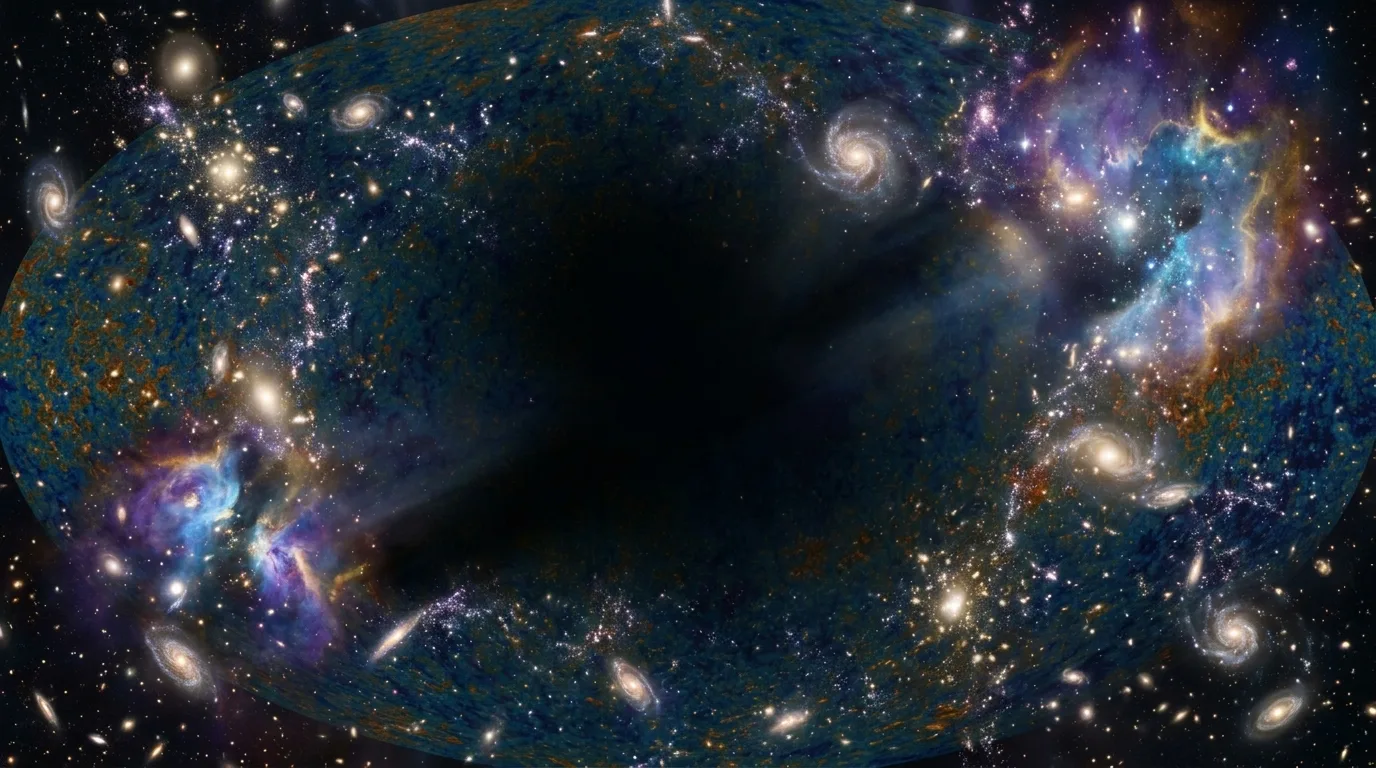
Imagine looking into the vastness of the universe and discovering a region so enormous and so empty that it seems to challenge everything astronomers thought they knew about how the cosmos is structured. This is not science fiction. It is one of the most intriguing puzzles in modern astronomy.
Known as the Giant Void, or more specifically the Eridanus Supervoid, this immense region stretches across hundreds of millions of light years and contains far fewer galaxies than scientists would normally expect. While the universe is filled with clusters of galaxies, glowing nebulae, and massive cosmic structures connected through an intricate web, this colossal empty space appears to break the pattern.
Its existence has inspired years of research, countless scientific papers, and even speculation about exotic physics. Although astronomers have learned a great deal about the Giant Void, many questions remain unanswered.
🔭 What Exactly Is a Cosmic Void?
To understand why the Giant Void is so extraordinary, it helps to understand what cosmic voids are.
The universe is not evenly distributed. Galaxies gather together under gravity, forming clusters, superclusters, and long filaments that create what scientists call the Cosmic Web. Between these enormous structures lie vast regions containing relatively few galaxies. These regions are known as cosmic voids.
Voids are perfectly normal components of the large-scale universe.
Typical cosmic voids range from 20 to 150 million light years across. They are incredibly empty compared to surrounding regions but still contain scattered galaxies, dark matter, and diffuse gas.
The Eridanus Supervoid, however, appears to be much larger than average, making it one of the largest known underdense regions ever observed.
📍 Where Is the Giant Void?
The Giant Void lies in the direction of the constellation Eridanus, which is why astronomers call it the Eridanus Supervoid.
It is located roughly 1.8 to 3 billion light years away from Earth, depending on the particular region being measured.
Rather than being a perfectly spherical hole in space, researchers believe it is an enormous underdense region composed of several connected voids. This makes determining its exact dimensions extremely difficult.
Current estimates suggest that it may extend close to one billion light years across, although different observational methods produce somewhat different measurements.
Even by cosmic standards, this is astonishingly large.
🌠 How Was It Discovered?
The mystery began with observations of the Cosmic Microwave Background (CMB), the faint afterglow left behind by the Big Bang nearly 13.8 billion years ago.
In maps produced by satellites such as NASA’s Wilkinson Microwave Anisotropy Probe (WMAP) and later the European Space Agency’s Planck mission, astronomers noticed an unusual feature.
One particular region of the CMB appeared significantly colder than surrounding areas.
This anomaly became known as the Cold Spot.
The Cold Spot spans roughly five degrees of the sky, making it one of the largest unusual temperature fluctuations ever detected in the cosmic microwave background.
Naturally, scientists began searching for an explanation.
❄️ The Famous Cold Spot
The Cold Spot is not literally cold in the everyday sense.
Instead, it is a region where the microwave background radiation is slightly cooler than average by only a few dozen millionths of a degree.
Although this temperature difference is tiny, it is statistically significant on cosmological scales.
Astronomers wondered whether something between Earth and the distant background radiation could be affecting the photons traveling toward us.
One possibility was the existence of an enormous cosmic void.
💡 How Could a Void Create a Cold Spot?
The explanation involves one of Einstein’s theories.
As photons from the cosmic microwave background travel through the universe, they encounter regions with different gravitational strengths.
Normally, a photon gains energy as it falls into a gravitational well and loses approximately the same amount while climbing back out.
However, because the universe is expanding, very large structures evolve while the photons are passing through them.
This phenomenon is known as the Integrated Sachs-Wolfe Effect.
If photons travel through an enormous underdense region, they may lose a tiny amount of energy during their journey, making them appear slightly cooler when they finally reach Earth.
This made the Giant Void an attractive explanation for the mysterious Cold Spot.
🔬 Is the Giant Void Enough to Explain Everything?
This is where the mystery becomes even more fascinating.
After years of detailed observations, astronomers concluded that the Eridanus Supervoid probably exists.
However, there is still disagreement about whether it is large enough or empty enough to produce the entire Cold Spot observed in the cosmic microwave background.
Some studies suggest that the void could explain only part of the temperature anomaly.
Others argue that it contributes very little.
This leaves scientists with an intriguing puzzle that remains unresolved.
🧪 Alternative Theories
Since the Giant Void may not fully explain the Cold Spot, researchers have proposed several other possibilities.
Inflationary Fluctuations
One idea is that the Cold Spot simply represents an extremely rare statistical fluctuation created during cosmic inflation, the incredibly rapid expansion that occurred fractions of a second after the Big Bang.
If true, the Cold Spot would be unusual but still compatible with the standard model of cosmology.
Primordial Physics
Some cosmologists have suggested that the anomaly may hint at unknown physical processes occurring in the very early universe.
These possibilities include unusual quantum fluctuations or physics beyond the Standard Model.
Although exciting, no convincing evidence currently supports these ideas.
Cosmic Texture
Another hypothesis involves hypothetical objects called cosmic textures.
These are defects that may have formed during symmetry-breaking events shortly after the Big Bang.
If cosmic textures exist, they could distort the cosmic microwave background in ways similar to what astronomers observe.
To date, no confirmed cosmic textures have been detected.
Multiple Overlapping Voids
Another explanation is that the region is not one enormous void but a combination of several smaller voids aligned along our line of sight.
Together, these structures could potentially produce a stronger gravitational effect than a single void alone.
Researchers continue investigating this possibility.
🌍 Why This Matters
At first glance, an empty region of space may seem unimportant.
In reality, it could reveal fundamental information about how the universe formed and evolved.
Studying cosmic voids helps astronomers understand:
- The distribution of dark matter
- The influence of dark energy
- The growth of large-scale cosmic structures
- The expansion history of the universe
- The accuracy of current cosmological models
Because voids are less affected by gravitational interactions than dense galaxy clusters, they offer unusually clean laboratories for testing theories about the universe.
🛰️ New Surveys Are Improving Our Understanding
Modern astronomical surveys have dramatically improved our ability to map the universe.
Projects like the Sloan Digital Sky Survey (SDSS), the Dark Energy Survey (DES), the Dark Energy Spectroscopic Instrument (DESI), and the European Space Agency’s Euclid mission are collecting unprecedented amounts of data.
These observations allow astronomers to build increasingly detailed three-dimensional maps of galaxies across billions of light years.
As these maps improve, scientists can determine whether the Eridanus Supervoid truly represents one gigantic structure or a collection of overlapping voids.
Future observations may finally settle the debate surrounding the Cold Spot.
🌌 Could the Giant Void Affect Earth?
Fortunately, no.
Despite its immense size, the Giant Void is far too distant to have any direct impact on Earth or the Solar System.
Its effects are limited to the paths taken by light traveling across billions of years through the expanding universe.
Humans will never notice any physical influence from this structure.
Its significance lies entirely in what it teaches us about cosmology.
🚀 One of Astronomy’s Greatest Unsolved Mysteries
The Giant Void remains one of the most captivating enigmas in modern astronomy.
It reminds us that even after centuries of scientific discovery, the universe continues to surprise us with structures larger and stranger than anyone imagined.
Whether the Eridanus Supervoid fully explains the Cold Spot or merely represents one piece of a much larger puzzle, its study is helping scientists refine our understanding of cosmic evolution, gravity, dark energy, and the earliest moments after the Big Bang.
Every new telescope, every new galaxy survey, and every new observation brings researchers closer to answering one of cosmology’s most enduring questions.
For now, the Giant Void stands as a powerful reminder that the emptiest places in the universe can sometimes hold the deepest scientific secrets.