Published 02/12/2026 13:54 | Edited 02/12/2026 15:43
Approved by 42 votes to 30 in the early hours of this Thursday (12), President Javier Milei’s labor reform advanced in the Argentine Senate under strong police repression and national mobilization of trade unions.
The groups denounced the reform as part of a “plan to hand over to the International Monetary Fund” and promised to maintain the fight plan until the measure was defeated in the Chamber of Deputies.
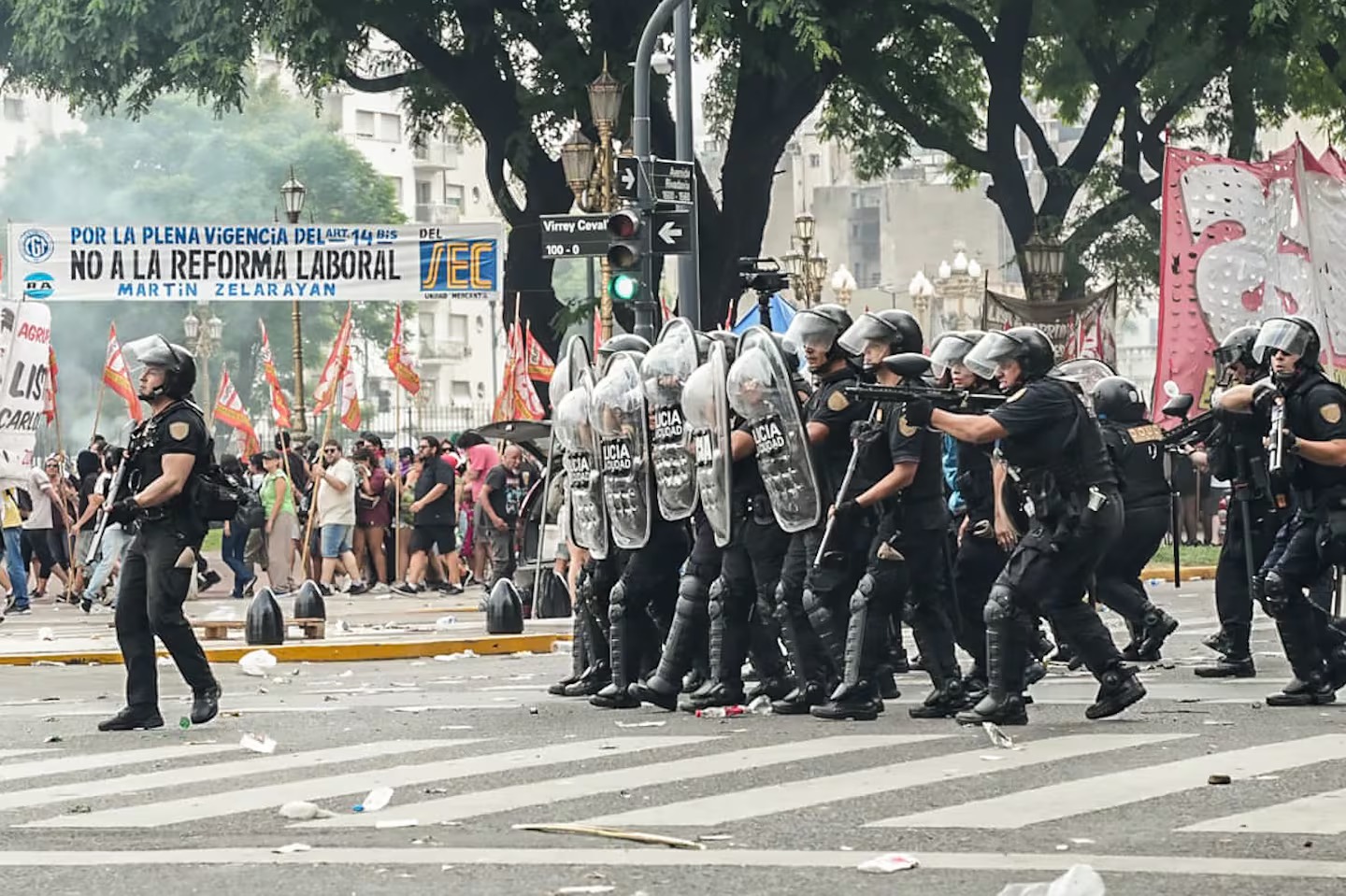
While the senators voted, thousands of workers protested in Buenos Aires and other cities across the country. The dispersal was marked by tear gas, fire hydrant trucks and rubber bullets. Social organizations reported arrests and denounced the excessive use of force.
Presented by the government as “work modernization”, the proposal changes rules in force since the 1970s and affects central points of Argentine labor protection.
The reform facilitates layoffs by replacing the traditional compensation model with a Labor Assistance Fund (FAL). Instead of paying the compensation in full at the time of dismissal, the employer starts contributing in advance to a fund that can be used upon dismissal.
For unions, this reduces the immediate cost of layoffs and weakens job stability.
“What will multiply are layoffs, because there will be total freedom to fire people,” said Hugo “Cachorro” Godoy, from CTA Autónoma. According to him, it is “a concatenated plan of actions, to be delivered to the International Monetary Fund”.
In the plenary, Peronist senator Mariano Recalde classified the fund as a “channel for dismissals” and stated that the reform “is not designed to create jobs, but to end labor rights and that there are no judgments”.
Longer working hours and restricted strike
The text also extends the working day to up to 12 hours a day, as long as there is subsequent compensation, and allows for greater flexibility through individual agreements.
Furthermore, it limits the so-called “ultraactivity” — a mechanism that maintains collective agreements valid until a new one is signed — which can weaken historical conventions won by professional categories.
In the right to strike, the change is significant. The reform expands the number of activities considered essential and imposes a minimum operation of up to 75% during stoppages, reducing workers’ ability to exert pressure.
It also restricts assemblies in the workplace and allows labor court convictions to be paid in installments, reducing the immediate financial impact for companies.
For the trade unions, the set of measures represents a setback.
Abel Furlán, from the UOM, stated that the labor movement maintains “absolute rejection of all the articles that compose it, because they only propose the plundering of rights”.
How most were built
The approval was made possible with the support of the Radical Civic Union (UCR), a traditional center-right party, the PRO — a party founded by former president Mauricio Macri — and provincial blocs.
The Justicialista bloco, which brings together the Peronists, voted entirely against.
To consolidate the votes, the government removed an article from the text that reduced business taxes and temporarily maintained the 2% union contribution and the employer tax allocated to social works managed by the unions.
Even with the concessions, the core of the reform was preserved.
During the debate, Patricia Bullrich, former minister and strong ally of Casa Rosada in the Senate, defended the proposal, repeating traditional liberal arguments, such as that “hiring today is a risky act” and that “no one hires because they are afraid”. Casa Rosada stated that the law returns “predictability and freedom to the job market”.
National strike and repression
The vote in the Senate was accompanied by a national strike called by the Union Front of Unity, an organization that brings together the Central de Trabalhadores del Argentina Autónoma (CTA Autónoma), the Central de Trabalhadores de los Trabajadores Argentina (CTA de los Trabajadores) and unions linked to the General Confederation of Labor (CGT), including the Metallurgical Workers Union (UOM).
The strike mobilized different categories and represented the greatest demonstration of strength by the union movement since the reform began.
The State Workers’ Association (ATE), which represents federal, provincial and municipal public servants, reported membership of 92% of workers in all categories.
The Argentine Confederation of Transport Workers (CATT) also joined the protest, with a partial impact on air and port transport. In Buenos Aires, metro and VLT lines suspended operations for part of the day, while urban transport was maintained to allow workers to get to the events.
In the Argentine capital, the traditional union columns gathered on Avenida de Maio and 9 de Julho and marched to Congress Square. The act brought together thousands of workers under a strong police presence and the legislative area was fenced off.
After the act, a strong security operative surrounded the National Congress and attacked the protesters with tear gas, fire hydrant trucks and rubber bullets. The Senate session took place under what Argentine media outlets classified as “brutal repression in the streets”, while the final text of the reform was negotiated.
Trade union organizations denounced the disproportionate use of force against workers demonstrating in the vicinity of Congress. For the central offices, the security operation sought to defuse the protest at the decisive moment of the vote.
In Córdoba, teachers and union delegates mobilized at the Centenario Bridge, over the Suquía River. The repression occurred a few hours after the start of the act, with the use of tear gas and arrests. A cooperative journalist Enfant terrible was arrested during coverage.
The Press Workers Union (Cispren) denounced obstruction of journalistic work and repudiated what it called the “judicialization of social protest”.
The trade union centrals announced that the struggle plan will continue in the coming weeks, with new mobilizations in different provinces, while the reform continues for analysis in the Chamber of Deputies.
Source: vermelho.org.br