Published 22/05/2025 11:13 | Edited 22/05/2025 11:33
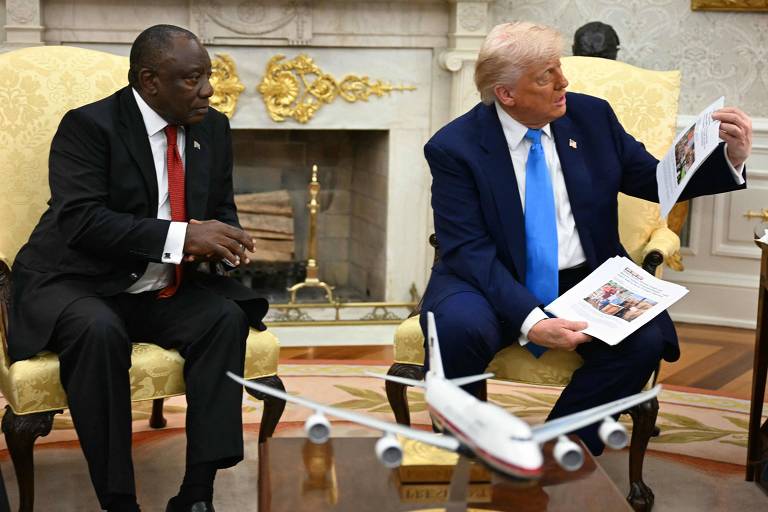
South Africa President Cyril Ramaphosa reacted firmly to Donald Trump’s attempt to turn him into the target of an staging in the oval hall. During the bilateral meeting held on Wednesday (21), the Republican exhibited distorted videos and articles to support the unfounded thesis that a “white genocide” against South African farmers would be underway.
The new ambush to a head of state exposed the strategic use of US presidential space to reinforce agendas from the extreme global right.
With the lights off and a screen positioned against the press, Trump exhibited lines from South African opposition politicians such as Julius Malema, and images of white crosses, which the American described as white farmers tombs killed by blacks.
Checked, the images, however, were identified as part of a rural protest in 2020, unrelated to cemeteries or mass violence.
Ramaphosa watched the part of the material without sketching reaction, but answered clearly soon after. “Those people who are unfortunately murdered because of crime are not just white. Most are black,” he said.
Alongside two white golfers and his agriculture minister John Steenhuisen, Ramaphosa added: “If there were genocide against Africanks in South Africa, these gentlemen would not be with me here today.”
The Africaners are whites of South Africans of European origin, mostly descendants of the Dutch, who formed the social and political base of the apartheid regime (1948–1994).
Even today they maintain strong influence on conservative sectors of South African society.
Official data corroborate Ramaphosa’s response. According to South African police, the country registered 26,232 homicides in 2024, of which only eight involved white farmers.
Studies from the Institute of Security Studies show that rates of violence in rural areas, although alarming, are not directed by racial criteria.
Serene reaction is praised; South African population questions visit
The Posture of the South African President was seen by analysts as strategic. In article Daily MaverickColumnist Rebecca Davis stated that Ramaphosa “was not Zelenskado”, in reference to the confrontation between Trump and the president of Ukraine in February. “It was impossible not to feel empathy for Ramaphosa, who received the message that he should not lose his calm, and did so,” Davis wrote.
Still, the visit to the White House shared opinions in South Africa. Part of the population praised the president’s stance, but questioned the diplomatic gains of the trip.
“We know there is no white genocide. For me it was a waste of time,” he told Reuters The unionist undergo Motha, heard on the streets of Johannesburg.
Already the spokesman for the Ministry of Foreign Affairs, Chrispin Phiri, defended the meeting. “Most importantly, the two presidents met. Ramaphosa is straightforward, calm, and that’s what we expected,” he said.
President mocking Trump’s billionaire scandal with Qatar plane
The moment of greatest tension came when Trump jokingly said he would accept a South Africa plane as a gift. Ramaphosa reacted with irony contained: “Sorry, I don’t have a plane to give you.”
The pinned refers to the scandal of the present billionaire that Trump would have accepted from the Government of Qatar – a $ 2 billion boeing 747, which will remain as the republican’s personal, not the state.
Shortly after Ramaphosa’s response, Trump laughed and added: “If your country offered a plane to the US Air Force, I would accept it.”
The reference to the gift of Qatar generated new embarrassment, and Trump began to classify the information about the plane as “fake news” in hit with journalists.
Trump transforms the oval hall into the stage of embarrassment
Since the beginning of his second term, Donald Trump has transformed bilateral meetings into media ambushes.
In February, Ukraine President Volodymyr Zelensky was confronted in front of the cameras and rebuked by Trump and his deputy JD Vance for alleged lack of “gratitude” to US military aid.
Days later, the Ukrainian had to soften the tone to try to preserve Washington’s support.
King Abdullah II of Jordan was also publicly pressured by Trump to accept Palestinian refugees, in a gesture that, according to his interests, would endanger the country’s political balance.
British Prime Minister Keir Strmer reacted at the time when he was accused by Trump of censoring Big Techs in the US. “We have freedom of expression for a long time and it will continue to exist for a long time,” he said.
Accustomed to rhetorical clashes in the British parliament, Stmerer renamed Musk’s lobby and its social network, which faces regulation in European countries. Starmer then also drew a letter from King Charles III inviting Trump for a state visit.
Even nearby leaders, such as Italian Giorgia Meloni, had to circumvent diplomatic traps. To avoid shocks, Meloni personally took over the translation of his speech and adapted his speech with the phrase “Make the West Great Again.”
Canadian Mark Carnery responded sarcastically when Trump suggested that parts of Canada could be “bought”: “Canada is not for sale. It will never be,” he said, looking at the cameras.
Afriforum and the rhetoric of “white genocide”
The narrative presented by Trump in the Oval Hall echoes directly the materials produced by Afriforum, a conservative organization linked to the white minority of European origin in South Africa.
Although the group denies using the term “genocide”, their speech acts against land redistribution policies and affirmative actions, and their videos are often promoted by names of the new global right, such as Tucker Carlson and Elon Musk.
In an interview with BloombergAfriforum CEO Kallie Kriel confirmed that Trump’s video is based on images similar to the entity’s ever used in her campaigns.
According to him, “now issues such as property rights and racial measures are clearly on the table.”
The law sanctioned by Ramaphosa in January allows the expropriation of land without compensation only in exceptional cases, such as abandonment or speculative use.
The measure seeks to correct part of the distortions inherited from apartheid, which concentrated the earth in the hands of a white minority. Currently whites are 7% of the South African population, but hold over 70% of registered agricultural lands.
Source: vermelho.org.br