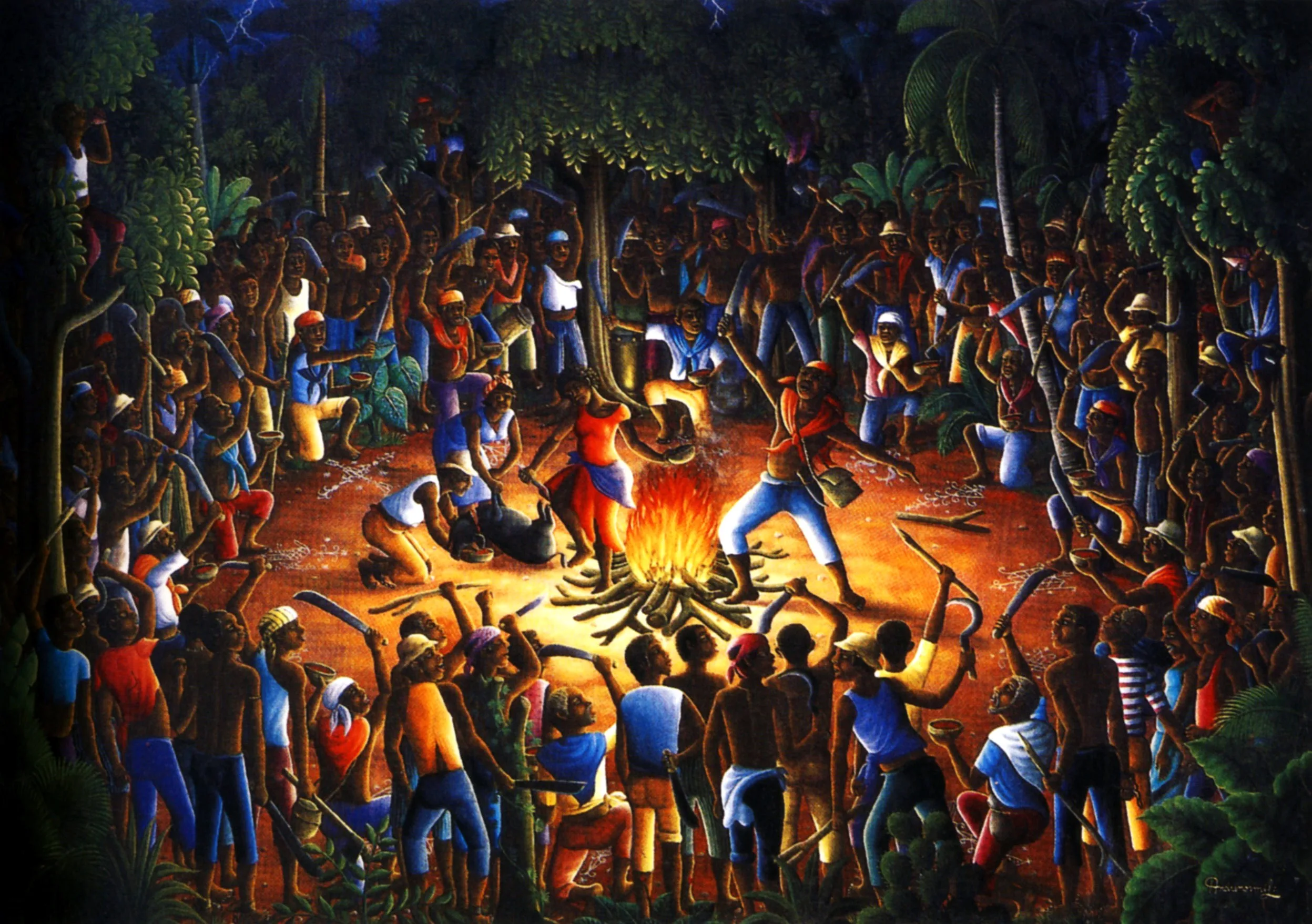
Bonfires lit and drums echoing. At piristil, a house of voodoo religion, dances and songs revive the memory of a night that changed the course of humanity. It was only in 2025 that August 14th, the day of the historic Bwa Kayiman Congress, was declared a national holiday by the Haitian State. Perhaps for this reason, its celebration remains discreet, almost hidden, as if such a legacy needed to be treated with care and without fanfare. Not just on this commemorative date, but every day, preserving the true meaning of what was a profound break with the colonial system in Haiti.
In the early hours of August 14, 1791, around 200 enslaved black people or maroon (Quilombolas), coming from the entire northern region of the island, gathered in the Morne Rouge forest, eight kilometers from the city of Cap Français (today Cape Haitian). A religious and political ceremony was led by Dutty Boukman and Cécile Fatiman, voodoo priests and leaders from the region. A pig was sacrificed to call upon the strength and support of the ancestors. All those present took their blood and, invited by Boukman to “listen to freedom speaking in everyone’s hearts”, they swore the same oath.
A week later, on the night of the 22nd to the 23rd of August, thousands of enslaved people, on several farms, set fire to the sugarcane fields and murdered their owners, in a simultaneous and incredibly coordinated insurrection. The revolt did not take long to spread to the rest of the country and quickly became a revolution.
Boukman’s execution by the French in November did nothing to reverse the ongoing process. At the beginning of 1792, a third of the island was already under the control of black people. In 1804, after 13 years of bloodshed and an incessant struggle that allowed the defeat of the largest European armies, Haiti became the first independent country in the Caribbean, the first black republic in the world, marking the beginning of the liberation of all of Latin America.
The political congress
We know that the version of history that spans time is usually that of the winners. But the Haitian Revolution became the exception that proves the rule. The nation that liberated itself did not have the hegemony of the narrative, and what we know about the events usually passes through some (neo)colonial filter that tends to diminish the importance of the facts and, in this case, the level of organization and intelligence of the insurrection.
About that night of Bwa Kayiman, often treated as a mere religious or mystical ceremony — demonized by Christianity — little is known and even less is understood. It is as if the general uprising of the following days was a coincidence or the result of chance. However, the most current reading by Haitian historians is that that meeting had much less to do with any god than with the need to organize the revolt. In other words, it was, first and foremost, a political and revolutionary congress, from which each of the 200 delegates left with the task of territorial articulation and a date set for direct action.
Even so, the mysteries remain and feed the doubts or imagination of those who look into the topic. Because organizing an event of this scope in a context of deprivation of liberty is, to say the least, challenging — not to mention the communication and travel conditions at that time. “It really seems impossible, doesn’t it!” marvels Bedouby Norbert, popular historian and educator. “Because, even today, with the internet, with means of transport, we know that bringing together 200 delegates in an assembly is not easy! This requires a minimum of conditions and logistics. At that time, people were not free. Enslaved people could not leave the farms. And even the maroon they could not move freely. So, it is a fundamental question for us to understand how they managed to do this.”
Since the call for the congress itself, Dutty Boukman, an educated and influential coachman, with extensive knowledge of the region, played a fundamental role. Just like black people maroon or freedmen, who were able to enter the plantations to pass messages. “You maroon they lived hidden in the hills. But, at night, they used to go down to get supplies. They plundered the plantations. But they also took the opportunity to communicate with the enslaved, especially in the moments of rituals or dance that they had”, explains Norbert.
It still remains to be conceived of the days or weeks of clandestine walking that many took, crossing different landscapes, to arrive at the right place at the right time… and then return to their territory to inform the other companions of the guidelines to follow. To hide this part of history would be to think that the abolition of slavery, approved by France in 1794 — and, it is worth remembering, revoked eight years later by Napoleon Bonaparte — was a generous gift from the white bourgeoisie and not an achievement. Bedouby Norbert smiles: “The truth is that, when they decreed abolition, the vast majority of black people had already freed themselves!”
An anti-colonial and humanist revolution
In the end, if the religious rite was at the center of the process and the congress, it also needs to be understood in its dimension of political and cultural resistance, of links with ancestry and future generations. Voodoo, like the Creole language, is a foundation of Haitian culture and a guardian of its memory.
No original writing allows us to certify exactly what was said on the night of the congress, but the strength of oral tradition made it possible, even two centuries later, to preserve the essence of revolutionary ideology within popular wisdom. For the people gathered there were not moved by a dream of individual freedom, but rather by a commitment to the liberation of all human beings. In this sense, more than a fight for the independence of a country, the Haitian Revolution represented a profound cultural break with the dominant capitalist, colonial and slavery system.
Thus, the silencing of their history may be a consequence of this radicalism. Much is read and studied, in schools around the world, about the Declaration of the Rights of Man and the Citizen, promulgated by the French Revolution. Much less is known about the principles of Bwa Kayman, agreed around the fire, on August 14, 1791. But, while the first was content with promulgating rights for white men, the agreements made by the Haitian delegates carried a truly universal vision, of freedom, tolerance, respect and solidarity.
In the absence of a physical document, these agreements were transmitted orally from generation to generation, becoming practical, often transformed into sayings or advice from grandparents, into ways of being and acting, but always associated with the historic milestone of the congress. It was only in 2009 that a thorough work to rescue this memory was carried out by the writer and researcher Pierre Michel Chery (1956-2024). Months of research in the four corners of the country, especially in rural and peasant areas, allowed him to highlight 12 major principles.
Principles, it is worth highlighting, that were not only born that night, but that preceded it and made it possible, placing Bwa Kayiman in a broader temporality and cosmology. “Many principles of Haitian life, many rules that Haitians have in the way they organize their lives, come from the lines that the enslaved defined before they even broke the chains in 1791”, explains the writer in an article published in 2009, in which he highlights the radical difference in vision of the world that the enslaved people opposed to the Europeans.
“Thus, we have gathered 12 of the greatest principles that are still alive in the Haitian tradition, to show what was the ideological basis that led to Bwa Kayiman, but also what was the vision of life addressed in that ceremony. These 12 principles are 12 direct answers, 12 answers that clash with the ideas that circulated at the time about life in general”, he concludes.
“The twelve principles of Bwa Kayiman”, foundation of Haitian revolutionary, popular, political and religious culture and thought:
1- Each person is a person. No one is more than another.
2- Each one has a place under the blue sky.
3- If it’s for one, it’s for two. Remember who is behind.
4- Everyone has their own way of praying. Respect each person’s way of praying.
5- What we don’t know is bigger than us.
6- There is nothing in life that doesn’t have rules. It is the rule that gives balance to life.
7- Don’t undo the balance of life without reason. Whoever moves the elements puts everyone in danger.
8- The more you learn, the more you know how to respect the balance of life.
9- Don’t eat the food of forgetfulness.
10- Always remember: iron cuts iron! Behind the hill, there is a hill! Don’t let the blood of the innocent flow! Don’t give charge to an irresponsible person.
11- Be careful! Bwa Kayiman’s enemy can come with any name and any outfit to take revenge.
12- Misery is the heir forgetting that the slaves did the Bwa Kayiman so that the people who serve God are not crowded among the animals.
Source: www.brasildefato.com.br