Published 03/16/2026 12:49 | Edited 03/16/2026 14:05
The government of Ecuador began an operation this Sunday (15) that mobilizes around 30,000 soldiers and imposes a curfew in four provinces of the country, amid the advance of the United States’ presence in Ecuadorian security policy.
The operation takes place in a context of expanded United States presence in the country’s security structures.
Ecuador is part of the regional alliance created by Donald Trump’s government under the name “Shield of the Americas”, which brings together 17 countries from Latin America and the Caribbean and provides for military and intelligence coordination under Washington’s leadership for actions against organized crime in the region.
In recent days, the Ecuadorian government announced that FBI agents will begin to operate permanently in the national territory, while US forces are already providing training and intelligence support to Ecuadorian units.
The measure also comes amid complaints from human rights organizations about abuses committed by security forces during the frequent states of exception decreed by President Daniel Noboa since 2023.
The operation was announced by the government as an offensive against organized crime and will take place over two weeks, between Sunday night and March 31st.
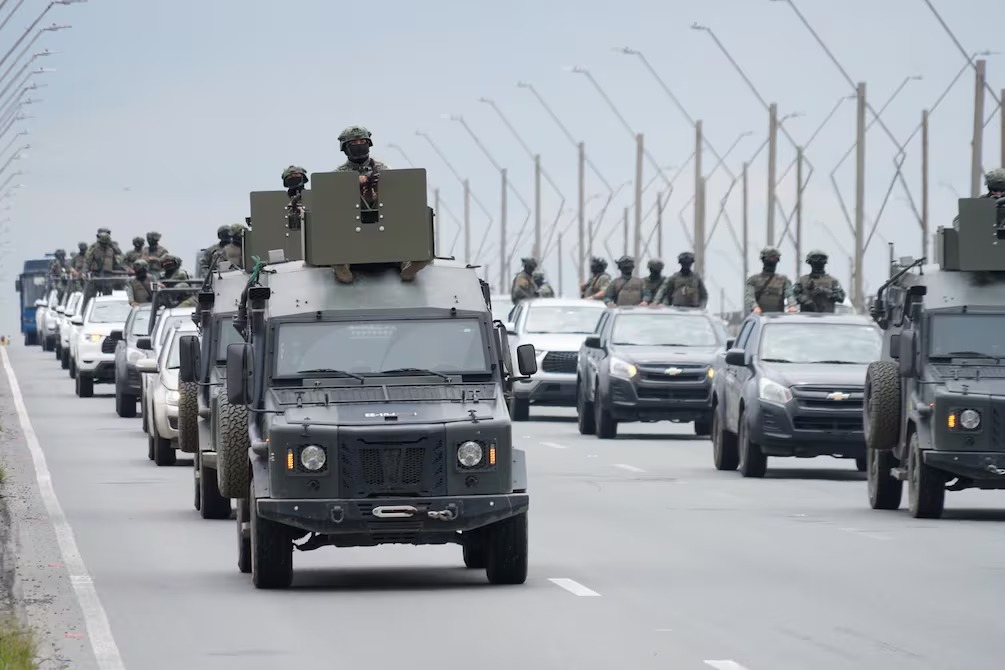
According to Ecuadorian authorities, around 30,000 heavily armed soldiers were mobilized to carry out ground patrols, road control and aerial surveillance operations.
The curfew was imposed in the provinces of Guayas, Los Ríos, Santo Domingo de los Tsáchilas and El Oro, regions on the country’s coast that concentrate a significant part of the violence linked to drug trafficking.
For fifteen days, residents of these areas will be prohibited from circulating between 11pm and 5am, with exceptions only for healthcare professionals, emergency teams and travelers with airline tickets.
According to the Minister of the Interior, John Reimberg, the Ecuadorian armed forces will launch a “very strong offensive”, with reinforced patrolling, the use of helicopters, drones and armored vehicles.
Part of the operations also includes border surveillance, control of strategic roads and actions against activities considered illegal by the government, such as mining camps.
The military escalation takes place in a country that, although it does not produce cocaine, has become one of the main exit points for the drug that reaches the United States.
Located between Colombia and Peru, the world’s two largest producers of the substance, Ecuador currently records one of the highest homicide rates in Latin America, with 52 deaths per 100,000 inhabitants, according to data from the Organized Crime Observatory.
The worsening of violence in the country occurs after years of economic and political changes that altered the Ecuadorian social scenario.
Since the rupture with the political project of the Citizen Revolution led by Rafael Correa, Ecuador has been governed by right-wing administrations that have implemented austerity policies, privatizations and reduced public investments, a process that has affected areas such as education, health and social programs.
During this period, the precariousness of employment, the reduction of opportunities for youth and the weakening of state structures coincided with the expansion of networks linked to drug trafficking.
Between 2018 and 2023, the number of homicides in the country tripled, while criminal factions expanded their presence in ports and drug export routes.
Critics of the current government claim that the response based on militarization and successive states of exception does not address these structural causes of the crisis and tends to deepen the security model adopted by President Daniel Noboa.
In recent months, the Ecuadorian government has also announced joint operations with the United States against armed groups operating in the country.
Last week, the Ministry of Defense reported that a camp of the Border Commands, a splinter group from the former Colombian guerrilla group the FARC, was bombed in the province of Sucumbíos, on the border with Colombia, in an action carried out with North American support.
The operation in Sucumbíos was seen as a provocation to the government of the neighboring country, led by Gustavo Petro.
Permanent presence of the FBI
The expansion of cooperation with Washington also includes the institutional presence of US security agencies in the country. On March 11, the Ecuadorian government announced that it had signed a memorandum of understanding with the United States to allow Federal Bureau of Investigation (FBI) agents to operate permanently in Ecuador.
According to the Minister of the Interior, John Reimberg, the agents will work together with a unit of the National Police in investigations related to organized crime, money laundering and corruption. The FBI already cooperated with Ecuadorian authorities, but the new agreement establishes that this collaboration will take place permanently within the country’s territory.
The announcement was made just days after Ecuador and the United States confirmed carrying out joint operations against gangs such as Los Lobos and Los Choneros, groups that Washington classifies as transnational terrorist organizations.
Source: vermelho.org.br