Published 06/06/2026 15:56 | Edited 06/06/2026 15:58
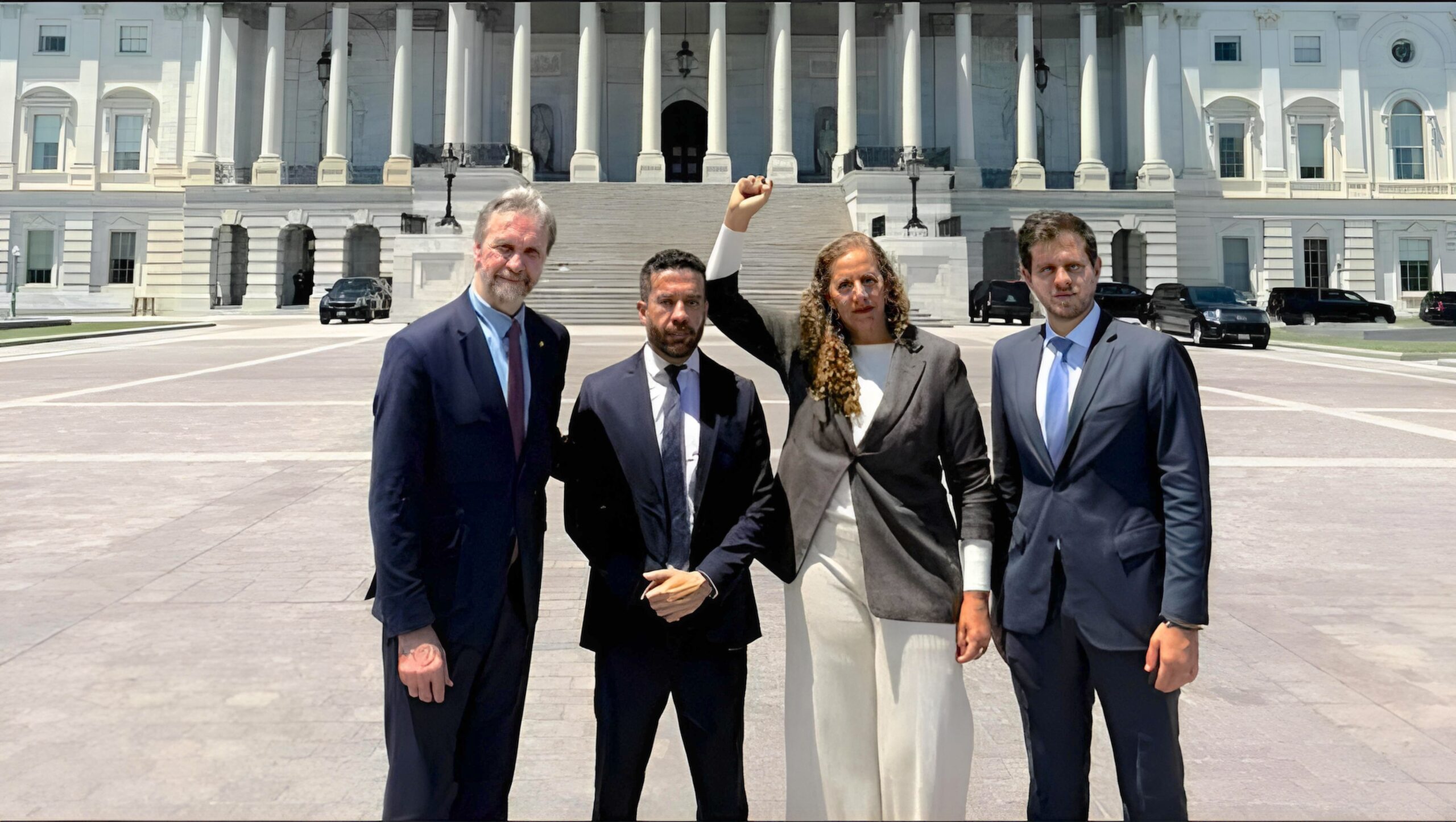
A delegation of Brazilian parliamentarians concluded this week a series of meetings in Washington with the aim of presenting to North American institutions an alternative vision to that defended by sectors of the Brazilian right. Made up of deputies Pedro Uczai (PT-SC), Jandira Feghali (PCdoB-RJ), Pedro Campos (PSB-PE) and André Janones (Rede-MG), the group represented benches totaling 114 parliamentarians in the Chamber of Deputies.
Over the course of three days of meetings at the United States Congress, the Organization of American States (OAS) and other institutions, the delegation focused its activities on three axes: the defense of national sovereignty, the challenge of tariffs imposed by the United States on Brazil and the expansion of international cooperation to combat organized crime and money laundering.
Jandira: “Cooperation, not intervention”
One of the main voices of the mission, federal deputy Jandira Feghali, emphasized that the initiative aimed to strengthen collaboration mechanisms between the two countries without opening space for external interference in Brazilian politics.
According to the parliamentarian, one of the documents delivered to the North American authorities requests joint actions to combat drug trafficking, arms trafficking, the international movement of illicit resources and other types of transnational crime.
“We need to intensify cooperation and not intervention”, he stated during an agenda in the North American Congress.
The formulation seeks to establish a clear political line: the Brazilian government accepts and seeks international cooperation on public security issues, but rejects any attempt at foreign interference in the country’s political, economic or electoral decisions.
Pix defense becomes a symbol of sovereignty
Another central point of the mission was the reaction to North American initiatives that question Brazilian economic instruments, especially Pix.
Jandira classified the instant payments system as a national asset and stated that any attempt to weaken it would be interpreted as an affront to the country’s financial sovereignty.
“The issue of Pix was addressed with the declaration that any intervention that makes the use of Pix unfeasible, weakened or difficult will not be accepted”, he reported.
The deputy argues that the system represents a technological innovation built by the Brazilian State and widely incorporated by the population, becoming a strategic element of national financial autonomy.
Trump’s tariff unites economy and political dispute
During the visit, parliamentarians delivered a 44-page technical document contesting the tariffs imposed by the government of US President Donald Trump against Brazilian products.
According to Jandira, the studies presented demonstrate that the measures do not have a consistent economic basis and end up producing negative effects both for the Brazilian economy and for North American consumers themselves.
The parliamentarian maintains that tariffs increase costs, put pressure on inflation and deepen inequalities in the United States. In his assessment, the commercial conflict cannot be understood only from a technical perspective.
“The tariff, the issue of public security and the issue of corruption have a political impact,” he stated.
Complaints involving Bolsonaro and request for investigation
The agenda also included meetings with Democratic parliamentarians to discuss suspicions of money laundering related to the financing of the film “Dark Horse”, a production about the trajectory of former president Jair Bolsonaro.
According to Jandira, North American congressmen showed interest in the information presented by the Brazilian delegation and committed to analyzing legislative and institutional instruments to deepen possible investigations.
The deputy highlighted that opposition parliamentarians in the United States have mechanisms to open investigations and request action from bodies such as the Department of Justice.
“They were all willing to immediately see what instruments to use,” he declared.
Warning about elections and the digital environment
At the headquarters of the Organization of American States, parliamentarians raised concerns related to the 2026 Brazilian electoral process.
Among the topics covered were the dissemination of misinformation on digital platforms, political violence and possible attempts at foreign interference in the election.
According to Jandira, the OAS Secretariat for Strengthening Democracy has committed to closely monitoring the Brazilian elections through its electoral observation mechanisms.
“We reaffirm our sovereignty above all else”, stated the deputy when reporting the meeting.
Mission reflects international dispute over Brazil’s political future
More than a diplomatic agenda, the mission highlighted the growing internationalization of the Brazilian political dispute. For Jandira Feghali, decisions related to commercial tariffs, digital platforms, combating organized crime and financial flows have become part of a broader scenario of geopolitical dispute.
His assessment is that sectors linked to the Trump government and the North American conservative movement seek to influence the Latin American political environment, including Brazil.
Given this situation, the deputy maintains that the response must combine defense of national sovereignty, strengthening of democratic institutions and expansion of international cooperation on a basis of mutual respect.
At the end of the mission, the parliamentarian stated that the delegation returns to Brazil with the perception that it managed to open important channels of dialogue and present an alternative vision of Brazilian political reality at a moment considered decisive for the direction of democracy in the country.
Source: vermelho.org.br