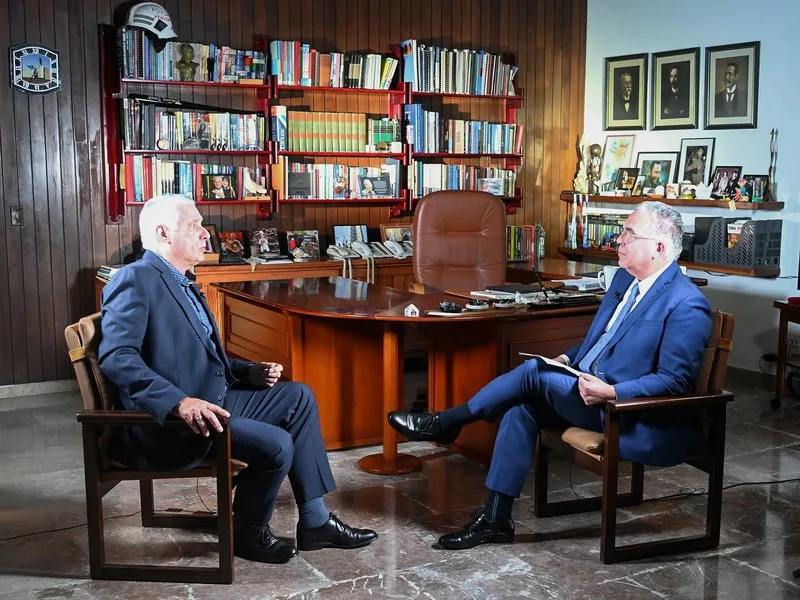
“We are not seeking a capitalist restoration of the country. We are seeking the improvement of socialist construction in the very adverse conditions in which we live today”, stated Cuban President Miguel Díaz-Canel during an extensive interview given to a program by the Dominican press vehicle Corripio Groupled by journalist of Cuban origin Roberto Cavada.
This is the first interview after the announcement of the package of deepest economic and social transformations driven by the country in recent decades, reforms that generated strong controversies both inside and outside the island.
The president framed the national debate in the historical and structural conditions that Cuba is going through, highlighting the need to rethink the economic model without abandoning its foundations. These changes occur at a time when the country is facing one of the most serious crises in its history, with an accumulated drop of 15% in GDP in the last five years.
“In current conditions, as a small island subjected to the prolonged and most genocidal blockade in history for more than sixty years, and now to an intensified blockade with an additional component which is the energy blockade, how can we build socialism? How can we find ways to maintain the social achievements of the revolution?”, reflects Díaz-Canel.
The president insisted that the transformation process responds to a change in the global situation in which Cuba is inserted. He highlighted that these reforms are “ways” to continue advancing in the construction of socialism in a context of “intensified blockade” by the United States, and added that “these are times of transformation”.
“Times have changed, geopolitics has changed, the aggressiveness of the United States has changed; we cannot remain the same. We must transform. These are times of transformation. Fidel always asked us that, in crises, we be able to renounce neither thought nor creativity, and that we find in crises opportunities not only to resist, but to grow, to advance, to improve”, recalled the president.
Along the same lines, he stated that current reforms take into account a review process compared to other contemporary socialist experiences, highlighting that socialist construction transformations such as those in Vietnam and China were analyzed.
One of the central points of his explanation was the structure of the measures, summarized into three axes. Regarding the first, he detailed: “A first axis is to change or improve, update the economy’s management system, in which there is an adequate relationship between centralization and decentralization, and in which there is an adequate relationship between what we plan and what will move according to market signals.”
Asked about the role of economic planning, the president defended the validity of the strategic principles of the Cuban model, clarifying that this is not a renunciation of its essence. In this sense, he stated that there are “strategic” lines that Cuba does not renounce, including balances between different sectors of the economy.
Likewise, he defended greater territorial autonomy as part of the institutional reorganization process, showing himself in favor of the political strengthening of municipalities.
As a third axis, he defended the incorporation of the private sector as a “part of the Cuban business system”.
“As people are describing there is a single business system in the country… This business system has state components, cooperative components and non-state or private components; but they all participate, they all interconnect, they all link together, they all depend on the country’s development.”
Regarding the relationship with the United States, Díaz-Canel expressed a critical view of Washington’s stance on reforms, pointing out that the White House defends a “Cuba totally dependent on the United States”.
“They will never understand what we do and they will never accept what we do. Because what they want is another Cuba, a Cuba that is totally dependent on the United States, a totally privatized Cuba,” he said.
He also added that Donald Trump does not rule Cuba, nor does the US government. “Cuba is sovereign, Cuba defends its self-determination… This is a process that is a consequence of things that have already been discussed in the last ten or fifteen years”, he maintained.
Along the same lines, he once again emphasized that transformations do not respond to external pressures, but to “sovereign decisions”.
“Not because we are giving in to pressure from the United States, but because we are seeking how to overcome these pressures without putting our country’s sovereignty, independence and self-determination at risk.”
The president was even more categorical in rejecting any intervention scenario, describing as “nonsense” anyone who thinks that Washington’s military presence on the island could solve the country’s current situation. “Cuba’s alternative could never be annexation to the US. There is no future for Cuba with annexation to the US.”
Finally, in relation to the social pillars of the Cuban model, especially health and education, the president defended its essential character within the political and economic system.
“These are sacred things, social achievements are sacred… There will continue to be a universal education system, a universal health system; free education and free health with access for all Cuban citizens, totally inclusive, of quality.”
And he concluded by linking the sustainability of these rights to the country’s economic performance: “With a stronger economy, with the productive forces released, which contribute more, there will then be more possibilities not only to sustain this immense work of social justice… But also to expand it and achieve more social justice.”
Source: www.brasildefato.com.br