Published 25/05/2025 16:19
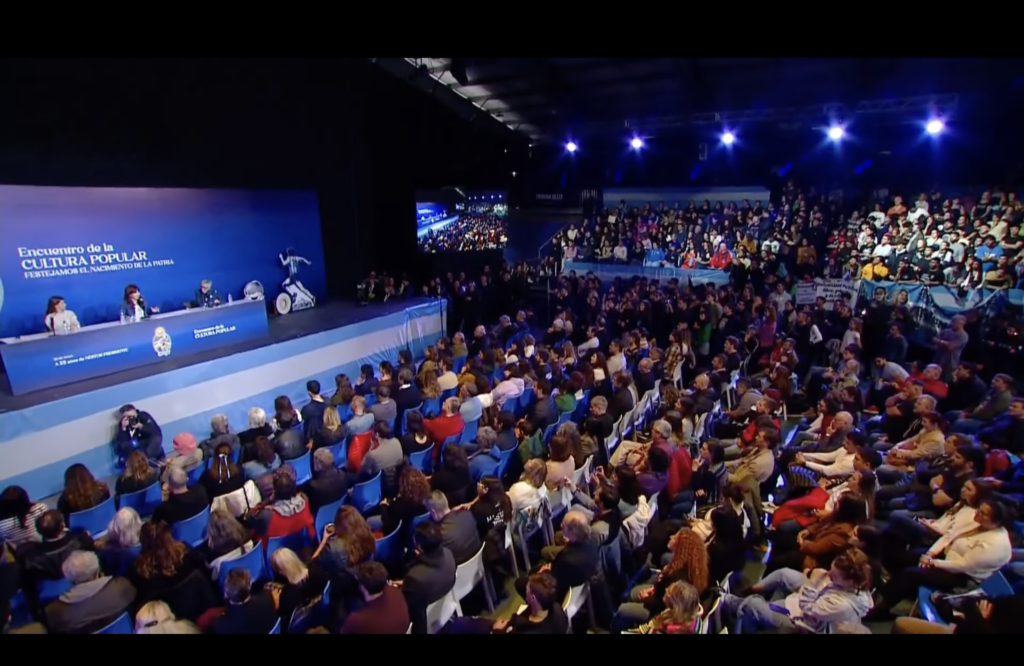
On the 22nd anniversary of Nestor Kirchner’s inauguration as president, Cristina Fernández de Kirchner spoke in “Meeting of Popular Culture” In Buenos Aires, an event that brought together artists, intellectuals and political leaders. The symbolic date – May 25, Argentine Independence Day – was used to reaffirm cultural and political resistance against Javier Milei’s reforms. “Argentine culture is memory, it is meaning, it is what unites us as people. They want to erase our identity with a brutal adjustment,” he said.
Cristina revisited the concept of popular culture beyond artistic expressions, also encompassing social behaviors and the construction of national identity.
On an emblematic date for Argentina, which marks May 25, 1810 and, coincidentally, the 22 years of Nestor Kirchner’s inauguration, the Peronist leader made criticism of the policies of the current government, warning of a historical “loop” of indebtedness and failure.
“Default is around the corner”: economic crisis and lack of dollars
The former president warned of the imminent risk of default (moratorium) Argentineattributing the crisis to mismanagement of the Milei government. “The problem is not the fiscal deficit, as it insists, but the lack of dollars. If they do not change the course, the collapse will be inevitable,” he said, referring to the difficulties of honoring external debts. Cristina pointed out that the current economic model, based on spending and liberalization cuts, has failed in the past – citing the failures of 2001 and before – And it only aggravates inequality.
In the current context of Argentina, for her, he lives a “loop” of neoliberal policies. She compared the current economic situation with the 1990s and the 2001 crisis, which culminated in the largest default in Argentine history, of which Néstor Kirchner was “son.” Kirchner criticized the idea that the current government “found the Coca-Cola formula”, because what is being done “have done so before.”
The former president brought out the figure of Ricardo Arreazúeconomist respected by President Milei and considered the “intellectual and material author of the Tablita of Martínez de Hoz”, a dictatorship politics that indebted and deindustrialized Argentina. Kirchner emphasized contradiction in economic discourses, where the fiscal deficit is blamed, but at the same time it is admitted that real problems arise from the lack of dollars. “The 9 defaults in Argentina were because they got dollars,” he said.
Criticism of adjustment policies: “70% of the population is excluded”
The peronist leader denounced the impact of austerity measures on popular sectors. “In the neighborhoods where Milei lost votes after the first lap, the crisis came first: unemployment, lack of basic services and hunger,” he said, referring to the electoral result of 2023. For Cristina, the neoliberal model benefits only 30% of the population, while the rest faces unemployment, rampant inflation and accelerated deindustrialization.
Cristina Kirchner has unmasked what she called “smoke bombs” released by the government to divert the attention of crucial topics such as the economic crisis. She mentioned last year’s “May Pact”, which, despite all the discussion, did not materialize.
The former president attacked the government’s “cultural battle”, especially the slogan “his dollars, his decision”, mocking that a pastry costs “two Lucas” (two thousand pesos). She questioned the supposed fiscal persecution, pointing out the high informality of the economy, and refuted the idea that Argentina can get rid of drug trafficking with 50 million weights per month, calling the statement “idiot”.
One of the most incisive points of his criticism was the analysis of the “chainsaw”, an image used by Milei in his campaign. Kirchner argued that the chainsaw, initially seen as an instrument against the state, eventually turned against the major majorities, impacting retirees and workers. She pointed out that the crisis first reaches popular neighborhoods, where informal employment disappears rapidly.
Messages to Peronism: unity against the “common enemy”
In a summons, Cristina asked Peronism to join to face what she called “Common enemy” : Neoliberalism that, according to her, seeks to “eradicate history and national identity.” “Nostor has taught us that one can rule with love of the people, without betraying their values. It is time to resume this legacy, with courage and conviction,” he said, remembering that Peronism must be a “space of cultural and social resistance.”
For Cristina Kirchner, Argentina needs to “rethink.” She emphasized the need to abandon “Electoral militancy” to resume the “Political militancy”. This implies being able to analyze, look beyond the next election and, fundamentally, “to set aside the mesquandads and egos that have so much damage to and that have caused useless fragmentation.”
The former president defended the review of economic models, such as import replacement, to seek technological innovation and global competitiveness. She cited the example of “The Eternal”, an Argentine comic that was able to be produced by Netflix, to argue that Argentina has the ability to negotiate “equally to” with foreign investors, without “subordinating or selling the homeland.”
Cristina Kirchner concluded her speech by reaffirming Peronism’s commitment to the celebration of the Fatherland Day and inviting all Argentines to reflect on the country’s future. “These are ideas, they are not revealed truths,” he said, encouraging the debate and collective construction of a new way to Argentina.
Culture as a weapon of resistance: “Argentine identity will not be erased”
Central in the speech was the defense of culture as a struggle tool. “Argentine culture is that of the missing 1976, that of the mothers of Praça de May, that of Diego Maradona. This is what they want to destroy,” he said, referring to the attacks of the government Malei to the Ministry of Culture and cuts in artistic programs. For Cristina, preserving historical memory is essential to prevent the country from being “transformed into a devastated land for foreign interests.”
Cristina Kirchner began her speech by demystifying popular culture, stating that she is not limited to music or formal art. For the former president, culture is “making sense”and this dimension manifests itself in everyday and historical acts of resistance. She cited as examples the mothers of May Square, who in 1977, with their white handkerchiefs, created a “Identity Sign” unmistakable. Similarly, he recalled Néstor Kirchner’s gesture as he removed the paintings from dictators Videla and Bignone, an act that “also generates culture”.
The former president listed a series of cultural achievements of her governments, such as support for Incaa (National Institute of Cinema and Audiovisual Arts) with 900 films produced, the creation of the Encuentro and Paka Paka channel, the development of the Kirchner Cultural Center and Tecnópolis, and the rise of cultural GDP to 3.8%, surpassing sectors such as mining and fishing. In a direct attack on the current government, Kirchner stated: “If they realized that these guys have built nothing? Nothing! Not a bitch school, not a bitch building, nor a bitch monument, nothing! They change the name of his only work… his only work is to change the name of what others did, or not.
The highlight of its cultural retrospective, however, was the Bicentennial of the May Revolution in 2010. For Kirchner, the event allowed to “recover to the people on May 25”, a date that, according to her, had been “appropriate by liberal historiography”. She recalled the parade with millions of people and the anecdote of the float of the original peoples who, by chance, came out before the “flying homeland” car, symbolizing the primacy of peoples origins about the formation of the country.
Néstor Kirchner and the 2003 Legacy: Lessons for the Future
Remembering her husband and former president, Cristina highlighted as the government of Néstor, which began on May 25, 2003, rescued Argentina from Post-Default chaos. “He ruled without fear, with passion for the people. Today we need this same determination to face Milei’s adjustment,” he said, reaffirming that Peronism must be “the guardian of economic and cultural sovereignty.”
Ending with a message of hope, Cristina stated: “Argentina will not be erased. We have the strength of the people, the memory of our dead, and the courage of those who know that the fight continues.” The discourse, full of historical references and emotional appeals, has consolidated itself as a milestone in political and cultural resistance against Milei’s reforms, while Peronism seeks to rebuild its narrative for future elections.
Source: vermelho.org.br