An official delegation from the government of Shanghai, China, specializing in technological infrastructure, trade and digital sovereignty began an official visit to Brazil this week. The team includes members of the Shanghai Municipal Data Office, employees of state-owned companies and private entrepreneurs from various sectors.
Yong Lu is executive director of the Shanghai Data Service Provider Association, an association that works together with the public administration and brings together data companies, providers and technology corporations.
The member of the delegation told the Brazil in fact that the visit aims to explore opportunities for cooperation and joint business. “We can share a lot of our experience with Brazil so that we can develop together,” he stated.
The expert pointed out that both countries must cooperate to overcome development gaps that facilitate business, such as the creation of independent digital tools.
“In terms of digital sovereignty, Brazil and China are not so similar because China has already developed its tools, its own providers”, he explained.
“So, instead of depending on Google and WhatsApp, we have our own tools. In Brazil it is more complicated. Many services are provided by American companies. In this sense, I think that if Brazil is interested in advancing this sovereignty, Chinese services could provide Brazil with their services.”
According to Lu, China could do more than simply implement a specific tool: “Chinese companies can offer the technology, such as some open source models. source [código aberto]such as Deep Seek so that Brazil can develop its tools”.
Lu also highlighted that the fact that China is currently Brazil’s main trading partner and both countries have reached a trade balance of more than 170 billion dollars in 2025 only reinforces the need to build digital sovereignty.
“We are in the era of the digital economy. Many services are based on this type of platform. That’s why we need to think not only about using these resources more, but also about having control over them”, he said.
Meeting with businesspeople
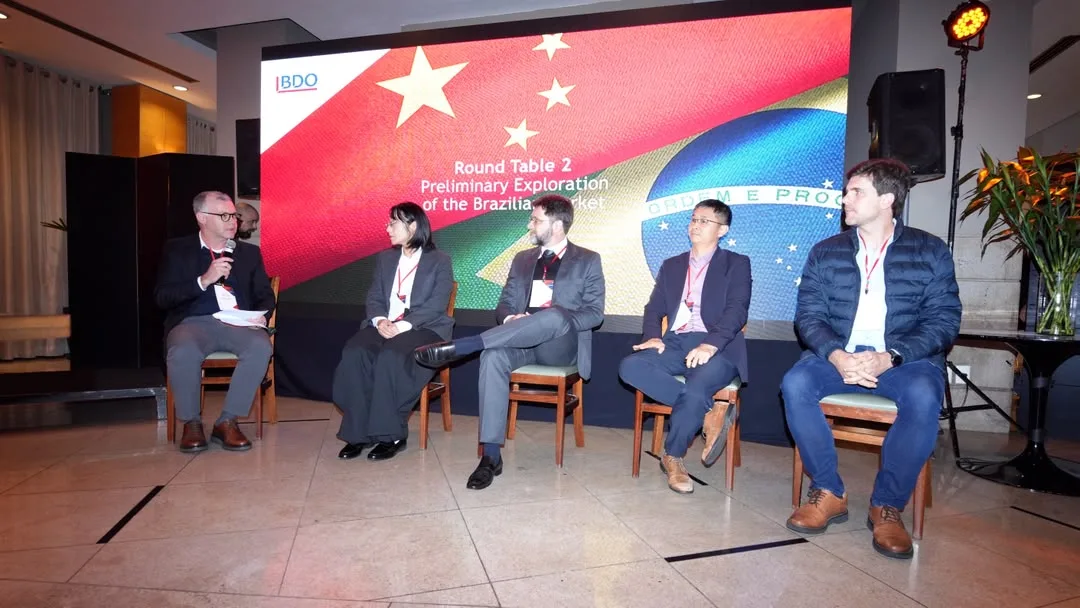
The official delegation held a meeting this Wednesday (24) with Brazilian and Chinese businesspeople in São Paulo. At the opening of the event, Jun Shao, director of the Shanghai Municipal Data Office, highlighted the political and economic similarities of both countries and how different sectors of society can explore these similarities.
“China and Brazil are important members of the BRICS, with strong complementarity in the digital economy. We can join forces to face common challenges in the era of artificial intelligence, such as uneven development and digital sovereignty,” he said.
Jun also highlighted the presence in Brazilian territory of Chinese companies in the communications, automotive, delivery and video games sectors, which use “digital production, models to boost local industrial transformation”.
“In Shanghai, many companies and institutions also expressed a clear interest in cooperating with Brazil in areas such as smart manufacturing, smart health and smart agriculture, including the various institutions that will share their experiences today,” he said.
Representing the Ministry of Foreign Affairs, Itamaraty’s AI advisor, Guilherme Fitzgibbon, was also present at the event and highlighted the government’s efforts to build a regulatory policy on Artificial Intelligence.
“In Congress, we are building AI policy, inspired by standards recently approved by the European Union. The EU recently declared that protections in Brazil are equivalent to those in Europe. It is industrially important,” he said.
PL 2,338/2023, called the Legal Framework for Artificial Intelligence, was approved by the Senate Plenary and is being processed in the Chamber of Deputies. The project seeks to implement ethical and safe guidelines for the development and use of AI, establishing a classification based on risks, protection of human rights, transparency and safeguarding copyright against generative tools.
Source: www.brasildefato.com.br